Blog
Mercedes Battery Fix After Russell DNF 2026
 123Helmets Editorial Team
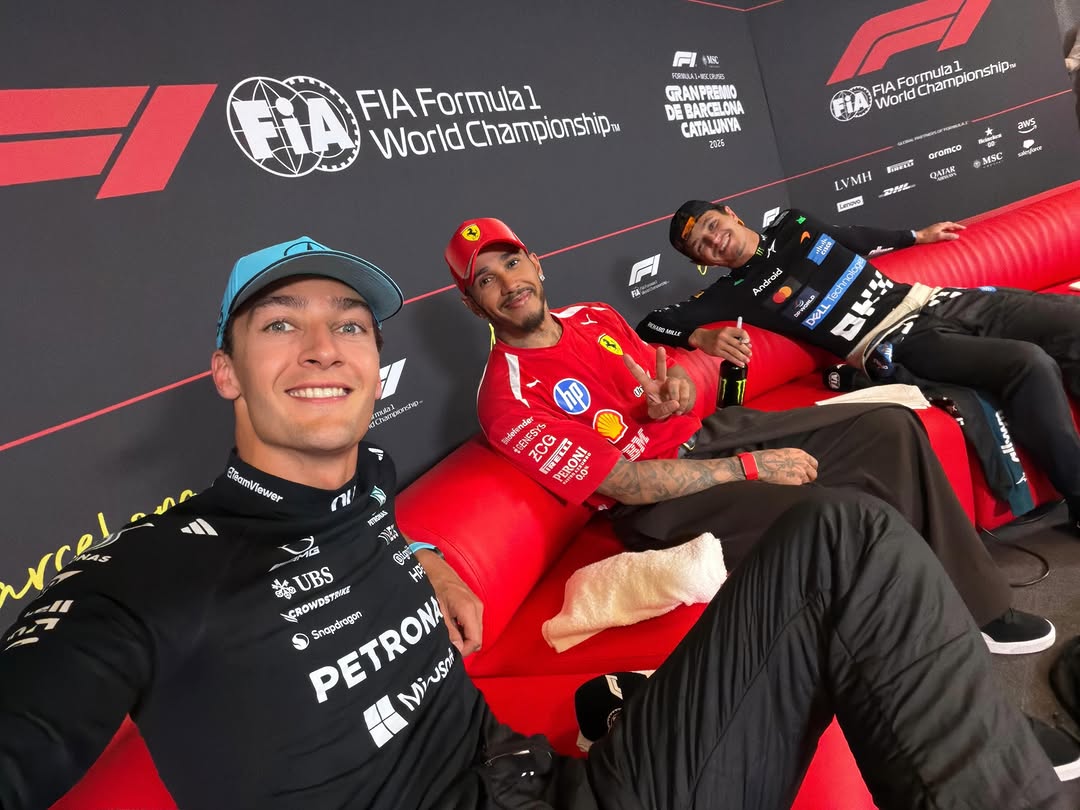
Mercedes has traced a run of costly race retirements — including George Russell leading the Canadian Grand Prix before his car stopped — to a battery fault inside its power unit. Technical director James Allison confirmed a permanent fix is being phased in. Here is what happened, what it means for the 2026 championship, and why these race moments deserve a place on your display shelf.
Key Takeaways
Mercedes has traced both Russell’s Canadian GP DNF and Antonelli’s Barcelona GP retirement to the same broad area of the power unit battery module.
Technical director James Allison confirmed a phased introduction of new battery modules is planned for the ongoing 2026 racing season.
Customer team McLaren also suffered related electrical trouble, with Norris retiring from Monaco and both McLarens failing to start the Chinese GP.
Team principal Toto Wolff stated Mercedes will ‘leave no stone unturned’ to resolve the reliability issue during the 2026 title fight.
The DNFs That Defined Mercedes’ 2026 Mid-Season
Two retirement events have directly cost Mercedes points that could prove decisive in the 2026 Formula 1 World Championship. The first came at the Canadian Grand Prix, where George Russell was leading the race outright when his Mercedes W16 lost power and pulled off the circuit. The second arrived at the Barcelona Grand Prix the following weekend, when Kimi Antonelli was running in second place before suffering an identical fate. Both failures have been traced by the team to the same broad region of the power unit’s battery module.
To understand the visual and emotional weight of these moments, consider the context: Russell had not merely been competitive — he had control of the race lead at the Canadian Grand Prix on 2026-06-08, a circuit where Mercedes’ aerodynamic package had looked strong across practice and qualifying. Losing a race win from that position is among the most painful outcomes in a championship campaign. Antonelli’s Barcelona DNF on 2026-06-15 compounded the damage, with second place also evaporating in the same manner.
For collectors who document the 2026 season through full-size 1:1 display replica helmets, these are the races that define a championship narrative. A race lead abandoned under power failure, a silver car stationary on track — these are the images that make a George Russell 2026 season replica helmet a document of both brilliance and misfortune. At 1:1 scale, a display piece captures the exact livery Russell wore on those race weekends, the silver and teal of the W16 era rendered in full exhibition quality.
What Mercedes Found: The Battery Module Fault
The fault lies in the battery module — the term Mercedes uses internally for the energy store component of its hybrid power unit. James Allison, Mercedes’ technical director, confirmed the diagnosis publicly on the team’s Nu Silver Arrows Radio Show after Antonelli’s Barcelona retirement, stating that the issues across the fleet “do sort of originate in the same broad part of the battery.”
Allison was direct about the pattern: “I think anyone who’s a keen watcher of the sport will have seen that this has laid a few Mercedes engine cars low over the season so far. They’re not all identical, but they do sort of originate in the same broad part of the battery.” He added that “most of the areas of risk have been understood” and that new modules will be phased into the 2026 racing season as a permanent fix.
The scale of the problem is wider than the works team alone. Customer squad McLaren also recorded electrical failures in the same period: Lando Norris required a battery change during the Monaco GP weekend before retiring from the race itself, and both Norris and Oscar Piastri failed to start the Chinese Grand Prix due to separate electrical issues. While Allison was careful to note these are “not all identical,” the originating region of the hardware is consistent. That pattern across at least four race retirements across two teams in a single 2026 season campaign underlines why Allison described the DNFs as “very, very painful.”
The phased introduction of replacement modules mid-season is a standard engineering response, but it carries risk. Installing a revised battery component requires a power unit token allocation under 2026 regulations, and each team must manage the trade-off between reliability and performance. For Mercedes, the calculation is clear: further DNFs are more damaging than any short-term disruption from swapping hardware.
Russell’s Helmet and Livery in the 2026 Silver Arrow Era
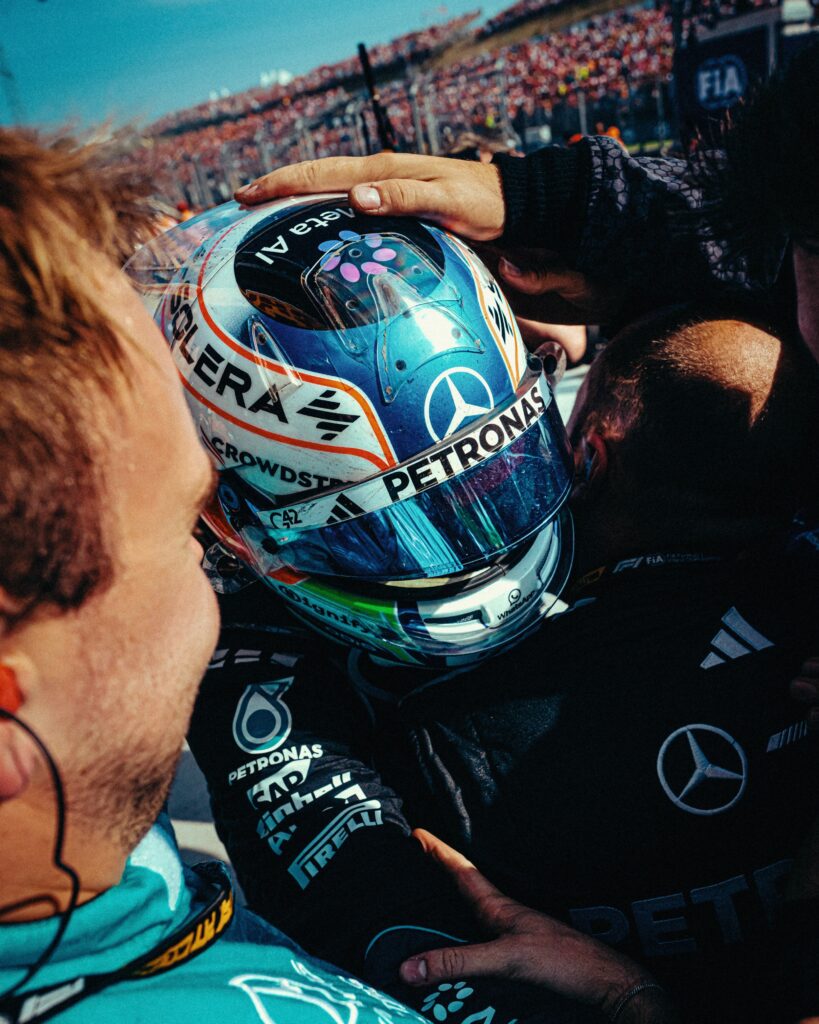
George Russell’s 2026 race helmet carries the full Mercedes teal-and-silver identity that the W16 brought to the grid this season, with his personal white-based design overlaid with the team’s sponsorship suite. At the Canadian Grand Prix, Russell wore a helmet finished in his signature white shell with cyan and black detailing — a design that appeared on television screens in close-up as he led the race before the retirement.
For display collectors, the Canadian GP 2026 is already a historically significant round simply because of what it denied. A full-size 1:1 replica helmet matching Russell’s Canadian GP specification measures at standard adult racing shell dimensions and is produced as a display piece and collector item, not for protective use. The livery on the W16 that weekend — the Petronas-branded silver flanks and the F1 75th anniversary detail Mercedes carried on the engine cover — makes the visual record of this race particularly striking.
The Barcelona GP helmet design followed a similar specification, with Russell having run a consistent personal livery across the European rounds of the 2026 season. Antonelli’s helmet for Barcelona carried the same team identity colours but with his own personal graphic treatment, making both the Canadian and Spanish rounds visually distinct chapters in the 2026 Mercedes collector record.
Exhibition-quality replica helmets produced at 1:1 scale allow collectors to place the exact visual language of these race weekends on a shelf or in a display case. The weight of a standard display replica shell sits around 1.2–1.5 kg, and the visor on display replicas is typically a 3 mm polycarbonate panel matched to the tinted specification Russell ran in Canada. These are collector items, made for display purposes only — not certified for any protective or safety application.
Wolff’s Championship Warning and What It Means for 2026
Toto Wolff stated immediately after the Barcelona GP that Mercedes cannot afford further retirements in the 2026 championship fight, and pledged the team would “leave no stone unturned to understand” the root cause of the unreliability. That language, from a team principal known for measured public statements, signals the seriousness with which Mercedes is treating the battery problem.
The championship arithmetic is straightforward. A race leader who retires scores zero points. In the 2026 season, where the field is closely matched under the new technical regulations, a zero against a rival’s podium finish can represent a swing of 25 points or more in a single afternoon. Two such results — Canada and Barcelona — have already altered the standings in ways that will take multiple race victories to recover. The 2026 Canadian GP took place on 2026-06-08 and the Barcelona GP on 2026-06-15, meaning both losses fell within a seven-day window, concentrating the damage before the summer calendar offers any respite.
Allison’s public diagnosis, while unusual in its candour, serves a purpose: it signals to suppliers, internal engineers and the broader team that the failure mode is understood and the fix is in progress. His specific use of the phrase “phase in the new modules into the racing season” indicates the replacement programme will begin at the next available opportunity within the 2026 schedule, likely before the British Grand Prix.
For collectors following the 2026 season as a documentary record, Wolff’s post-Barcelona comments and Allison’s technical explanation together form the verbal backdrop to a set of race helmets that carry real weight. A Russell Canadian GP 2026 replica helmet is not merely a decorative object — it is a record of a race lead lost to a fault the team was still working to contain.
Why These Race Moments Are Worth Collecting in 2026
The most collectible moments in motorsport history are rarely the comfortable victories — they are the races where something broke, where a title fight turned on mechanical fate, where a driver led and then did not finish. The 2026 Canadian and Barcelona GPs already qualify.
Full-size 1:1 display replica helmets matching George Russell’s 2026 specification bring those race weekends into a collector’s space in physical form. The shell dimensions, at 1:1 scale, match the geometry of the actual race helmet worn on circuit. The livery detail — the white base, the cyan accent lines, the Mercedes and Petronas branding — is reproduced at exhibition quality. These pieces exist as collector items and display objects, with no protective certification of any kind and no suitability for road or track use.
The McLaren angle also adds context for collectors. Norris and Piastri both experienced electrical failures connected to the same Mercedes power unit supply, meaning the 2026 mid-season electrical crisis touches three of the most sought-after driver helmet designs on the current market: Russell, Norris and Piastri. Each of their 2026 helmets carries the visual record of a season in which unreliability briefly overshadowed pace.
From a display perspective, the contrast between the W16’s striking silver livery — arguably the cleanest Mercedes visual identity in several seasons — and the mechanical difficulties the car suffered makes the 2026 mid-season an especially layered period to document. A display case containing a Russell 2026 helmet alongside the team’s silver arrow livery card represents one of the more complete single-driver narratives available from this point in the season.
The 29 × 25 × 35 cm standard display footprint of a boxed full-size replica helmet fits standard collector shelving, making these pieces accessible for home display without specialist mounting requirements. Each is produced as a collector item for exhibition purposes only.
The Fix in Progress: What Comes Next for Mercedes
Mercedes is phasing replacement battery modules into its 2026 race programme, with Allison confirming that most of the failure risk areas are now understood. The fix is described as a permanent solution rather than a short-term workaround, with new modules replacing the affected hardware across the works team and, by extension, customer teams running the same power unit.
The timeline matters for the championship. With the British Grand Prix at Silverstone scheduled as the next major European round following the Barcelona weekend, the pressure to have at least one upgraded module available for Russell’s car is considerable. A third DNF from the battery issue would effectively end any realistic works-team title challenge for 2026, given the points already conceded in Canada and Spain.
Allison’s Radio Show explanation also pointed to a broader principle in how Mercedes designs reliability into its components. The team’s engineering process involves extensive bench testing of modules before race deployment, but the failure mode identified in 2026 appears to have emerged under sustained race load conditions that bench testing alone did not fully replicate. That gap between laboratory validation and race reality is a challenge every power unit manufacturer faces under the 2026 technical regulations, which introduced revised energy recovery and deployment parameters.
For collectors, the period between the Barcelona GP on 2026-06-15 and the British GP represents a hinge point in the 2026 season narrative. Whatever Russell and Mercedes produce at Silverstone — whether a recovery win or a third disappointment — will be framed against the battery crisis of the mid-season. A Russell Silverstone 2026 display helmet, should the team return to form there, would carry the additional significance of being the first race after the fix was applied. That is the kind of detail that makes a collector item more than decoration.
“They’re not all identical, but they do sort of originate in the same broad part of the battery. Most of the areas of risk have been understood. And with a bit of luck, when we start to sort of phase in the new modules into the racing season, then our fortunes as a fleet should pick up.”
— James Allison, Mercedes Technical Director, Nu Silver Arrows Radio Show, 2026
“These DNFs are very, very painful.”
— James Allison, Mercedes Technical Director, 2026
“We will leave no stone unturned to understand what is causing the unreliability.”
— Toto Wolff, Mercedes Team Principal, post-Barcelona GP 2026
FAQ
Q: What caused George Russell’s DNF at the 2026 Canadian Grand Prix?
Russell’s DNF at the 2026 Canadian Grand Prix on 2026-06-08 was caused by a failure in the battery module of the Mercedes power unit. Technical director James Allison confirmed the fault originates in the same broad area of the battery that also caused Kimi Antonelli’s retirement at the Barcelona GP on 2026-06-15.
Q: Has Mercedes found a fix for the 2026 battery reliability issue?
Yes, Mercedes has identified the fault and is phasing in replacement battery modules during the 2026 racing season. James Allison stated on the Nu Silver Arrows Radio Show that most areas of risk are now understood and the new modules constitute a permanent fix rather than a temporary workaround.
Q: Did the Mercedes battery problem affect McLaren as well?
McLaren also experienced electrical problems during the same 2026 mid-season period. Lando Norris needed a battery change during the Monaco GP weekend and retired from the race, while both Norris and Oscar Piastri failed to start the Chinese Grand Prix due to separate electrical issues — all connected to the Mercedes power unit supply.
Q: What does a George Russell 2026 display replica helmet look like?
Russell’s 2026 race helmet features a white base shell with cyan and black detailing, carrying Mercedes and Petronas branding consistent with the W16 livery. Full-size 1:1 display replicas reproduce this design at exhibition quality with a standard adult shell geometry and a 3 mm polycarbonate visor panel. These are collector items for display only — not certified for any protective use.
Q: Are the Mercedes replica helmets from the 2026 season safe to wear?
No. The full-size 1:1 replica helmets sold at 123Helmets.com are display pieces and collector items only. They carry no FIA, Snell, ECE or DOT certification and are not suitable for road use, track use, or any protective application. They are produced exclusively for exhibition and collection purposes.
Shop Mercedes Helmets — browse our full range of 2026 season full-size 1:1 display replica helmets from the Silver Arrows, including George Russell’s race specifications.
Display and collector replicas only. Not certified for protective use. Full-size 1:1 scale.
This article was written with the help of AI tools. Editorial policy