- Keke Rosberg
- Nigel Mansell
- Jenson Button
- Nico Rosberg
- Gilles Villeneuve
- Mika Hakkinen
- Jackie Stewart
- Mika Salo
- Emerson Fittipaldi
- Charles Leclerc
- Lewis Hamilton
- Max Verstappen
- Lando Norris
- Ayrton Senna
- Michael Schumacher
- Fernando Alonso
- Oscar Piastri
- George Russell
- Kimi Antonelli
- Nico Hülkenberg
- Gabriel Bortoleto
- Pierre Gasly
- Franco Colapinto
- Carlos Sainz
- Oliver Bearman
- Sergio Pérez
- Valtteri Bottas
- Isack Hadjar
- Alain Prost
- James Hunt
Mercedes Battery Fix After Russell & Antonelli DNFs
Posted by
 123Helmets Editorial Team
123Helmets Editorial Team
2026 Season Crisis
Mercedes has pinpointed a recurring battery module failure as the cause of both George Russell’s retirement while leading the 2026 Canadian Grand Prix and Kimi Antonelli’s exit from second place at the Barcelona GP. Technical director James Allison confirmed a permanent fix is in development, with new modules set to phase into the 2026 racing season.
Key Takeaways
Mercedes traced both the Canadian GP and Barcelona GP DNFs to the same broad area of its power unit battery module.
George Russell was leading the 2026 Canadian Grand Prix when his car failed; Antonelli was running second at Barcelona when the same issue struck.
Technical director James Allison confirmed new battery modules will phase into the 2026 race season as a permanent fix.
Customer team McLaren also suffered electrical problems across Monaco and China, though Mercedes has not confirmed a direct link to its own battery fault.
The Battery Module: One Root Cause, Two Devastating Retirements
Mercedes has identified a single broad area of its power unit battery module as the source of two separate 2026 race retirements. George Russell was leading the Canadian Grand Prix when his W16 shut down, and Kimi Antonelli lost second place at the Barcelona GP to the same category of fault weeks later — two incidents, one diagnosis.
Technical director James Allison addressed the situation directly on Mercedes’ Nu Silver Arrows Radio Show, confirming the team has completed post-race analysis of Antonelli’s car from Barcelona and traced the failure to what the team internally calls “the module.” That is Mercedes’ in-house term for its power unit battery pack.
“They’re not all identical, but they do sort of originate in the same broad part of the battery,” Allison said. The distinction matters: while the two failures share a common origin, they are not carbon-copy events. The team is treating the fault as a family of related risks rather than a single repeating failure mode.
For any collector following the 2026 season, these two moments carry weight beyond the points table. Russell’s silver W16 helmet livery, worn during his lead laps at the Canadian GP before the retirement, and Antonelli’s matching Mercedes colour scheme at Barcelona both represent a snapshot of the team at maximum pressure — full-size 1:1 display replicas of those race helmets capture exactly that tension in exhibition-ready form.
Canadian GP: Russell Leading, Then Gone
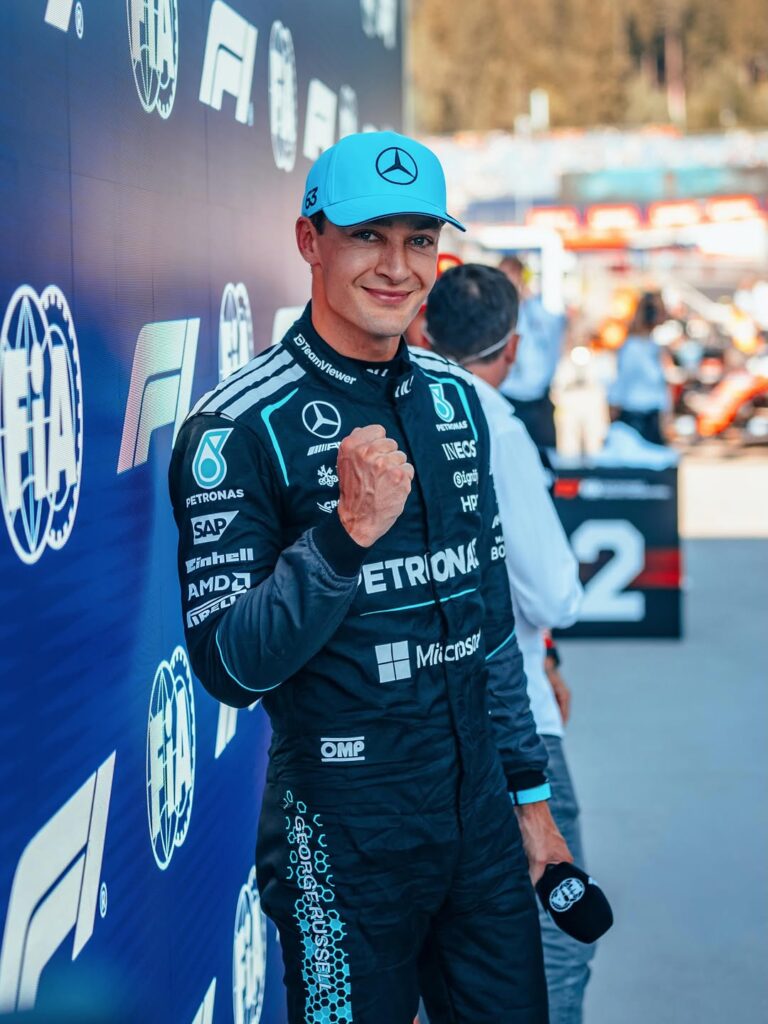
George Russell was at the front of the 2026 Canadian Grand Prix field when his Mercedes power unit failed, handing away what would have been a race win. The retirement arrived at one of the most painful possible moments — not from a midfield gamble or a strategy call, but from a position of outright control.
The Circuit Gilles Villeneuve race is run across 70 laps on the 4.361 km Montreal street circuit, meaning Russell had managed a significant race distance before the battery gave way. Any replica helmet from this weekend reflects a driver who had already done the hard competitive work; the DNF came from engineering, not from pace.
For George Russell helmet collectors, the Canadian GP 2026 is a defining moment in his season narrative. The silver and black Mercedes colourway he ran in Montreal — consistent with the team’s 2026 livery — sits alongside some of the most discussed race hours of the year. A full-size 1:1 display replica from this race weekend is not simply a decorative piece; it is a record of a race that shifted the championship conversation.
Toto Wolff’s immediate post-Barcelona statement underlined just how much had already been lost: Mercedes “can’t afford” further retirements in the title fight, and the team would “leave no stone unturned” to find the cause. That language, applied retroactively to the Canadian GP exit, confirms the Montreal retirement was already being counted as a turning point by team leadership.
Barcelona GP: Antonelli’s Second Place Disappears
Kimi Antonelli retired from second place at the 2026 Barcelona Grand Prix, the identical battery module fault taking him out of a race he was on course to podium. Barcelona’s Circuit de Barcelona-Catalunya runs 66 laps over 4.657 km, and Antonelli had worked his way into a position that would have delivered crucial championship points before the power unit failed.
What made the Barcelona retirement particularly significant for Mercedes was the pattern it confirmed. A single DNF can be an anomaly; two consecutive retirements from strong positions, separated by a matter of weeks and linked to the same component, is a systemic issue. Allison acknowledged the sport’s “keen watchers” had already drawn that connection themselves.
The Barcelona race weekend also carries strong visual interest from a collector standpoint. Antonelli’s Mercedes helmet design for 2026, in the team’s recognisable teal and silver colour palette, was on track for a podium finish at one of the calendar’s most-watched European rounds. Full-size 1:1 display replicas of the Barcelona 2026 helmets — both Russell’s and Antonelli’s — document a weekend where the team showed raw speed and suffered for factors entirely outside driver control.
Wolff’s post-race comments at Barcelona set the tone for the weeks that followed: the team had to understand the failures before the next race, and the pressure of the 2026 title fight left no room for patience. That urgency is part of the story a collector replica from this event tells.
Allison’s Fix: Phasing In New Modules for the Rest of 2026
James Allison confirmed that Mercedes has understood most of the risk areas within its battery module and is actively phasing replacement units into its 2026 race programme. The fix is not a single-race swap but a structured rollout across the fleet — which includes customer teams running Mercedes power units.
“Most of the areas of risk have been understood,” Allison said. “And with a bit of luck, when we start to sort of phase in the new modules into the racing season — we call the battery ‘the module’ — then our fortunes as a fleet should pick up.” The phrase “as a fleet” is notable: it signals that Mercedes is thinking about reliability across all cars running its power unit, not only the works W16.
The module replacement programme represents a meaningful mid-season engineering intervention. In 2026 F1 regulations, power unit components are subject to allocation limits across the season, meaning any unplanned replacements carry the risk of grid penalties. Mercedes will be managing that constraint alongside the technical fix itself, balancing urgency against regulatory cost.
Allison’s comment — “these DNFs are very, very painful” — was unusually direct for a technical director speaking publicly. It reflects the scale of what has been lost: Russell’s Canadian GP lead and Antonelli’s Barcelona podium together represent a points swing that, in a tight 2026 title fight, can be the difference between leading and chasing the championship.
The broader design philosophy Allison described, of building reliability into parts from the initial design stage rather than correcting in the field, is the standard Mercedes has held itself to through its most successful seasons. The 2026 battery module issue is a departure from that standard, and the team is treating the fix with corresponding seriousness.
McLaren’s Parallel Electrical Troubles in 2026
McLaren, running Mercedes power units as a customer team, recorded a series of electrical failures across three separate 2026 race weekends. The incidents are not confirmed by Mercedes as directly caused by the same battery fault, but the proximity and component overlap make them part of the wider story.
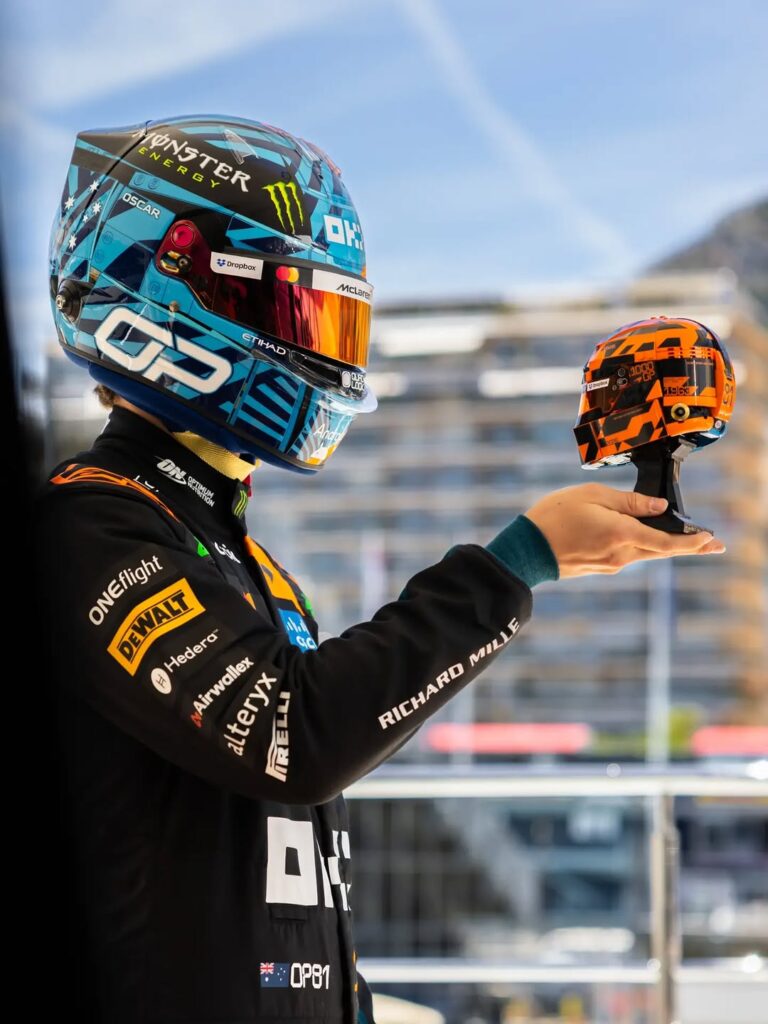
Lando Norris required a battery change during the 2026 Monaco GP weekend and subsequently retired from the race, with power unit settings listed as the cause. At the Chinese GP, both Norris and Oscar Piastri failed to start, each carrying separate electrical issues — an extraordinary situation for a team that arrived in 2026 as a title contender. Three weekends, three drivers, multiple electrical incidents across the fleet.
For collectors, McLaren’s parallel difficulties add another dimension to the 2026 season’s visual record. The papaya livery helmets from Monaco, where Norris’ retirement ended what had been a weekend of strong pace, and the non-start designs from China sit alongside the Mercedes silver helmets as artefacts of a season defined in part by power unit reliability. Full-size 1:1 display replicas of the Russell and Mercedes helmets from these weekends document a specific competitive moment with precision that race photography alone cannot replicate.
Allison’s reference to the broader “fleet” in his fix timeline suggests Mercedes is coordinating the module rollout with its customer teams as well as the works programme. Whether McLaren’s China and Monaco issues are traced to the same root cause or treated as separate problems, the 2026 power unit reliability story now spans multiple teams and events — and that is what makes the helmets from these races particularly notable as display pieces.
What These Helmets Represent as Display Pieces
The 2026 Canadian GP and Barcelona GP helmets worn by George Russell and Kimi Antonelli represent two of the most discussed race weekends of this season, and full-size 1:1 collector replicas capture that history in a form built for long-term display. Each replica is produced at true 1:1 scale — identical in dimension to the helmets worn on track — making them accurate exhibition pieces rather than scaled souvenirs.
Russell’s Canadian GP helmet carries the Mercedes 2026 livery in the teal and silver colourway the team has run across this season. The visor tint, visor thickness specifications, and shell geometry of a quality display replica are matched to the race-use originals. These are not decorative approximations; they are collector-grade reproductions designed for permanent exhibition.
Antonelli’s Barcelona helmet, from the same 2026 Mercedes design family, documents his breakthrough season as a works driver. Running second at Barcelona before the battery failure, Antonelli was on the edge of his first podium of the year — a moment a display replica preserves regardless of how the race ended. For collectors building a 2026 season archive, both helmets belong in the same display alongside the broader championship narrative they represent.
The Mercedes colour family — teal at approximately #00D2BE against the silver base — is one of the most recognised in the paddock, and in full-size 1:1 form it reads exactly as it does on a broadcast screen. These replicas are exhibition-quality display pieces only, produced for collector and decorative use and not certified for any protective or safety application.
“They’re not all identical, but they do sort of originate in the same broad part of the battery. Most of the areas of risk have been understood. And with a bit of luck, when we start to sort of phase in the new modules into the racing season — we call the battery ‘the module’ — then our fortunes as a fleet should pick up. Obviously for us, that’s an important thing. These DNFs are very, very painful.”
— James Allison, Mercedes Technical Director, Nu Silver Arrows Radio Show
“We can’t afford the run of retirements in the battle for the F1 world titles and the team would leave no stone unturned to understand what was causing the unreliability.”
— Toto Wolff, Mercedes Team Principal, post-Barcelona GP 2026
FAQ
Q: What caused George Russell’s retirement at the 2026 Canadian Grand Prix?
A fault within Mercedes’ power unit battery module caused Russell’s retirement while he was leading the 2026 Canadian Grand Prix. Technical director James Allison confirmed after the subsequent Barcelona GP that both Russell’s and Antonelli’s DNFs originate in the same broad area of the battery, which Mercedes calls ‘the module.’
Q: Is Mercedes fixing the battery problem for the rest of the 2026 season?
Yes. James Allison confirmed that Mercedes has understood most of the risk areas within the battery module and is actively phasing new replacement modules into its 2026 race programme across the full fleet of Mercedes-powered cars.
Q: Were McLaren’s 2026 electrical failures caused by the same Mercedes battery fault?
Mercedes has not confirmed a direct link. Lando Norris retired from the 2026 Monaco GP with power unit settings listed as the cause and needed a battery change that weekend; both Norris and Oscar Piastri failed to start the Chinese GP with separate electrical issues. Allison’s reference to fixing reliability ‘as a fleet’ suggests a coordinated response across customer teams.
Q: What does a full-size 1:1 replica George Russell Mercedes helmet look like?
A full-size 1:1 replica of George Russell’s 2026 Mercedes helmet reproduces the team’s teal and silver livery at true race scale, matching the shell geometry and visor specifications of the helmet worn on track. These are exhibition-quality collector display pieces only, not certified for any protective use.
Q: Why are the 2026 Canadian GP and Barcelona GP helmets collectible?
Both the 2026 Canadian GP and Barcelona GP were pivotal moments in the Mercedes season — Russell led Canada before his retirement and Antonelli held second at Barcelona before the same fault struck. Collector replicas from these weekends document specific championship-defining moments in full-size 1:1 display form.
Shop Mercedes Helmets — add the 2026 Canadian GP and Barcelona GP collector replicas to your display. Full-size 1:1 exhibition pieces, built for permanent collection.
Display and collector replicas only. Not certified for protective use. Full-size 1:1 scale.