
Blog
Miami GP 2026 FP1 Recap: Leclerc Sets the Pace, Verstappen Close Behind
 123Helmets Editorial Team
Miami GP 2026 FP1 Recap: Leclerc Sets the Pace, Verstappen Close Behind
Under a heavy Florida sky and the kind of humidity that turns garages into greenhouses, Charles Leclerc opened the Miami International Autodrome weekend with a statement: 1:29.310, fastest by nearly three tenths over Max Verstappen, with Oscar Piastri and Lewis Hamilton tucked in behind. Ferrari’s 1-3 was the headline on the timing tower — but the paddock story was wider than a single benchmark lap. New aerodynamic concepts surfaced on the Red Bull and the Ferrari, Mercedes lost both cars to power unit gremlins, and a striking wave of new helmet liveries hit the circuit, several of which 123Helmets has been documenting all race week as collector and display pieces.
Key Takeaways
Charles Leclerc set the FP1 benchmark at 1:29.310, leading a Ferrari 1-3 with Hamilton P4 and Verstappen splitting the red cars in second.
Mercedes endured a difficult opening session: Antonelli aborted his soft-tyre run while Russell reported turbo noise, both pulling in early.
Red Bull introduced a new rotating wing concept and Ferrari ran an updated ‘flip-flop’ rear wing; Aston Martin arrived as the only team without Miami-specific aero upgrades.
Race week delivered a remarkable run of helmet reveals — Bortoleto, Bottas and Pérez all unveiling Cadillac liveries, plus Sainz’s rare switch to STILO at Williams and Leclerc’s Paviot-designed JB17 tribute.
Leclerc on top, Ferrari 1-3 in the Miami opener
The extended 90-minute format — granted because of the five-week break since the previous round and the Sprint structure of the Miami weekend — gave teams unusually generous running, and Ferrari used it best. Leclerc’s 1:29.310 came on a clean second push of his soft-tyre simulation, the SF-26 carrying excellent rotation through the Turn 11–14 sweepers and refusing to wash wide on exit, which has historically been the Miami signature for tyre degradation.
Verstappen responded with a 1:29.607, a tidy lap that flattered the Red Bull on the long back straight but lost time across the slow infield section. Piastri’s McLaren split the Ferraris in third, +0.448s, with Lewis Hamilton on the second SF-26 just nineteen thousandths further back in fourth. For a Friday opening session, the front of the grid looked compressed enough to suggest a genuinely open Sprint Qualifying later in the day.
The wider top ten
Kimi Antonelli’s fifth, despite his aborted soft-tyre attempt, hinted at the underlying pace of the W17 before the Mercedes weekend turned tricky. George Russell completed the Mercedes lockout of P5–P6, ahead of Lando Norris on the second McLaren — a curious inversion of the papaya hierarchy that McLaren engineers will want to study before qualifying. Pierre Gasly took eighth for Alpine, Isack Hadjar slotted ninth for Red Bull, and Carlos Sainz rounded out the top ten on his Williams.
Mercedes power unit drama: Antonelli and Russell pull in
If Ferrari’s morning was the picture of execution, Mercedes’ was a study in damage limitation. Antonelli was on a strong soft-tyre lap when the team called him in, the Italian rookie reporting an unusual delivery from the power unit on the run down to Turn 1. The car was rolled into the garage with the cover off for the rest of the session.
On the other side of the box, Russell came on the radio describing a distinct turbo noise — the kind of high-frequency whine engineers tend to want silenced before any further high-load running. Mercedes opted for caution, parking the second W17 well before the chequered flag. The team will face a tight turnaround before Sprint Qualifying, and the implications for engine mileage management across the weekend are not trivial.
Honda’s vibration countermeasure
By contrast, Honda arrived in Miami with a planned engine vibration countermeasure following earlier reliability concerns, and the Red Bull and visiting Honda-powered cars completed their programmes without drama. Verstappen’s run plan was textbook: installation lap, aero rake data, low-fuel soft, then a long high-fuel stint that produced the kind of consistent 1:33s that suggest the RB22 is comfortable on this surface.
Aero updates: Red Bull’s rotating wing, Ferrari’s ‘flip-flop’ rear
Miami is a circuit that punishes aerodynamic compromise — long full-throttle straights, tight low-speed switchbacks, and a quirky surface that grips up dramatically across a session. Two updates dominated the technical conversation in the pit lane.
Red Bull deployed what the team referred to internally as a rotating wing concept, an evolution clearly designed to manage the trade-off between straight-line efficiency and mid-corner load. The visual signature on the rear assembly was distinct enough to draw photographers to the pit wall during Verstappen’s first installation lap.
Ferrari, meanwhile, ran an updated rear wing already nicknamed in the paddock the ‘flip-flop’ for the way its trailing edge geometry alternates load distribution across the beam. Combined with a revised floor edge, the package looked benign on television and decisive on the timing screen — Leclerc’s sector two splits being the clearest evidence.
Aston Martin stand still
Aston Martin arrived as the only team without Miami-specific aerodynamic upgrades, choosing instead to bank development hours for a later flyaway. The pace deficit was visible across the long-run data, although the team’s Friday was more about correlation than chasing a benchmark lap.
Race-week helmet reveals: a Cadillac trio and a Sainz brand switch
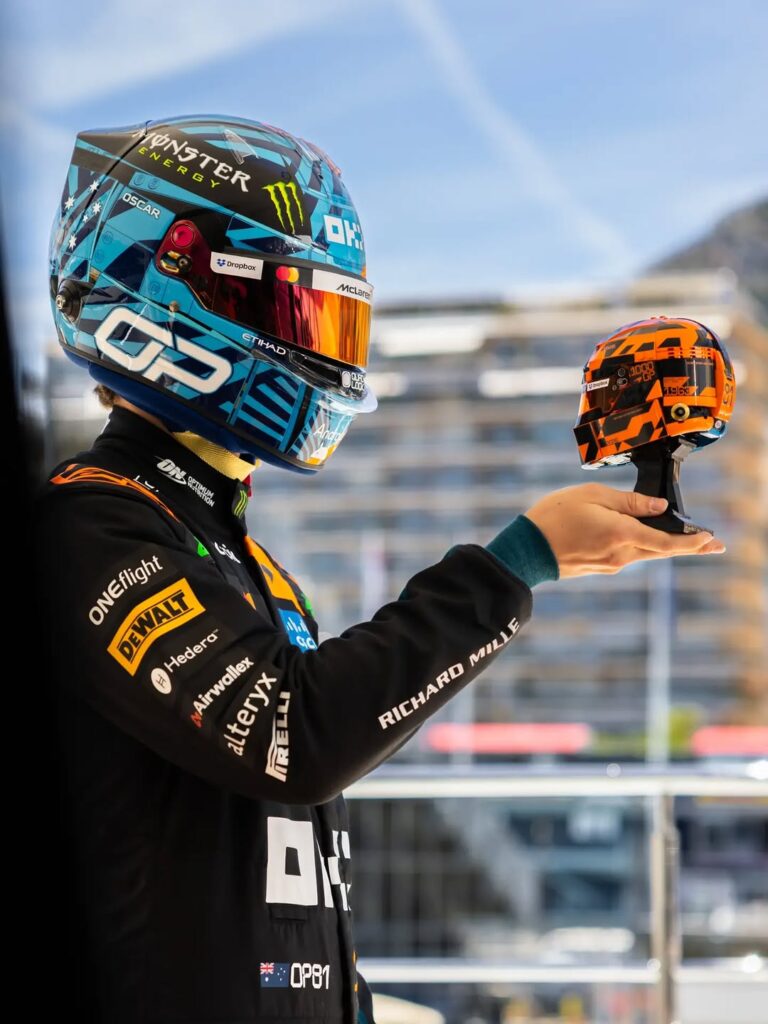
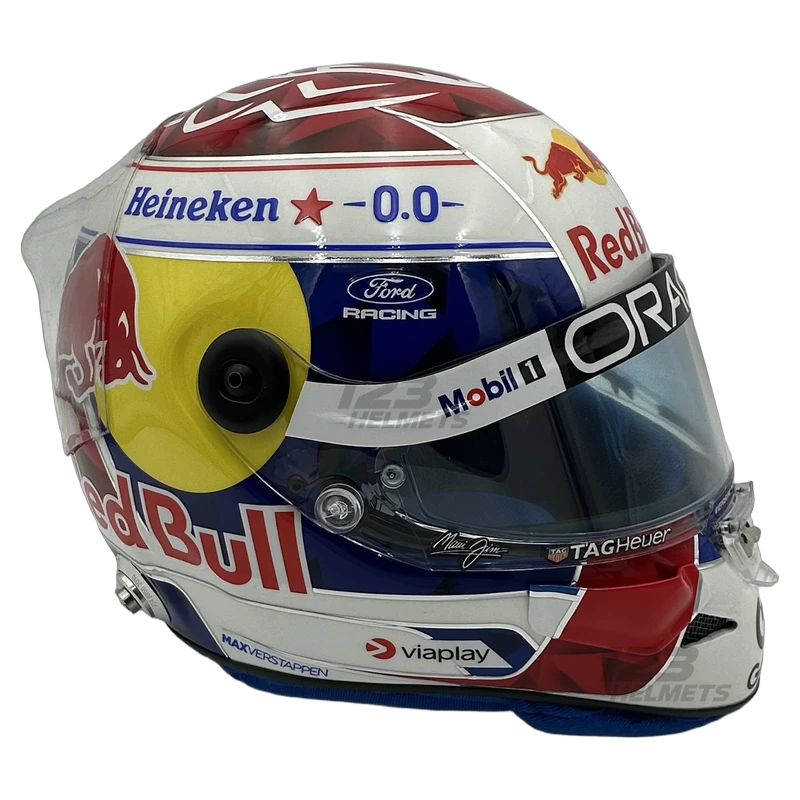
For the 123Helmets editorial desk, Miami race week has been one of the busiest reveal cycles of the season — and FP1 was the moment many of those liveries first hit the track in motion. Each of the helmets below has its own dedicated reveal article published this week, framed strictly through the display and collector lens that defines our coverage.
The Cadillac trio
Three Cadillac-liveried helmets surfaced across race week. Gabriel Bortoleto’s race-week Cadillac debut helmet drew particular attention in scrutineering, the design treatment reading beautifully under the Miami floodlights and translating exceptionally well into the full-size 1:1 replica format collectors look for in a display piece.
Valtteri Bottas’s Cadillac, finished by STILO as the partner manufacturer, carried the kind of restrained graphic language that ages well in a glass cabinet — a helmet built to be looked at as much as it is built to be talked about. Sergio Pérez’s first Cadillac F1 helmet reveal completed the trio, and the on-track debut in FP1 confirmed the photographic tests we’d run for the reveal article: the livery has genuine presence in motion.
Sainz to STILO at Williams
Carlos Sainz’s switch to STILO is one of the more unexpected brand storylines of the year, and the Williams-liveried shell on his head during FP1 was the first time the new combination has been seen in a session context. For collectors tracking brand provenance across a driver’s career, this is the kind of moment that reshapes a display shelf.
Ocon’s Haas signature, Leclerc’s Paviot tribute
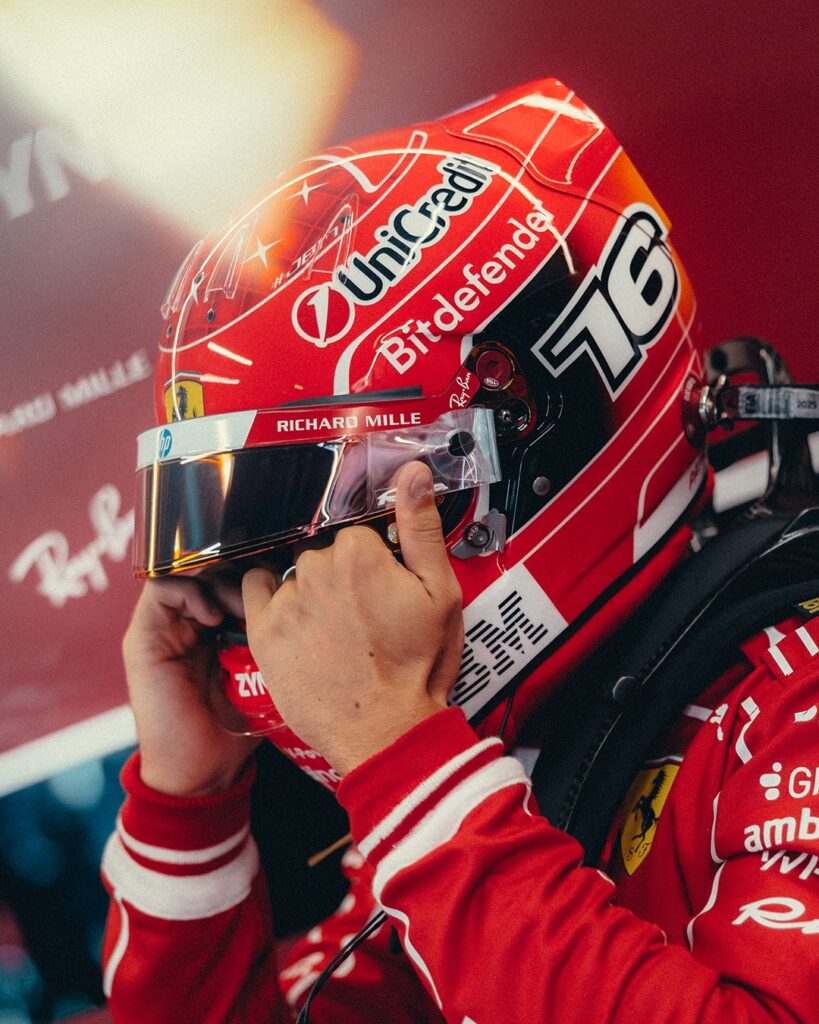
Esteban Ocon ran the Haas signature livery as expected, a clean execution of the team’s identity that translates directly into an exhibition-quality replica. The most emotionally weighted reveal of the week, however, was Leclerc’s designer-led Paviot tribute to Jules Bianchi (JB17), executed in Ferrari Red. Seeing it move through the Miami sweepers, helmet light catching the lettering on the crown, was the kind of moment that defines why collectors invest in a full-size 1:1 display replica in the first place: a frozen frame of a story.
What FP1 tells us about the rest of the weekend
With Sprint Qualifying scheduled for later the same day and the Grand Prix on Sunday, the Miami weekend offers limited margin for recovery. Three signals from FP1 stand out.
First, Ferrari’s pace looks legitimate rather than one-lap noise. Hamilton’s lap came on a more conservative fuel load than Leclerc’s, and the long-run delta to Red Bull on used softs was inside a tenth per lap. If correlation holds into the Sprint format, the SF-26 has a real shot at converting Friday pace into Saturday silverware.
Second, Mercedes need a clean engineering night. Two power unit issues in a single session, on a weekend with reduced practice time, is a difficult position from which to chase setup. Expect a conservative Sprint Qualifying from Antonelli and Russell unless the team is fully confident in the PU diagnosis.
Third, the McLaren hierarchy is worth watching. Piastri ahead of Norris on a circuit Norris has historically enjoyed is a noteworthy data point, and the team’s Friday simulation work suggested the MCL40 prefers a cooler track than Miami is likely to deliver this weekend.
The collector storyline
For the display-replica audience, Miami 2026 is shaping into a landmark race week. A Cadillac trio reveal, a rare brand switch on Sainz, and a Paviot-designed tribute on the championship-leading Ferrari is the kind of confluence that fills shelves and rewrites collection priorities. Ferrari’s on-track momentum only sharpens the appeal: provenance and performance moving in the same direction.
“Miami is a circuit where small aerodynamic gains feel enormous on a Friday — and Ferrari’s package looks like it has translated cleanly from the wind tunnel to the asphalt.”
— 123Helmets technical desk, Miami paddock
“Race week has delivered one of the strongest reveal cycles of the season for collectors — three Cadillac liveries, a Sainz brand switch, and a Paviot tribute that will define shelves for years.”
— 123Helmets editorial team
FAQ
Q: Why was Miami GP 2026 FP1 extended to 90 minutes?
The session was lengthened from the standard 60 minutes to 90 minutes because of the five-week break since the previous round and the Sprint format of the Miami weekend, which reduces the number of conventional practice sessions available.
Q: How fast was Charles Leclerc’s fastest FP1 lap?
Leclerc set a 1:29.310 to top the session, ahead of Max Verstappen by 0.297 seconds and Oscar Piastri by 0.448 seconds.
Q: What happened to Mercedes in FP1?
Both Mercedes drivers experienced power unit concerns. Kimi Antonelli was unable to complete his soft-tyre run, while George Russell reported turbo noise. Both cars were pulled into the garage well before the chequered flag.
Q: Which helmet liveries debuted on track during the Miami race week?
Race-week reveals covered by 123Helmets included Bortoleto’s Cadillac, Bottas’s STILO-built Cadillac, Pérez’s first Cadillac F1 helmet, Sainz’s switch to STILO at Williams, Ocon’s Haas signature livery and Leclerc’s Paviot-designed JB17 tribute in Ferrari Red — each available to admire as a full-size 1:1 display replica.
Q: Are the helmets featured in this article wearable?
No. All helmets discussed by 123Helmets are full-size 1:1 collector and display replicas, intended exclusively as exhibition-quality display pieces. They are not certified for protective use.
Browse F1 Helmet Collection
Display and collector replicas only. Not certified for protective use. Full-size 1:1 scale.
This article was written with the help of AI tools. Editorial policy