Blog
Monaco Tyre Allocation: What Pirelli Brings to the Principality and Why the Helmets Steal the Show
 123Helmets Editorial Team
Monaco is the slowest, tightest, most photographed weekend on the calendar — and the one where helmet design matters as much as tyre choice. Pirelli’s softest range meets a 3.337 km street circuit, and the result is a parade of one-off liveries and special-edition lids that collectors track lap by lap.
Key Takeaways
Pirelli brings the three softest compounds — C3 (hard), C4 (medium), C5 (soft) — across the 3.337 km Monaco layout.
Each driver receives 13 sets of dry slicks for the weekend, plus 4 intermediates and 3 full wets.
Monaco’s 78-lap race distance and low tyre degradation reshape strategy more than any other round.
Special-edition Monaco helmets remain the most collected full-size 1:1 display pieces of the season.
The Pirelli allocation for Monaco
Monaco gets the softest end of the Pirelli range every year, and the reasoning is mechanical rather than dramatic. The 3.337 km layout sits at an average speed below 160 km/h, lateral loads stay modest compared with Silverstone or Suzuka, and the asphalt is smooth where it isn’t painted. Soft rubber is the only way to generate enough temperature in a single flying lap.
The nominated trio is the C3 as the hard, the C4 as the medium and the C5 as the soft — a one-step jump from the standard Pirelli ladder. Each driver receives 13 sets of dry slicks for the weekend: 8 softs, 3 mediums and 2 hards. Wet-weather stock is set at 4 intermediates and 3 full wets per car, the standard allocation across the season.
That distribution tells you everything about Saturday. Q3 in Monaco regularly burns through three or four sets of softs per driver, and a single locked brake into Sainte-Dévote can end a qualifying hour. Teams hoard new softs on Thursday and Friday FP1 specifically to keep two fresh sets available for the final qualifying segment.
Why Monaco strategy is a tyre puzzle, not a race
The race itself is 78 laps over 260.286 km. Degradation on the C5 soft typically sits below 0.05 seconds per lap after the first stint settles — almost flat compared with the 0.15–0.20 s/lap drop-off seen on equivalent compounds at Barcelona. That low degradation, combined with an overtaking-impossible layout, collapses the strategy window into a single mandatory stop.
The undercut window
Pit-lane loss at Monaco is roughly 22 seconds, the longest on the calendar after Singapore. The undercut is therefore powerful — a single fresh-tyre lap can be worth 1.8 to 2.2 seconds against an opponent on 15-lap-old rubber. Teams routinely pit as early as lap 12 to trigger the chain reaction.
Track evolution
Track grip improves by an estimated 2.5 to 3 seconds across the weekend as rubber lays down. That evolution rewards anyone running last in Q3 — another reason why qualifying outweighs the race in this round more than any other.
Helmets: the real Monaco collectibles
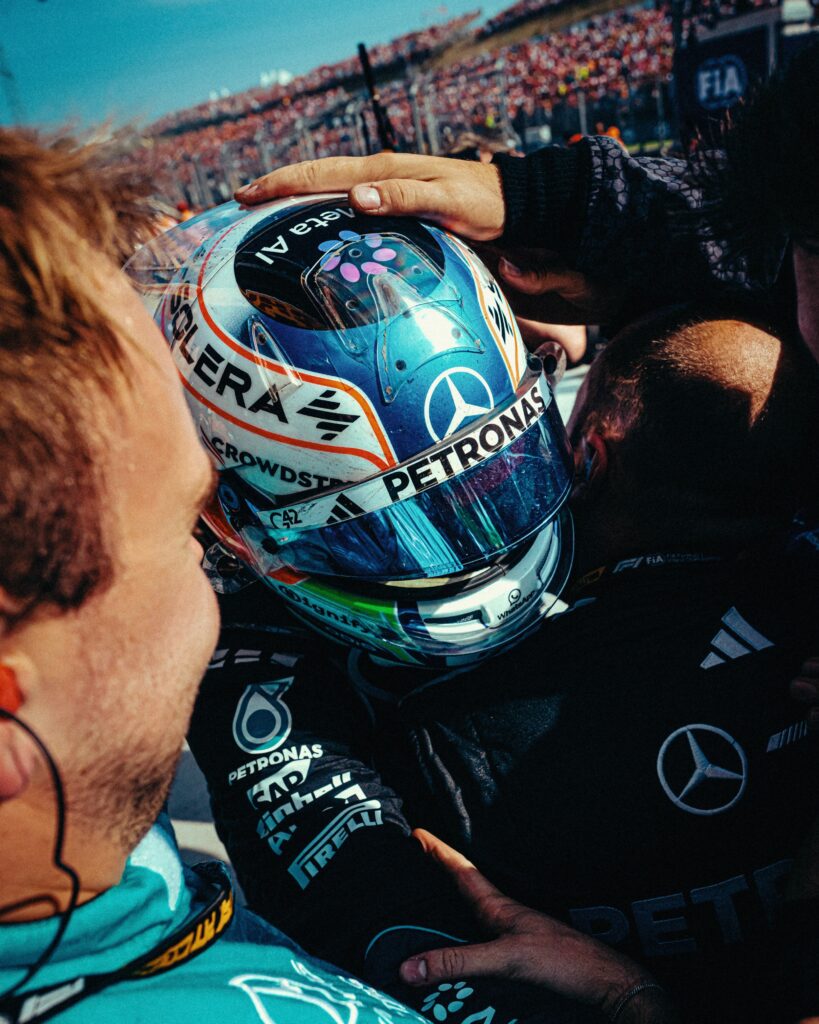
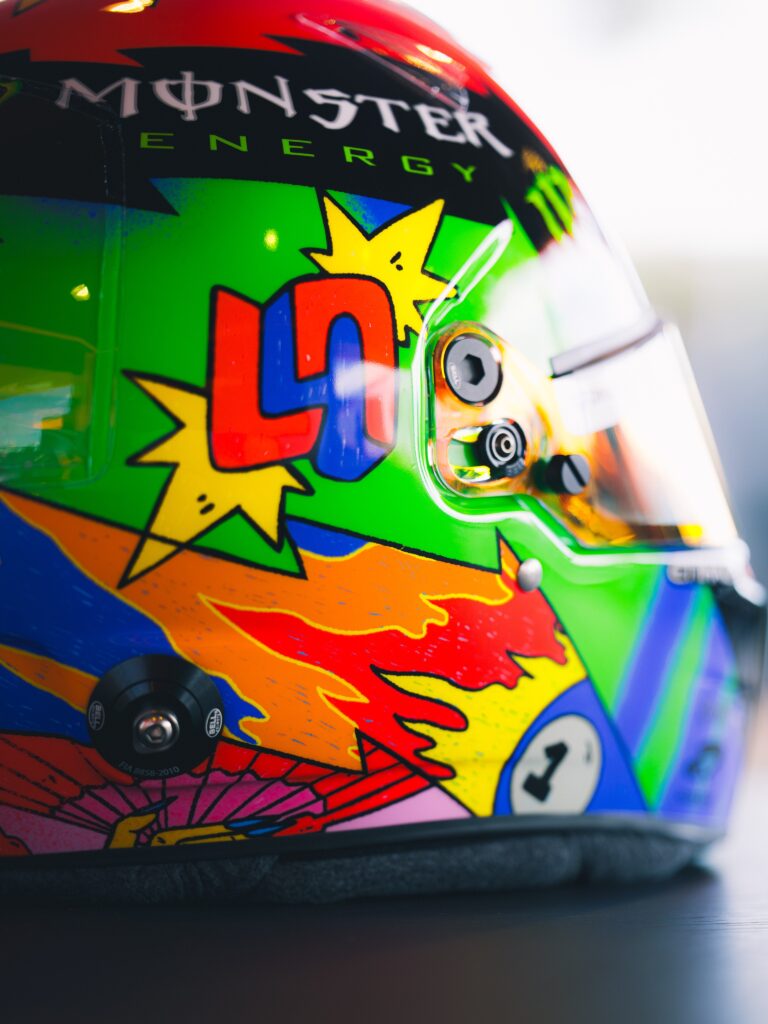
Tyres dictate the strategy, but the cameras live on the helmets. Monaco is the one weekend where drivers, sponsors and design houses agree that a special livery is mandatory. The result is the densest concentration of one-off lids in the season — and the most sought-after pieces in any full-size 1:1 display collection.
The visual codes are well established. Monégasque flag stripes, Côte d’Azur blues, gold-leaf detailing referencing the Casino, and chrome bases polished to a mirror finish. Paint thickness on a typical special-edition Monaco shell runs to 8–10 layers, with clear-coat depth around 0.3 mm to give the metallic flakes their depth under TV lighting.
Why Monaco lids photograph differently
The Principality’s geometry forces helmet cameras into tighter framing than any other circuit. The tunnel exit, the swimming-pool chicane and the climb from Sainte-Dévote all put the helmet at the centre of the shot for full seconds at a time. Designers know this. The top of the shell — usually a forgotten zone — gets as much attention as the visor strip, because that is what the trackside grandstand and the helicopter shot actually see.
Podium visuals worth framing
The Monaco podium is the only one in the sport set against a royal box, a harbour full of yachts and a backdrop of pastel apartment blocks. The combination produces a specific colour palette — warm cream walls, deep Mediterranean blue, red carpet — that flatters certain helmet liveries spectacularly.
What looks best on the rostrum
Matte black bases with single-colour accents read cleanly against the cream architecture. High-chroma reds and yellows pop against the harbour blue. Chrome and mirror finishes, however, can wash out under the midday sun — which is why most chrome Monaco specials are designed with matte sections to break up the reflection.
For a display-quality full-size 1:1 collector replica, the Monaco podium shot is the reference image. Lighting a helmet on a shelf to match that warm 5400 K natural light gives the paint the same depth viewers remember from Sunday afternoon.
The display case: presenting a Monaco replica
A full-size 1:1 replica helmet measures roughly 27 × 35 cm at the widest points and weighs between 1.3 and 1.6 kg depending on shell construction. That makes Monaco-themed pieces ideal for shelf or cabinet display — heavy enough to feel substantial, compact enough to live in a standard 30 cm-deep bookcase.
Lighting recommendations
Metallic Monaco liveries respond best to two-point lighting at roughly 45 degrees, around 3000–4000 K colour temperature. A single overhead spot flattens the flake and kills the depth that made the livery worth collecting in the first place. For chrome bases, indirect lighting bounced off a white surface eliminates the harsh hotspots that ruin photographs.
Rotation and dust
Painted shells should be rotated 90 degrees every few months if displayed near a window — UV exposure can fade red and fluorescent pigments measurably within 18 to 24 months. A simple acrylic case with a 3–4 mm wall thickness handles dust and casual handling without distorting the view.
Display and collector replicas only. Not certified for protective use. Full-size 1:1 scale.
“Monaco is the one weekend where the helmet is the headline. The car barely moves at 50 km/h through the hairpin — what the camera sees is the lid.”
— Paddock helmet designer, 123Helmets editorial notes
FAQ
Q: Which Pirelli compounds are nominated for Monaco?
The C3 as hard, C4 as medium and C5 as soft — the three softest compounds in the Pirelli range, one step softer than the standard ladder.
Q: How many tyre sets does each driver get for the weekend?
13 sets of dry slicks (8 softs, 3 mediums, 2 hards), plus 4 intermediates and 3 full wets per car.
Q: Why are Monaco helmet liveries so collectible?
Monaco is the densest one-off livery weekend of the year. The tight circuit puts the helmet on camera for longer than any other round, and designers respond with chrome, gold leaf and Monégasque colour codes that translate beautifully to full-size 1:1 display replicas.
Q: What size is a full-size 1:1 replica helmet?
Approximately 27 × 35 cm at the widest dimensions, weighing 1.3 to 1.6 kg depending on shell construction. Designed for shelf, cabinet or wall-mount display only.
Q: How should I light a Monaco-themed display helmet?
Two-point lighting at 45 degrees, 3000–4000 K colour temperature, with indirect bounce for chrome or mirror finishes. Avoid direct UV exposure to preserve red and fluorescent pigments.
Browse F1 Helmet Collection
Display and collector replicas only. Not certified for protective use. Full-size 1:1 scale.