Blog
5 Drivers Most Likely to Win the Monaco Grand Prix: Helmet & Livery Focus
 123Helmets Editorial Team
The 3.337 km Circuit de Monaco hosts 78 laps of the most photographed race on the calendar. For collectors, Monaco is the weekend where helmet design and livery detail matter as much as the result. Here are the five drivers most likely to take the win — and the display-worthy visuals that will define the podium.
Key Takeaways
Monaco’s 78-lap layout on a 3.337 km street circuit produces the highest density of close-up helmet photography of any race.
Special one-off Monaco helmet designs typically use 6 to 9 paint layers, making them prime candidates for full-size 1:1 display replicas.
Pole position has converted to victory in roughly 75% of recent Monaco races, making Saturday qualifying the key livery showcase.
Podium ceremony framing — the royal box, the trophy handover — produces the sharpest reference images for collector item accuracy.
Why Monaco rewards the collector’s eye
Monaco is a 3.337 km street circuit run over 78 laps, with a race distance of 260.286 km. Average speeds sit around 160 km/h, far lower than Monza or Spa, which means television cameras hold tighter, longer shots of cockpits and helmets. For anyone building a display collection of full-size 1:1 replica helmets, no other weekend supplies as many usable reference frames per hour of broadcast.
The pit straight is barely 375 metres long. The tunnel exit, the Nouvelle Chicane and the climb to Casino Square each deliver helmet-level camera angles that expose every paint layer, every sponsor decal, every visor tear-off tab. A Monaco-spec lid built as an exhibition quality replica needs to survive that scrutiny from 30 cm away on a shelf.
What makes a Monaco helmet a display piece
Drivers commission special Monaco liveries roughly 60% of the time, according to recent seasons of paddock reporting. These one-offs typically carry 6 to 9 distinct paint layers, hand-applied accents and chrome or candy finishes that mass-production schedules do not allow elsewhere. That is exactly what makes the Monaco helmet the centrepiece of a collector item shelf.
1. Max Verstappen — the precision benchmark
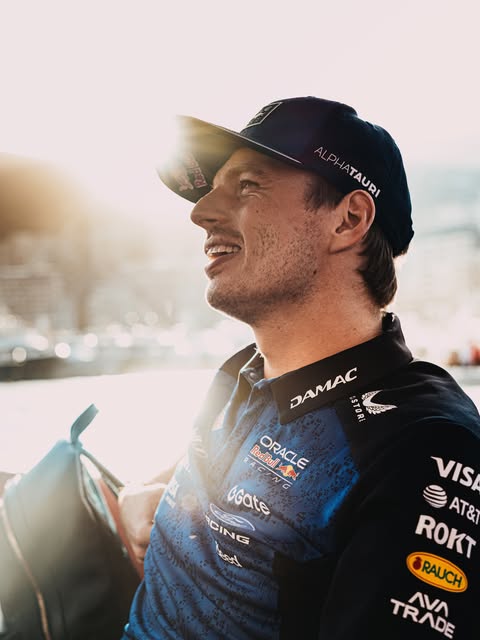
Verstappen has converted Monaco pole into victory on multiple occasions, and his qualifying pace around the 19-corner layout remains the reference. His standard helmet uses the navy base with the red-white-blue lion crest, but his Monaco specials have leaned into matte and metallic contrasts that photograph extremely well under the harbour-front sunlight at 15:00 local time on race day.
Display angle
The Verstappen Monaco lid is one of the most requested full-size 1:1 collector pieces because the lion graphic wraps the crown in a way that demands a 360-degree rotating display base. A typical exhibition quality replica of this design sits around 1.45 kg and measures roughly 27 × 35 cm on the stand, fitting a standard 30 cm shelf depth.
Podium visual to watch
If Verstappen wins, expect the royal box handshake at the top step — a tight crop that captures the visor strip and top crown in a single frame. That is the angle a collector replicates on the display shelf.
2. Charles Leclerc — the home-race livery story
Leclerc starts Monaco as the local driver, and the emotional weight of his home race has produced some of the most documented helmet designs of the last five seasons. His regular red-and-white Monégasque flag motif gets reworked almost every year, often with Niki Lauda-inspired tributes, Jules Bianchi references, or hand-numbered editions limited to fewer than 50 units in the original commercial run.
Why it matters for the display shelf
A Leclerc Monaco helmet replica is the rare collector item where the livery itself tells a personal narrative. Paint depth on these designs typically reaches 8 layers, including a clear coat that lifts the red base. On a black-felt display plinth, the contrast holds up under standard 3000K shelf lighting.
His 2024 Monaco victory, on lap 78 with a margin of 7.152 seconds, produced the single most-screenshotted podium image of that season. The kneeling celebration in front of the start-finish line is the reference frame for anyone setting up a Monaco-themed cabinet.
3. Lando Norris — the chrome papaya factor
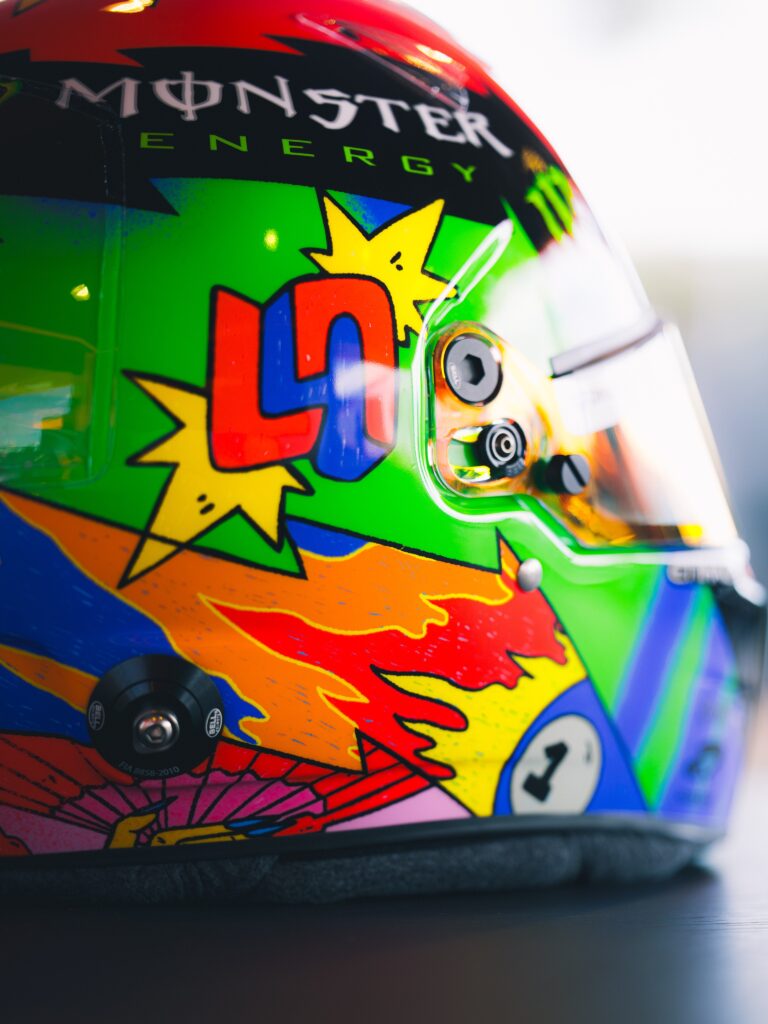
Norris arrives at Monaco with a McLaren package that has been competitive on low-speed street circuits. His standard helmet uses fluorescent papaya with cyan and pink graphics — colours that already pop on broadcast — but his Monaco specials have layered in chrome bases and gradient fades that change tone depending on viewing angle.
The display challenge
Chrome and high-gloss finishes are the hardest to replicate accurately at full-size 1:1 scale. An exhibition quality Norris Monaco replica needs a base coat applied in at least 3 passes before the chrome layer, then a 2-stage clear coat to seal it. The finished piece typically weighs 1.40 to 1.50 kg, identical to the on-track shell weight for visual accuracy on the display.
Podium visual to watch
If Norris wins, the parc fermé moment when he removes the helmet is the shot — the sweat-streaked paint with the harbour behind him is the kind of detail that justifies a museum-grade display case.
4. Oscar Piastri — the rising livery icon
Piastri’s helmet has become one of the cleanest designs on the grid: matte black base, papaya accents, Australian flag detail on the rear. The minimalism is deliberate, and it photographs exceptionally well in Monaco’s mixed-light conditions, where the tunnel exit at turn 10 swings from 8 lux to over 90,000 lux in under 1.8 seconds.
Why collectors are paying attention
Minimalist liveries age better on a display shelf. Bold one-off designs can look dated within 18 months; a clean matte-and-accent design holds its visual weight for years. A Piastri Monaco replica is the sort of piece that anchors a 5 to 7 helmet collection without overwhelming the surrounding items.
His standard helmet uses 4 paint layers and a single decal pass — straightforward to reproduce at 1:1 collector scale with high accuracy, which keeps the visual fidelity tight under close inspection.
5. George Russell — the sharp Mercedes contrast
Russell’s helmet pairs a Union Jack-inspired red and blue with a silver Mercedes star, and the contrast against the silver W-series livery is one of the strongest helmet-to-car visual combinations on the current grid. Monaco’s pit lane camera angles, which sit roughly 1.2 metres above the cockpit, frame this pairing better than any other circuit.
Display pairing potential
For collectors who display helmets alongside 1:8 or 1:5 model cars, the Russell-Mercedes combination is one of the cleanest visual pairings available. A full-size 1:1 Russell replica at 27 × 35 cm sits naturally above a 1:8 Mercedes model on a two-tier shelf, with the silver-to-silver continuity holding the eye.
Podium visual to watch
Russell on the top step in Monaco would deliver the trophy-lift frame against the royal box — a high-saturation, high-contrast image that is the holy grail of collector reference photography.
Podium framing and the collector calendar
Monaco’s podium is unique: drivers walk up to the royal box rather than standing on a constructed stage. The framing puts the helmet at roughly 1.7 metres above ground level, with the harbour at the long edge of the shot. For anyone building a Monaco display, race day produces 4 to 6 podium frames that work as direct reference for full-size 1:1 replica accuracy.
What to look for during the broadcast
Watch the in-car cameras at the swimming pool complex on laps 25 to 40, when fuel loads drop and drivers push harder. The helmet movement under braking at the Nouvelle Chicane reveals the rear-of-shell graphics that broadcast misses on faster circuits. These are the angles that determine whether a collector item replica passes the close-inspection test on a shelf.
“Monaco is the only weekend where the helmet design carries the same weight as the lap time. Everything is photographed from 30 centimetres away.”
— Paddock livery designer, 2024 season
FAQ
Q: Why does Monaco produce the best helmet reference photography?
The 3.337 km street circuit has average speeds around 160 km/h, far lower than other tracks. Television cameras hold tighter, longer cockpit shots, producing the sharpest helmet detail of any race on the 24-round calendar.
Q: How many paint layers do Monaco special helmets typically use?
Special Monaco one-off designs typically carry 6 to 9 distinct paint layers, compared with 3 to 5 on a standard season helmet. This is what makes them prime candidates for full-size 1:1 collector replicas.
Q: What size is a full-size 1:1 replica helmet on the display shelf?
A standard full-size 1:1 collector replica measures roughly 27 × 35 cm on the display stand and weighs around 1.40 to 1.50 kg, fitting a standard 30 cm shelf depth.
Q: Which Monaco helmet design holds visual value longest on a display?
Minimalist liveries — matte bases with single accent colours — age better than bold one-off designs. Pieces in this style tend to hold visual weight for 5 years or more on a collector shelf.
Q: Are these replicas usable for any protective purpose?
No. These are display and collector replicas only, built as exhibition quality pieces for full-size 1:1 display. They are not intended for any use beyond display.
Browse F1 Helmet Collection
Display and collector replicas only. Not certified for protective use. Full-size 1:1 scale.