Blog
Bearman: Ferrari Move Forged His F1 Maturity
 123Helmets Editorial Team
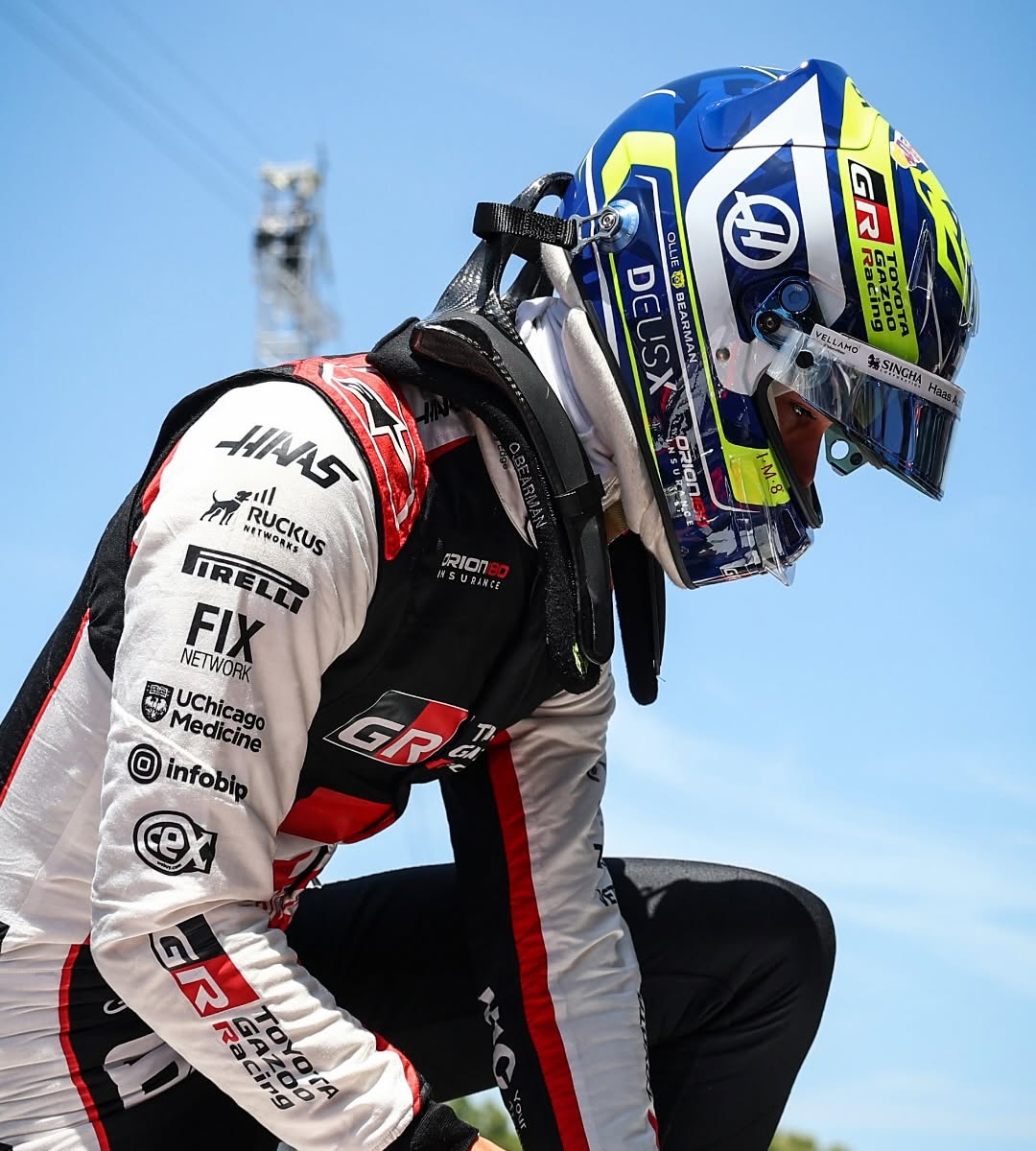
Oliver Bearman says moving to Maranello at 16 — learning Italian, living alone, and training daily alongside engineers twice his age — built the mental foundation that put him in a Ferrari cockpit before his 19th birthday.
Key Takeaways
Bearman relocated to Maranello at approximately 16 years old, younger than most FDA recruits, and had no Italian language skills on arrival.
His 2024 Saudi Arabian Grand Prix debut at age 18 came with zero notice — a direct test of the maturity built during his years inside the Ferrari structure.
Constant exposure to engineers, mechanics, and trainers far older than him forced a level of professional conduct most teenagers never encounter.
The helmet and red Ferrari livery Bearman wore at Jeddah in 2024 now stand as one of the most collectible display moments of that season.
A Teenager Dropped Into Maranello’s Deep End
Oliver Bearman arrived in Maranello at roughly 16 years old with no Italian, no local contacts, and no blueprint for what the Ferrari Driver Academy would demand of him. He has described that period as the single biggest accelerant of his personal growth, saying plainly: “I just wasn’t ready for what the world had to throw at me.”
The town of Maranello sits in the Emilia-Romagna region of northern Italy, a compact, largely industrial community built around the Ferrari factory. For a teenager from the UK used to a wider social circle, weekends there offered little distraction. Bearman has recalled being left largely to his own devices on those days — a deliberate or incidental form of isolation that, in retrospect, he credits as formative rather than difficult.
He learned Italian not from a classroom but from necessity. As he put it himself, the motivation was simple: getting pizza and pasta required at least basic communication. That practical, immediate incentive compressed what might have taken years into months. It is the same pattern that runs through his entire early career — compressed timelines, elevated stakes, faster adaptation than the standard junior pathway would ever have required.
The Ferrari Driver Academy is known for placing young drivers inside a professional adult environment from day one. Engineers, mechanics, data analysts, and performance coaches do not adjust their communication style for a 16-year-old. Bearman either matched that register or fell behind. He matched it.
Surrounded by Adults: The Unofficial Curriculum
Bearman’s sharpest observation about the Maranello years is that almost every person around him was significantly older — engineers, mechanics, and his trainer formed the daily social fabric of his life from age 16 onward. That sustained exposure to professional adults, rather than peers, functioned as an accelerated maturity programme with no formal syllabus.
Most junior drivers progress through academies while still embedded in age-appropriate environments — schools, junior teams with similarly young teammates, support structures designed around adolescence. Bearman bypassed most of that. The FDA placed him inside a world-class motorsport operation where the baseline expectation was adult-level professionalism, every single day.
He has been candid that he had to “mature to that level” because those were simply the people filling his calendar. There was no teenager-adjusted version of the briefing room, no junior mechanic shadowing arrangement — just the real environment, immediately.
A minor but telling detail: when he turned 17 and obtained his UK driving licence, European rules meant he could not legally drive on the continent until 18. He waited a full additional year for what most drivers his age in Italy had already. That kind of regulatory patience — accepting a constraint you cannot change and continuing to operate within it — is not dramatic, but it is precisely the disposition that F1 engineers respect in a young driver.
From First Test to Saudi Arabia in Six Months
Bearman’s first Formula 1 test was followed by his first FP1 session, and within roughly six months he was standing on a Jeddah pit lane in full Ferrari red, preparing to race in the 2024 Saudi Arabian Grand Prix as a last-minute substitute. The pace of escalation was not gradual — it was near-vertical.
The Saudi debut on 9 March 2024 has already taken on a fixed place in F1 folklore. Bearman was 18 years old. He qualified and raced the Ferrari SF-24, finishing inside the points on a street circuit known for punishing inexperience. The Jeddah Corniche Circuit runs to 6.174 km and features 27 corners at average speeds that leave almost no margin for a driver who hasn’t embedded the car’s characteristics over multiple sessions. Bearman had hours, not weeks.
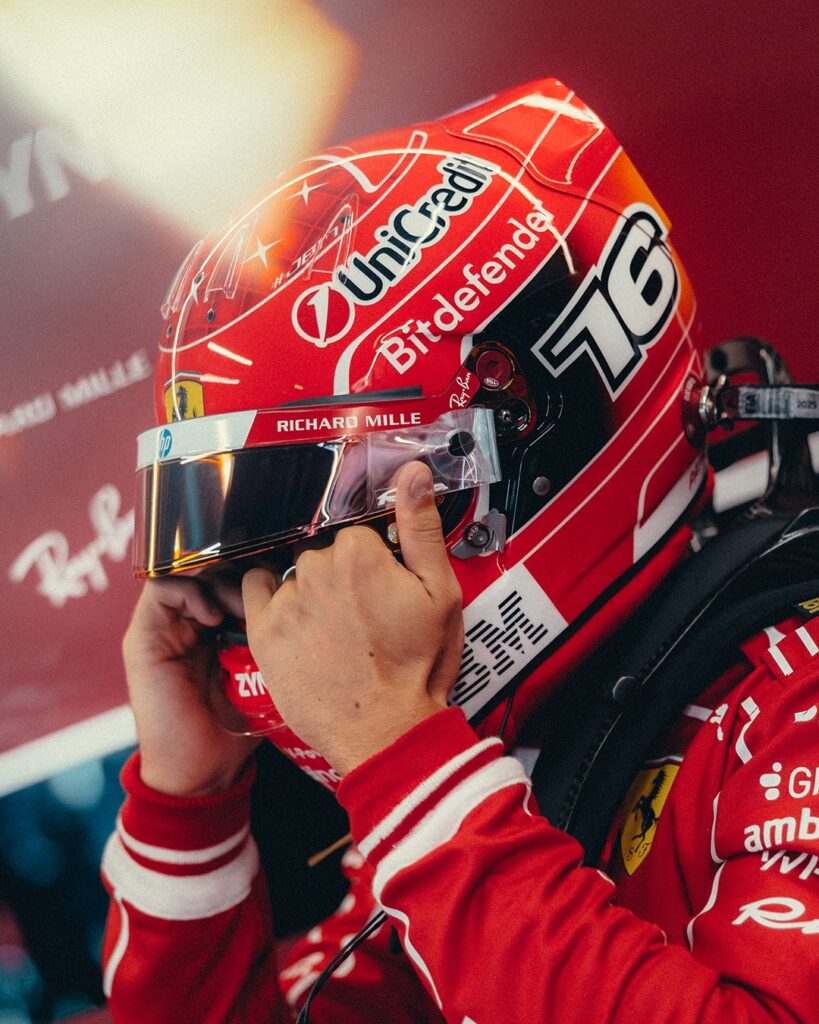
The helmet he wore that weekend — Ferrari’s traditional red with his personal graphic identity — became immediately significant to collectors and fans. A full-size 1:1 display replica of that lid captures what was, objectively, one of the most dramatic F1 debut moments of the 2020s: a teenager, parachuted in, scoring points for one of the sport’s two most storied constructors.
For display purposes, the visual story of that race concentrates into the helmet. The red and white Ferrari livery on the SF-24, the 2024 Saudi Arabian Grand Prix race number, the driver’s name on the halo — these are the exhibition-quality details that make a replica of the Bearman Jeddah helmet a genuine collector piece rather than generic merchandise.
The Ferrari Livery as a Display Object
Ferrari’s 2024 race livery — the SF-24’s deep Scuderia red, offset by white sponsor panels and the prancing horse on the nose — is one of the most photographically distinct colour schemes in modern F1. On a full-size 1:1 replica helmet, that palette reads at exhibition scale exactly as it does trackside: bold, immediately identifiable, historically grounded.
A display-quality replica of the helmet Bearman wore in Jeddah measures at standard 1:1 adult helmet dimensions, placing it correctly in any cabinet or stand-mounted display alongside other memorabilia from the 2024 season. The visor on a properly manufactured replica sits at approximately 3 mm in thickness with a gold or clear mirror finish consistent with the Saudi night-race configuration — night street circuits typically favour high-contrast visors that read well under artificial lighting and on broadcast cameras.
The Bearman Jeddah lid is also notable as a transitional object in the sport’s recent history: it represents the last time Ferrari ran a sub-19-year-old driver in a points-eligible race with the factory team, and it predates Bearman’s subsequent move to Haas for 2025. As a display piece, it belongs to a specific, closed chapter — which is exactly what gives collector replicas of race-specific helmets their long-term value as exhibition items.
For anyone building a themed Ferrari display — either around the 2024 season or around the FDA’s alumni record — this helmet pairs naturally with items from Charles Leclerc and the broader Ferrari range, anchoring a moment when the team’s junior pipeline delivered under maximum pressure.
What Bearman’s Story Means for the FDA Legacy
The Ferrari Driver Academy has produced race-ready F1 drivers from its programme since its formal relaunch in 2019, and Bearman’s trajectory — FDA entry at 16, F1 debut at 18, full-season Haas seat at 19 — is now its fastest documented progression from academy intake to competitive Grand Prix racing. That record matters beyond the individual driver because it confirms what the FDA’s structure is designed to do: compress the gap between talent identification and race readiness.
Bearman himself attributes the compression not to any single coaching intervention but to the environmental design of Maranello itself. Being geographically isolated in a small Italian city, professionally surrounded by adults, and operationally embedded inside a Formula 1 factory from age 16 produced an adaptation that a conventional junior pathway could not have replicated on the same timeline.
His reflection on the experience, shared on F1 Off The Grid, is unusually precise for a 20-year-old athlete. He does not describe it as fun or easy — he describes it as necessary and, in retrospect, exactly right for where he needed to go. That kind of retrospective clarity, delivered without sentimentality, is itself evidence that the maturation he describes actually happened.
For Oliver Bearman collectors and fans, the Jeddah 2024 helmet is the physical anchor of this story — a display piece that sits at the intersection of the FDA legacy, Ferrari’s 2024 campaign, and one of the sport’s most memorable debut performances of the decade.
Display Value: Why the Jeddah Debut Helmet Endures
The most collectible F1 helmets share a common characteristic: they are attached to a moment that is both singular and verifiable. Bearman’s 2024 Saudi Arabian Grand Prix lid meets both criteria. The debut happened on 9 March 2024, the circumstances were extraordinary, and the result — points scored — gives the helmet a sporting outcome to anchor it beyond pure novelty.
A full-size 1:1 replica produced to exhibition quality replicates the external geometry, livery placement, and visor configuration of the original to display standard. These are collector and display pieces only — not certified for any protective use, not rated to any safety standard, and not intended for road or track wear. Their purpose is exhibition: framed, mounted, or stand-displayed in a private collection, office, or showroom environment.
The Ferrari red of the 2024 scheme is applied in multiple paint layers on quality replicas — typically four to six coats including base, colour, and lacquer — which gives the finish the depth and gloss that reads correctly under gallery or cabinet lighting. At 1:1 scale, the helmet sits at the same proportions as the race-worn original, making it the only format that accurately conveys the visual weight of the object as it appeared on Bearman’s head at Jeddah.
As Bearman continues into his second Haas season and builds his own distinct identity in the sport, the Ferrari chapter — brief, high-stakes, and unexpectedly successful — will only grow in retrospective significance. Display replicas from that chapter document a specific moment in F1’s recent history that no subsequent season can replicate or replace.
“Looking back to the person that I was when I moved to Italy, 16, I think, or even a bit younger. I just wasn’t ready for what the world had to throw at me.”
— Oliver Bearman, F1 Off The Grid
“I had to mature and grow up very quickly. I was also surrounded by adults all the time: engineers, mechanics, sometimes other drivers, but mainly my trainer. All of these people were much, much older than me.”
— Oliver Bearman, F1 Off The Grid
FAQ
Q: How old was Oliver Bearman when he made his F1 debut?
Bearman was 18 years old when he made his Formula 1 debut at the 2024 Saudi Arabian Grand Prix on 9 March 2024, stepping in as a last-minute substitute for Ferrari.
Q: What makes the Bearman Jeddah 2024 helmet a collector display piece?
The helmet marks a singular, documented event — a last-minute F1 debut at 18 that resulted in a points finish for Ferrari — making it a display piece attached to a specific and verifiable moment in the sport’s recent history.
Q: Are these Ferrari replica helmets safe to wear or use on track?
No. These are full-size 1:1 display and collector replicas only. They carry no safety certification — no FIA, Snell, ECE, or DOT rating — and are not intended for road, track, or any protective use. They are exhibition items.
Q: How long did Bearman spend in the Ferrari Driver Academy before his F1 debut?
Bearman joined the Ferrari Driver Academy at approximately 16 years old and debuted in F1 at 18, meaning he spent roughly two years inside the FDA structure before his first Grand Prix start.
Q: Which Ferrari season livery does the Bearman replica helmet carry?
Display replicas of the Bearman debut helmet carry the Ferrari SF-24 livery from the 2024 season — the deep Scuderia red with white panels and prancing horse branding as raced at the Jeddah Corniche Circuit.
Shop Ferrari Helmets — full-size 1:1 display replicas from the 2024 season and beyond. Every piece is a collector item, not certified for protective use.
Display and collector replicas only. Not certified for protective use. Full-size 1:1 scale.
This article was written with the help of AI tools. Editorial policy