Blog
Piastri’s Plan for McLaren’s Experimental Wing
 123Helmets Editorial Team
Oscar Piastri has confirmed McLaren will trial an experimental rear wing during Friday practice at the 2026 Austrian Grand Prix — but ruled out racing it at the Red Bull Ring. Here is what the test means for the MCL40’s development arc and why the moments around it are already display-worthy.
Key Takeaways
McLaren’s experimental rear wing was assigned to Lando Norris’ car for Friday practice at the 2026 Austrian Grand Prix — Piastri confirmed it will not be raced at the Red Bull Ring.
Technical Director Neil Houldey described the Austria package as lighter than recent updates, focused on rear-corner detail work as part of a season-long development pathway.
Ferrari debuted their ‘flip-flop’ rotating rear wing in Bahrain pre-season testing and raced it at the 2026 Miami Grand Prix; Red Bull also unveiled a rival rotating wing solution at Miami.
Piastri finished fifth in Barcelona after qualifying seventh — a result that makes his 2026 Austrian GP one of the most visually and competitively loaded weekends to follow this season.
What Piastri Actually Said About the Wing
Piastri’s answer was direct: the experimental rear wing will not race at the 2026 Austrian Grand Prix. Speaking at Thursday’s Red Bull Ring press conference, the McLaren driver stated plainly, “No, we won’t race it. I believe it’s on Lando [Norris’] car tomorrow. It’s to test out; it’s not ready to race at the moment.”
That single sentence frames the entire weekend narrative for McLaren. The wing is a Friday-only evaluation item, restricted to practice sessions on 2026-06-27, and carries no guarantee of appearing in qualifying or the race. For anyone watching the session telemetry — or scanning the paddock for livery close-ups — the Friday afternoon run will be the window.
Piastri added a second, more revealing layer to the story: “Obviously we’ve seen some of the creative solutions [from rival teams], and they don’t come without their challenges, clearly. It won’t be raced, but useful to try it out.” The qualifier “clearly” is pointed. Both Ferrari and Red Bull have publicly wrestled with rotating rear wing geometries under the 2026 active-aerodynamic regulations, and McLaren is watching before committing.
The Norris–Piastri split
Running the experimental wing on Norris’ car rather than Piastri’s is standard McLaren engineering practice for prototype evaluation: one car collects the data, the other runs the baseline so the team has a clean performance delta. For Oscar Piastri, that means his Friday livery shots will show the known MCL40 specification — a detail that matters when assessing which on-track images represent the car’s race-ready visual identity.
McLaren’s Austria Package: What Neil Houldey Revealed
McLaren’s Technical Director of Applied Engineering, Neil Houldey, described the 2026 Austrian Grand Prix package as lighter in scope than the team’s recent upgrade sets — but deliberate in its targeting. “For this event, we’ve focused on minor detail updates around the car’s rear corners, as well as an experimental rear wing that will run throughout Friday’s sessions,” he said in McLaren’s pre-weekend preview.
The phrase “rear corners” is specific engineering language. It covers the junction between the diffuser, the rear brake duct exit, the tyre squirt zone and the lower rear wing endplate — a region where small geometry changes can meaningfully alter outwash and rear-axle stability at a circuit like the Red Bull Ring, which measures 4.318 km in lap length and features long, exposed corners such as Turn 1 and the uphill run to Turn 3.
Houldey was equally candid about the philosophy: “While the overall package is lighter than some of our recent updates, these developments are all part of our season-long development pathway, and we’re continuing to look for every lap time opportunity wherever we can.” That framing — season-long pathway rather than single-event fix — signals McLaren is prioritising learning rate over specification jumps in the current regulation cycle.
Why the rear wing matters most in 2026
F1’s 2026 regulations introduced active aerodynamics, meaning rear wings are no longer passive structures. Teams can now legally move wing elements under defined conditions. The experimental design McLaren is evaluating fits within that framework. Ferrari ran their rotating ‘flip-flop’ rear wing through pre-season testing in Bahrain as early as the 2026-02 test window, evaluated it again in China, then raced the system at the 2026 Miami Grand Prix. Red Bull also appeared at Miami with their own rotating solution. McLaren’s Austria test puts them approximately one event behind those rivals in the evaluation timeline — a gap they are clearly aware of.
Barcelona Context: Why Piastri Needs Austria to Deliver
Piastri qualified seventh and finished fifth at the 2026 Barcelona-Catalunya Grand Prix — a result that sat well outside the podium conversation for a driver of his standing. The gap between seventh on the grid and fifth at the flag reflects a strong race pace relative to qualifying, but fifth is not the result McLaren or Piastri target when they arrive at a European circuit.
For Oscar Piastri, Austria represents the first genuine reset opportunity after Barcelona. The Red Bull Ring’s layout — short, 71-lap races, heavy aerodynamic loading at Turn 1 — suits a car with a well-sorted rear end, which is precisely the area McLaren is addressing with the Austria package. If the rear-corner updates translate to on-track balance, Piastri should be in a better qualifying position than seventh, and a better race position than fifth.
The visual dimension of this matters too. A seventh-to-fifth recovery at Barcelona does not generate podium photography — the shots that end up on walls, in display cases, and reproduced on collector replicas. A top-three finish in Austria, with the MCL40’s papaya and carbon livery on the Red Bull Ring’s green hillside backdrop, is exactly the kind of image that defines a season chapter. That is the setting this weekend is building toward.
Rival Wings and the 2026 Active Aero Arms Race
Ferrari’s rotating rear wing was the first publicly visible response to F1’s 2026 active-aerodynamic regulations from a top team. The ‘flip-flop’ design — named for the mechanical action of its flap transition — appeared in Bahrain pre-season testing, was trialled again in China, and raced at the 2026 Miami Grand Prix. Red Bull’s version debuted at the same Miami event, making Miami the weekend where the aerodynamic arms race became visible to the public.
Piastri’s comment — “they don’t come without their challenges” — is a measured acknowledgement. Both Ferrari and Red Bull have had to manage deployment timing, mechanical reliability and the regulatory interpretation of what constitutes active versus passive movement under the 2026 rules. McLaren’s decision to test in Friday practice rather than commit to racing reflects that caution.
The strategic picture for McLaren as reigning World Champions is clear: they cannot afford to introduce an unreliable system mid-season, but they equally cannot afford to fall behind on aerodynamic development if rivals extract meaningful lap time from rotating rear wings. The Austria Friday test is how they gather the data to make that call cleanly.
What ‘experimental’ means in practice
In F1 engineering, an experimental component run in Friday practice is not a prototype in the casual sense — it is a part that has passed all internal sign-off criteria for structural integrity and legality, but has not yet accumulated sufficient on-track data to be trusted under race conditions. The Friday session typically yields around 90 minutes of running across two sessions, which at a 4.318 km circuit like the Red Bull Ring represents a meaningful dataset if conditions are consistent.
The MCL40 Livery and Helmet: Collector Display Moments in Austria
The MCL40’s papaya-and-carbon livery reads particularly well at the Red Bull Ring, where the hillside spectator banks and the exposed sky create a clean, high-contrast backdrop. For display replica collectors, Austria weekends consistently produce the kind of trackside imagery — low sun angles on the pit straight, the car framed against the Styrian hills — that defines a season’s visual identity.
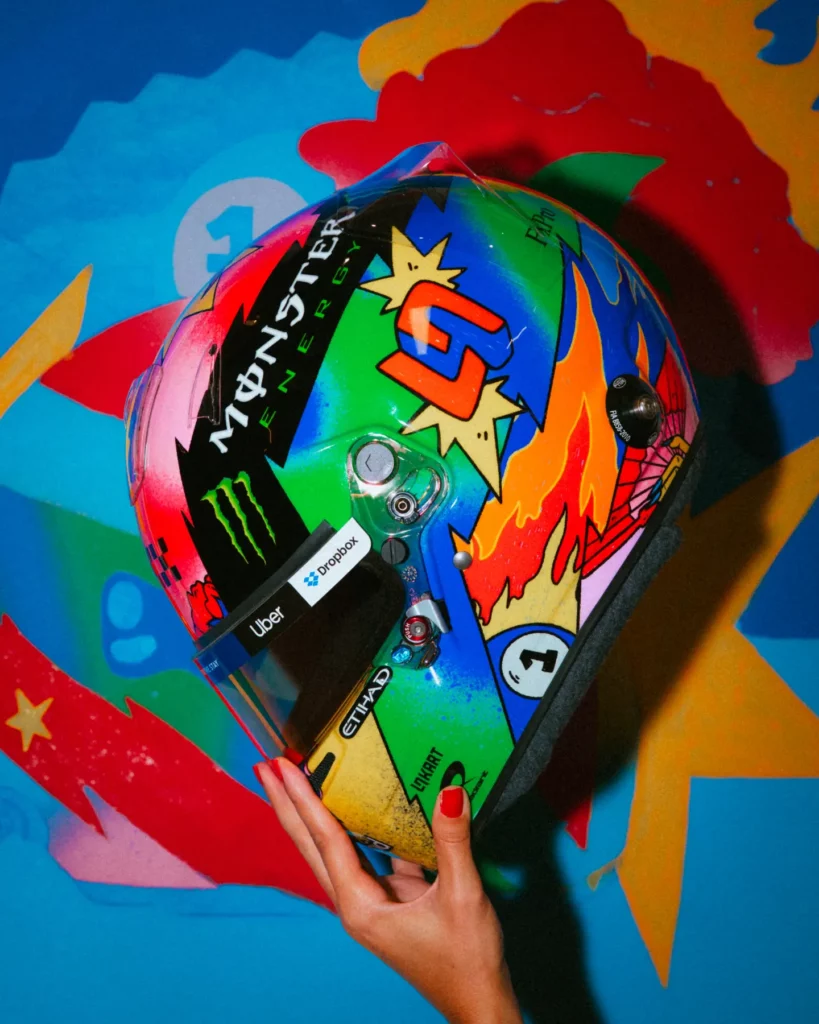
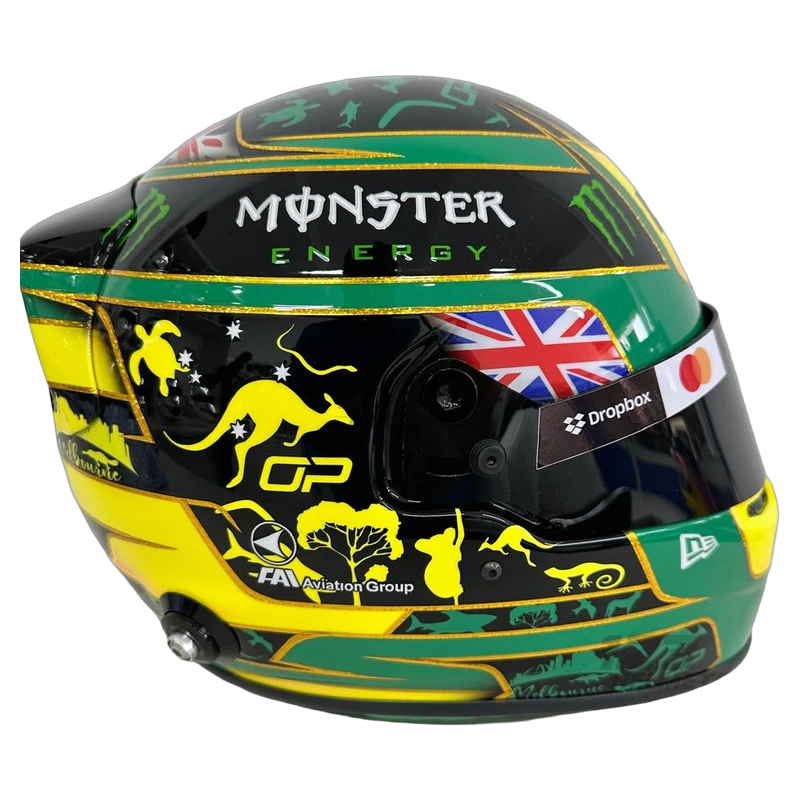
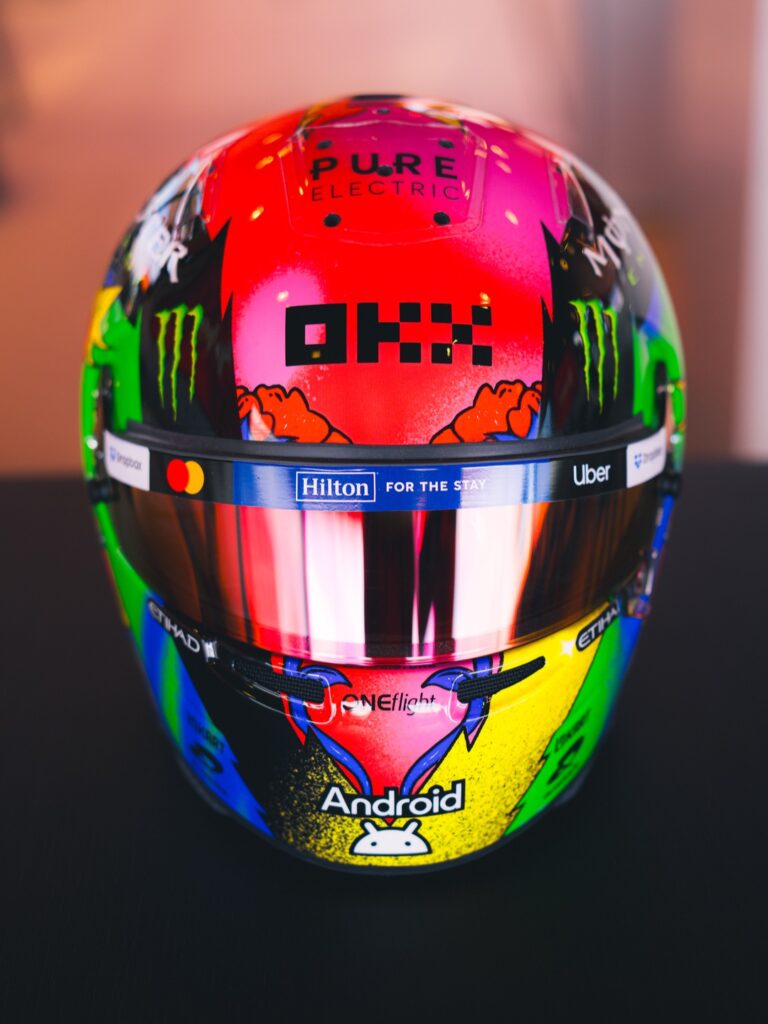
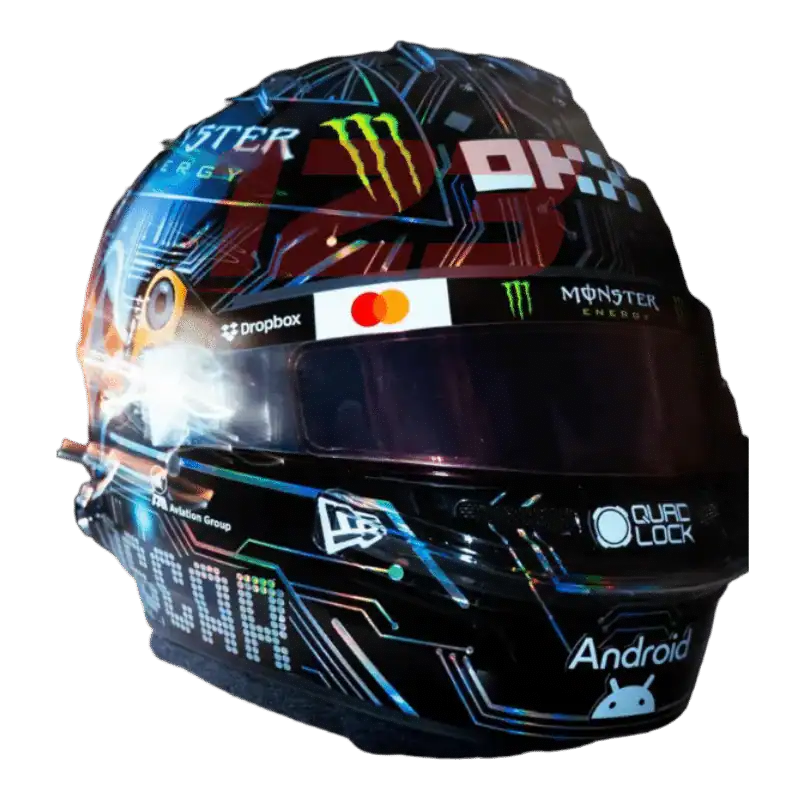
Piastri’s 2026 race helmet follows the established McLaren colour language: papaya orange as the primary ground, with black and white graphic elements that align with the MCL40’s livery blocking. The full-size 1:1 display replica of the helmet sits at 29 × 25 × 35 cm in standard road-display orientation, giving collectors a dimensionally accurate exhibition piece that matches the on-track visual without any functional certification requirement. These are display pieces and collector items only — not designed or certified for any protective use.
The Austria round is specifically worth noting for helmet display purposes because the Red Bull Ring’s compact 4.318 km lap means Piastri’s helmet is visible for longer per minute of broadcast time than at a power circuit like Monza. Slow corners, uphill runs and the spectator-facing infield section all expose the cockpit — and the helmet graphic — in ways that translate directly into the reference images collectors use when commissioning or selecting replicas.
Why the Friday wing test changes the livery story
Running the experimental wing on Norris’ car means Piastri’s MCL40 will carry the standard specification rear bodywork through qualifying and the race. For collectors focused on race-accurate display pieces, Piastri’s Austria race configuration will be the clean, unmodified MCL40 rear wing — not the experimental variant. That distinction is worth noting when selecting which weekend’s imagery best represents the car’s 2026 race specification.
What the Austria Test Means for the Rest of 2026
McLaren’s experimental rear wing evaluation at the 2026 Austrian Grand Prix is a data point in a longer development curve, not a one-weekend story. If Friday practice yields positive correlation between wind tunnel prediction and on-track measurement, the wing moves into the race-ready evaluation queue for a subsequent event. If it reveals unexpected behaviour — as Piastri’s comment about rival teams’ “challenges” implies is a real risk — the data still advances the design iteration before any race weekend is compromised.
For Piastri specifically, the development direction McLaren chooses over the next four to six rounds will define whether his 2026 season recovers the trajectory that made him World Champion in 2025. The rear-corner updates at Austria are the first visible step of that recovery arc.
Houldey’s framing — “season-long development pathway” — is the key phrase. McLaren has historically managed multi-round development cycles effectively, and the 2026 regulation shift to active aerodynamics gives every team a genuine opportunity to find performance through mechanical innovation rather than pure CFD iteration. The Austria Friday test is McLaren entering that phase.
From a collector and display perspective, the 2026 Austrian Grand Prix sits at a chapter break in Piastri’s season story. A strong result — particularly a podium — at the Red Bull Ring would mark the weekend as a defining visual reference point: the round where the MCL40 development direction clarified, Piastri’s season reset, and the papaya livery was back where it belongs at the front of the field.
“No, we won’t race it. I believe it’s on Lando’s car tomorrow. It’s to test out; it’s not ready to race at the moment. Obviously we’ve seen some of the creative solutions, and they don’t come without their challenges, clearly.”
— Oscar Piastri, 2026 Austrian Grand Prix Thursday press conference
“While the overall package is lighter than some of our recent updates, these developments are all part of our season-long development pathway, and we’re continuing to look for every lap time opportunity wherever we can.”
— Neil Houldey, McLaren Technical Director of Applied Engineering, 2026 Austrian GP preview
FAQ
Q: Will McLaren race the experimental rear wing at the 2026 Austrian Grand Prix?
No. Oscar Piastri confirmed at the Thursday press conference on 2026-06-25 that the experimental rear wing will not be raced at the Red Bull Ring — it is a Friday practice evaluation item only.
Q: Which McLaren driver is running the experimental rear wing in Austria?
Lando Norris’ car carries the experimental rear wing for Friday practice. Piastri confirmed this directly, meaning his own MCL40 runs the standard race-specification rear bodywork through qualifying and the race.
Q: What did McLaren’s technical director say about the Austria upgrade package?
Neil Houldey described the package as focused on minor detail updates around the MCL40’s rear corners plus the experimental rear wing for Friday running. He noted the overall package is lighter in scope than recent updates but forms part of McLaren’s season-long development pathway.
Q: How does McLaren’s wing test compare to Ferrari and Red Bull’s rotating rear wings?
Ferrari debuted their rotating ‘flip-flop’ rear wing in Bahrain pre-season testing and raced it at the 2026 Miami Grand Prix; Red Bull also ran a rotating design at Miami. McLaren’s Austria Friday test puts them one event behind those rivals in the evaluation timeline, and Piastri acknowledged the rival solutions have come with real challenges.
Q: What size is the full-size 1:1 Oscar Piastri display helmet replica?
The full-size 1:1 display replica measures 29 × 25 × 35 cm in standard road-display orientation. It is a collector and exhibition piece only — not certified or designed for any protective use.
Shop Oscar Piastri Collection
Display and collector replicas only. Not certified for protective use. Full-size 1:1 scale.
This article was written with the help of AI tools. Editorial policy