
Blog
Piastri ‘Mind-Blown’ by Gasly Monaco Reinstatement
 123Helmets Editorial Team
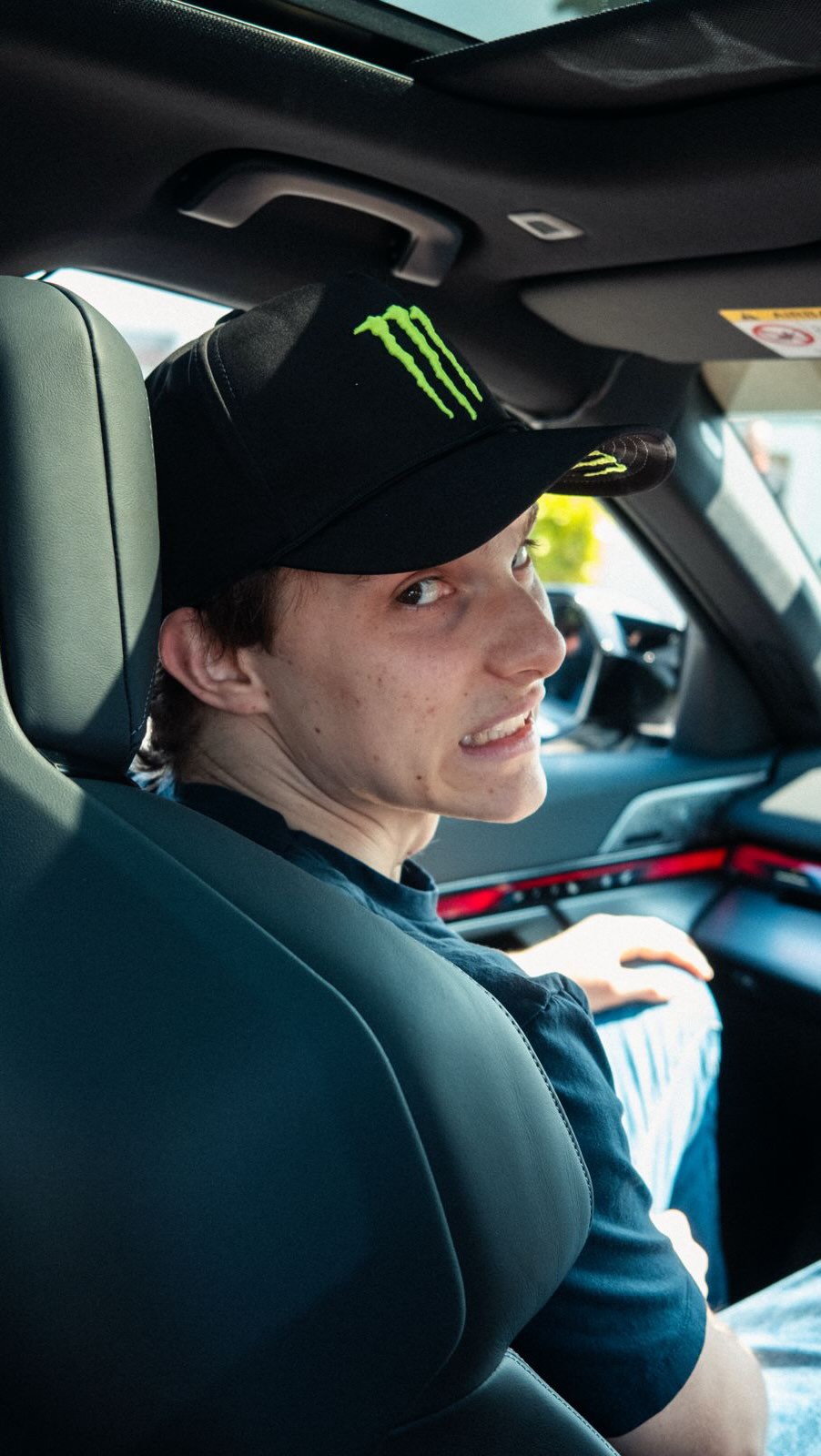
Oscar Piastri says he could not believe his eyes after FIA stewards reinstated Pierre Gasly to the Monaco Grand Prix podium four days after the race, pushing Piastri from fourth to fifth and reigniting one of the most contested post-race decisions of the 2026 season.
Key Takeaways
FIA stewards reinstated Gasly to third at Monaco four days after the race, citing a pitlane speed-measurement discrepancy confirmed by FOM data.
Piastri made an extra pitstop specifically to serve his five-second penalty during the race — a stop that handed Gasly the position in the first place.
At least five or six drivers served the same incorrect penalty during the race, yet only Gasly’s post-race penalty was reversed.
George Russell lost a potential podium and then received a drive-through for failing to serve a penalty that has since been deemed incorrectly issued.
The Decision That Flipped the Monaco Podium
FIA stewards reversed Pierre Gasly’s two five-second time penalties on the Friday after the 2026 Monaco Grand Prix, lifting him from seventh to third on the final classification. The reversal was based on evidence submitted by FOM — the body responsible for official F1 timekeeping — showing that a measurement discrepancy at the entry of Monaco’s distinctive pitlane had produced incorrect speed readings for Gasly and at least four other drivers.
Monaco’s pitlane configuration is unique on the calendar. Its entry geometry means the timing loop used to capture pitlane speed sits in a position that does not replicate the measurement conditions at other circuits. That geometric quirk produced readings that crossed the speed limit threshold when, according to FOM’s corrected data, the drivers were actually within the permitted limit at the point the penalty trigger fired.
The stewards accepted FOM’s revised data and cancelled Gasly’s penalties retroactively. The effect was immediate: Gasly moved from seventh to third, collecting his first podium of the 2026 season with Alpine. The drivers immediately behind him — including Oscar Piastri — each dropped one position, and the story that followed was not one of celebration.
Why Piastri Is ‘Mind-Blown’
Piastri’s reaction to the reinstatement cuts to the core of what makes the decision so contested: he served his penalty during the race, and that compliance is the direct reason he finished behind Gasly in the first place.
“I’m pretty mind-blown by the decision,” Piastri said. “When other people have been penalised for the same thing and served a penalty in the race, how you can then change one penalty, knowing that at least five or six other racers have been impacted by that, is astonishing. I’ve obviously lost the position, but I can only imagine how George is feeling. I could not believe my eyes.”
Piastri made an additional pitstop mid-race to absorb the five-second penalty. That stop dropped him behind Gasly. Had the penalty not been issued, or had it been cancelled before drivers were forced to react, Piastri would not have made the stop and would have stayed ahead. Instead, full compliance with the stewards’ instruction directly cost him a place — and the stewards then rewarded the driver who did not comply in the same way.
“I lost the position to Pierre because I served the penalty,” Piastri added. “Technically I should be P3, but then technically George should be P3. The whole thing is now a mess. It’s quite the predicament.”
That admission — “technically I should be P3” — underlines the structural problem the stewards’ decision created. The retroactive cancellation produced two distinct groups of affected drivers: those who served penalties during the race and accepted a sporting loss as a consequence, and one driver who did not fully serve his penalty and has now been rewarded with a podium four days later.
Russell’s Race Unravelled Further
George Russell’s Monaco afternoon deteriorated in a sequence that is now even harder to justify in light of Friday’s stewards’ decision. Russell pitted to serve his pitlane speeding penalty but then received a drive-through for failing to serve it correctly — a compound punishment that dropped the title contender entirely out of the points at a circuit where scoring is critical.
Piastri acknowledged that Russell’s situation was worse than his own. “I can only imagine how George is feeling,” Piastri said, a sentence that reflects the asymmetry at the centre of this controversy. Russell served a penalty in full — or attempted to — and was then punished further for the manner in which he served it. That the underlying penalty was based on incorrect data makes the drive-through look, in retrospect, like a double error stacked on top of the original mistake.
The situation left the 2026 Monaco Grand Prix final order shaped not by on-track performance alone but by which drivers happened to respond quickly to a penalty that should never have existed. Drivers who reacted fast and pitted to serve were punished twice: once by the time loss of the stop, and again on Friday when the results were adjusted in favour of a driver who had not yet served.
The Helmet and Livery Story Behind the Monaco Podium
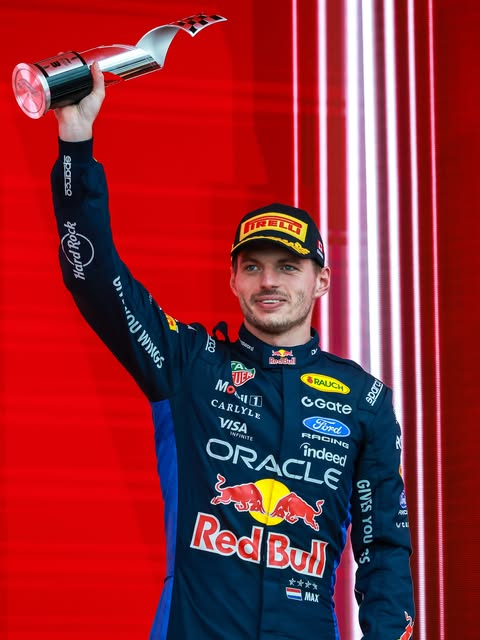
The Gasly podium moment — visually striking, whatever the circumstances — produced one of the sharper helmet and livery images of the 2026 Monaco weekend. Alpine’s 2026 livery, anchored in the team’s blue-and-pink palette, photographed prominently against the Monaco backdrop, and Gasly’s helmet design for the street circuit carried the same base tones.
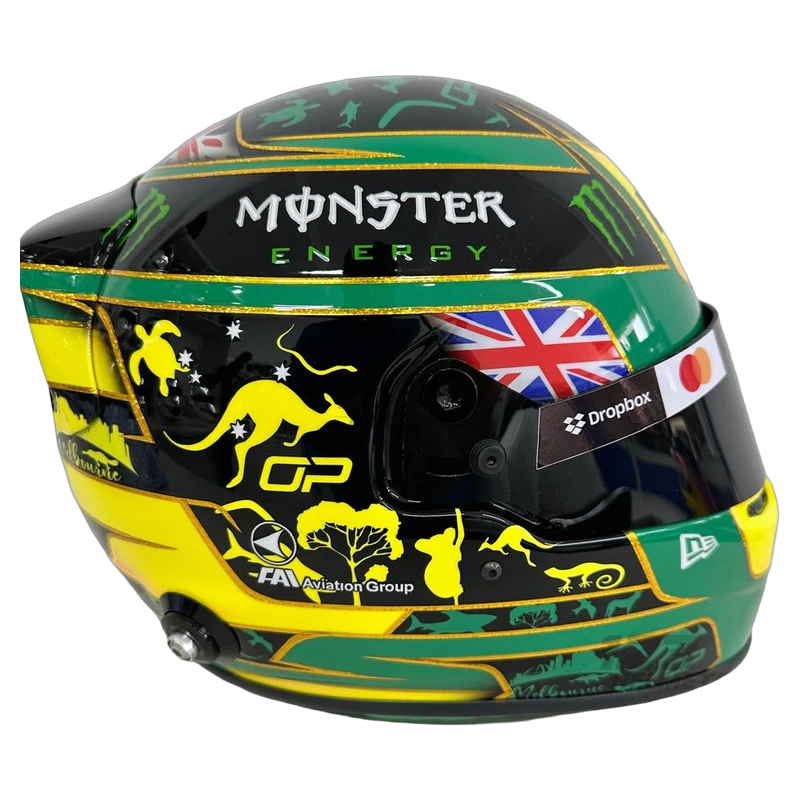
For collectors, the Monaco GP consistently produces the most display-worthy podium imagery of the season. The confined circuit, the historic setting, and the compressed podium presentation area generate photographs where helmet graphics read clearly even in still form. A full-size 1:1 replica of either Gasly’s or Piastri’s Monaco 2026 lid captures a race that will be discussed in F1 regulatory circles for years — a podium decided not on track but in a stewards’ room four days after the chequered flag.
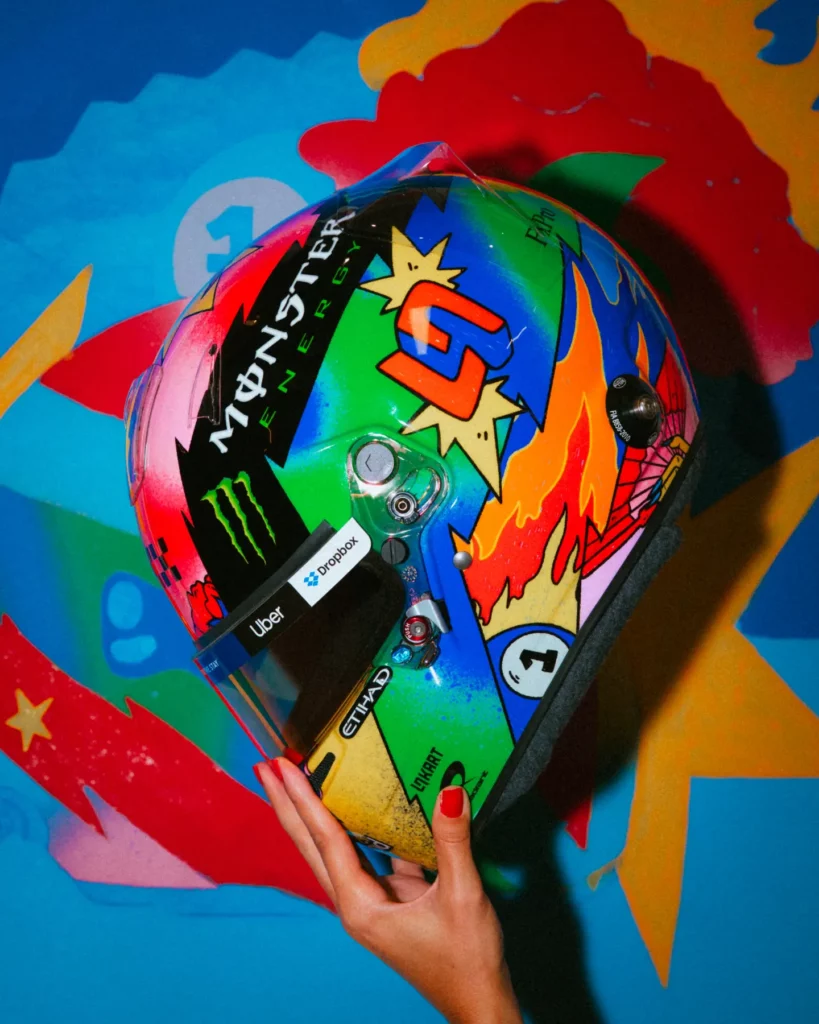
Piastri’s own helmet for Monaco 2026 appeared in a finish position that does not reflect where his race pace had placed him. He crossed the line fourth and was reclassified fifth. A display replica of his 2026 lid commemorates what is, by any straightforward reading of the on-track events, a race in which he drove to a podium and left without one. That backstory adds weight to the piece as a collector item — full-size 1:1 exhibition quality, 29 × 25 × 35 cm display footprint, not certified for any protective use.
Livery Details Worth Noting
Alpine’s Monaco 2026 livery carried no circuit-specific modifications visible on the helmet shell, keeping the design consistent with the season-opening livery first shown before the 2026 Bahrain Grand Prix. The continuity makes the Monaco helmet directly readable as a 2026 season piece without requiring circuit-specific identification, which suits a standing display context well.
What the Ruling Means for the 2026 Season
The Monaco reinstatement matters beyond this single race because it demonstrates that post-race reclassifications can, in certain circumstances, arrive days after a result and affect drivers who made active sporting decisions based on the original penalty information. That precedent will be debated in the paddock through the remainder of the 2026 season.
For Piastri, who is chasing points in what is already a closely contested 2026 campaign, the difference between fourth and fifth at Monaco is not trivial. Constructors’ points implications extend to Alpine as well — Gasly’s third place returns points that were briefly allocated elsewhere, and those points shift the team standings in a calendar that still has multiple races to run before the summer break.
The FIA has not publicly addressed the broader question of what remedy, if any, exists for drivers who served incorrect penalties during the race. Piastri’s framing of the situation as “quite the predicament” is accurate in formal regulatory terms: there is no straightforward mechanism to restore the race positions that Piastri, Russell, and others lost through their compliance with a penalty subsequently found to be based on faulty data.
The 2026 Monaco Grand Prix ended on Sunday, 2026-06-15. The stewards’ reinstatement decision was issued on Friday, 2026-06-20 — five days after the race concluded. In that five-day window, three different drivers briefly held the third-place result on paper. The final order, as it stands, reflects neither what happened on track in real time nor an outcome any driver could have predicted when the chequered flag fell.
Collecting the 2026 Monaco Story
A full-size 1:1 replica helmet from the 2026 Monaco GP represents one of the more layered collector items from this season — not simply because Monaco is historically the most prestigious street circuit, but because the 2026 edition produced a result that changed shape four days after it happened.
Display replicas in this format are exhibition-quality collector pieces, not certified for protective use of any kind. They are built to show, not wear — a physical record of a specific design at a specific race. When that race happens to sit at the centre of a season-defining regulatory debate, the helmet gains context beyond its visual design.
The Piastri 2026 Monaco lid, in particular, tells a story that a finishing position alone does not. Fifth on the official sheet; third by his own account of the race’s logic; part of a broader controversy involving six or more drivers, two distinct penalty sequences, and a five-day deliberation that reshaped the podium entirely. That is the kind of backstory a standing display replica can carry into a collection, and it is exactly the type of moment the 2026 season has already proved capable of producing.
“I’m pretty mind-blown by the decision. When other people have been penalised for the same thing and served a penalty in the race, how you can then change one penalty, knowing that at least five or six other racers have been impacted by that, is astonishing. I could not believe my eyes.”
— Oscar Piastri, 2026 Monaco Grand Prix post-decision press conference
“I lost the position to Pierre because I served the penalty. Technically I should be P3, but then technically George should be P3. The whole thing is now a mess. It’s quite the predicament.”
— Oscar Piastri, 2026 Monaco Grand Prix post-decision press conference
FAQ
Q: Why was Pierre Gasly reinstated to the Monaco 2026 podium?
Gasly was reinstated because FOM’s timekeeping data showed that the pitlane speed measurements at Monaco’s unique pitlane entry were incorrectly recorded, making his two five-second penalties invalid. FIA stewards accepted the revised data on 2026-06-20 and cancelled both penalties, moving him from seventh to third.
Q: How did the reinstatement affect Oscar Piastri’s race result?
Piastri dropped from fourth to fifth when Gasly was reinstated to third. Piastri had made an extra pitstop during the race specifically to serve his five-second penalty, which is what put him behind Gasly in the first place — making the post-race reclassification directly costly.
Q: How many drivers were incorrectly penalised at the 2026 Monaco Grand Prix?
At least five drivers received incorrect pitlane speeding penalties at the 2026 Monaco Grand Prix, according to the stewards’ reinstatement decision. Piastri referenced ‘five or six’ affected drivers in his own comments after the ruling was issued.
Q: What happened to George Russell at Monaco 2026?
Russell pitted to serve his pitlane speeding penalty but then received a drive-through for failing to serve it correctly. That compound punishment dropped him out of the points entirely at a race where scoring is particularly significant for championship standings.
Q: Are the Monaco 2026 helmet replicas certified for use on track?
No. All Monaco 2026 helmet replicas at 123Helmets.com are full-size 1:1 display and collector replicas only. They carry no FIA, Snell, ECE, or DOT certification and are not intended for protective use of any kind — they are exhibition-quality collector pieces for display purposes.
Shop Oscar Piastri Collection
Display and collector replicas only. Not certified for protective use. Full-size 1:1 scale.
This article was written with the help of AI tools. Editorial policy