Blog
Piastri P4 Austria 2026: Beating Ferrari
 123Helmets Editorial Team
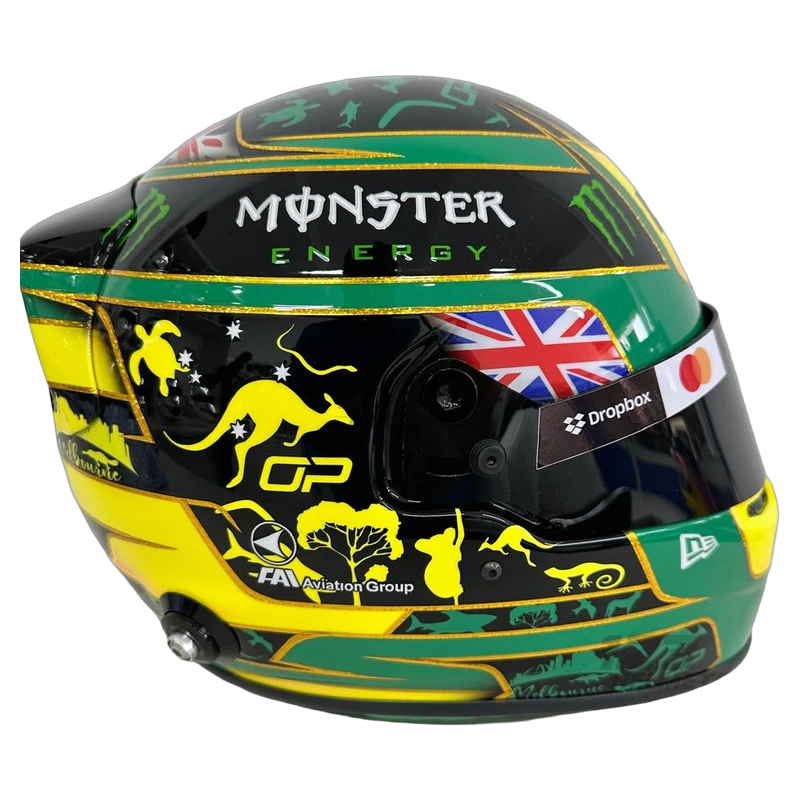
Oscar Piastri called it ‘a bit of a surprise’ after climbing from seventh on the grid to fourth at the 2026 Austrian Grand Prix, beating both Ferraris in a race that underlined McLaren’s heat-weather strength — and the gaps that still remain to Mercedes and Red Bull.
Key Takeaways
Piastri started seventh on the grid at the Red Bull Ring and finished fourth, passing both Lewis Hamilton and Charles Leclerc before the chequered flag.
Both Ferraris adopted a three-stop strategy and appeared to struggle for pace in the Austrian heat, which Piastri noted has historically suited McLaren.
Lando Norris, who started P6 alongside Piastri in P7, was compromised by a difficult opening lap and finished seventh — highlighting how much a clean start matters at the Red Bull Ring.
Piastri acknowledged McLaren still has significant ground to close on Mercedes and a resurgent Red Bull, making the 2026 midfield order genuinely unpredictable race to race.
From the Back of the Top Ten to Fourth
Oscar Piastri started the 2026 Austrian Grand Prix from seventh on the grid and finished fourth — a net gain of three positions that came at the direct expense of both Ferrari cars. The McLaren driver described the afternoon as ‘a really strong afternoon’, qualifying that remark with the honest admission that he did not fully expect the Scuderia to fade the way they did. After Saturday’s session had placed Charles Leclerc and Lewis Hamilton in P2 and P3 — one and two rows clear of the papaya pair in P6 and P7 — a result ahead of both red cars looked unlikely on paper.
What changed on Sunday was a combination of tyre management, strategy execution, and the sweltering conditions at the Red Bull Ring, an Austrian circuit that sits at roughly 700 metres above sea level and regularly produces some of the highest ambient temperatures on the calendar. Piastri converted those conditions into a composed drive that moved him through the field while Hamilton and Leclerc each went onto a three-stop strategy that ultimately cost them track position.
For display collectors, the 2026 Austrian Grand Prix weekend is already a standout moment in Piastri’s season — a P4 finish under the Styrian sun, captured in the papaya and black of the current McLaren MCL40 livery, makes it a natural reference point for a full-size 1:1 replica helmet from this race.
Why Ferrari’s Pace Faded in the Austrian Heat
Ferrari’s pace faded at the 2026 Austrian Grand Prix partly because the high-temperature conditions at the Red Bull Ring appeared to work against the SF-26’s tyre characteristics, pushing both Leclerc and Hamilton onto energy-sapping three-stop strategies. Piastri himself pointed to the pattern: ‘When it’s this hot, that seems to be beneficial for us at the moment. It has been in the past few years, and I think this year it’s still a bit of a trend.’
That is a meaningful observation from a driver who is careful with his words post-race. He is not claiming McLaren solved a fundamental performance deficit — quite the opposite. He noted plainly that the team is ‘lacking the performance to go with it’, meaning the heat benefit alone is not enough to make McLaren consistent frontrunners across the full calendar. The Austrian circuit’s shorter lap length, which typically produces lap times in the low 1:05 range in race trim, also amplifies small tyre-delta differences between cars.
For Charles Leclerc and Lewis Hamilton, the three-stop calls may have been reactive rather than planned — a sign that Ferrari’s race engineers were managing a car that was not performing as expected after qualifying in P2 and P3. Each additional stop costs approximately 22–24 seconds in stationary time at the Red Bull Ring’s pit lane speed limit, a deficit that requires a substantial pace advantage to recover, which Ferrari evidently did not have on Sunday.
Piastri’s Helmet and Livery at the Red Bull Ring
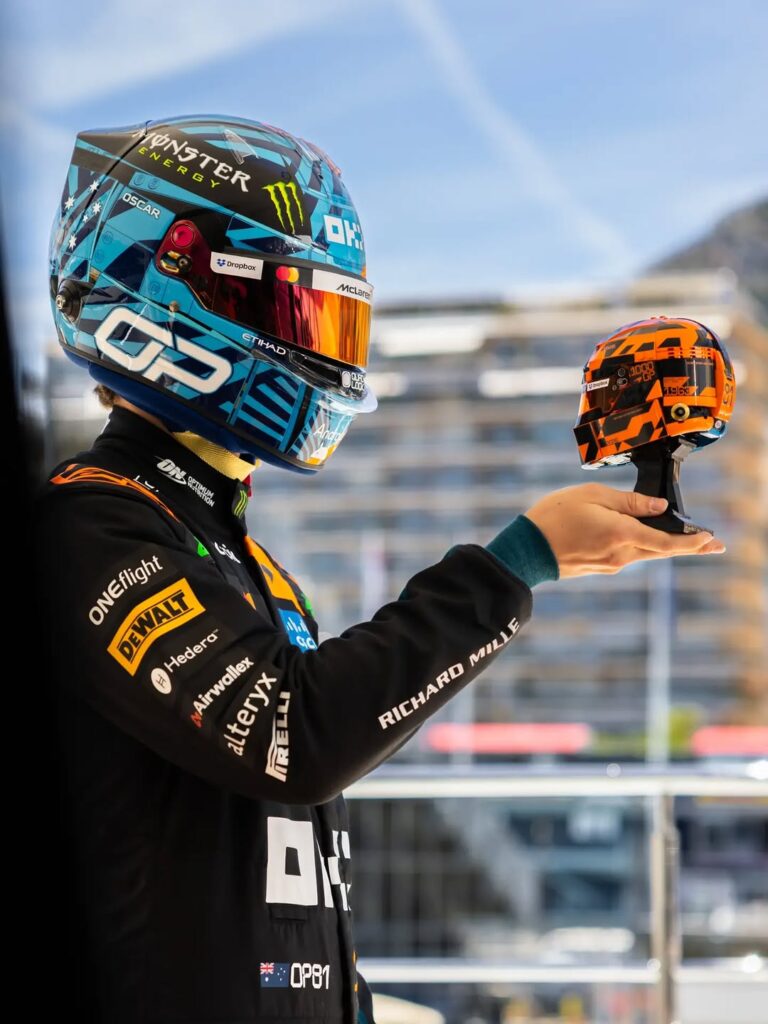
Oscar Piastri wore his standard 2026 McLaren-spec race helmet at the Austrian Grand Prix, finished in the team’s papaya-orange and black colourway with his personal graphic identity — a design that has become one of the more photographed lids on the current grid. The helmet’s colour relationship with the MCL40’s bodywork creates a visually cohesive package that photographs particularly well at the Red Bull Ring, where the green Styrian hillside provides a natural contrast backdrop.
For a full-size 1:1 collector replica, the 2026 Austrian specification is notable for several reasons. The papaya base shell measures 29 × 25 × 35 cm in standard medium sizing — the scale most commonly used for display replicas — and at approximately 1.2–1.5 kg it sits comfortably on a stand without requiring additional ballast. The exterior features a multi-layer paint process that replicates the depth of the original shell’s finish, with the visor moulded to a 26 mm depth to match the profile of the race-worn version.
The podium visuals from Austria — Piastri’s helmet catching the afternoon light as he climbed out of the MCL40 in parc fermé — are the kind of moment that defines a collector piece. A display replica at 1:1 scale captures that exact aesthetic: the papaya orange against the dark visor, the sponsor decals in their correct positions, the McLaren wordmark above the brow. This is strictly a display and collector item, not certified for any protective use.
The Gap to Mercedes and Red Bull in 2026
McLaren’s 2026 championship position remains under pressure from both Mercedes and a resurgent Red Bull, a situation Piastri described with characteristic directness after the Austrian race. His exact words: ‘We’ve still got a lot to find to catch Mercedes, and now Red Bull look very quick as well, so it’s going to be a constantly changing order, I think.’ That is not a driver offering false modesty — it is a clear-eyed read of the 2026 grid hierarchy as it stood at the Red Bull Ring on 2026-06-28.
The Barcelona Grand Prix, which preceded Austria on the calendar, had been a ‘big struggle’ in Piastri’s words, and he acknowledged the team had ‘some things to learn and improve on from there’. The fact that Austria felt like ‘a massive improvement’ is encouraging for McLaren, but Piastri’s own caveat — that it is ‘very difficult to know’ whether the Red Bull Ring performance was track-specific — keeps the optimism measured.
For Oscar Piastri, the 2026 season is shaping up as a constant calibration exercise: extracting maximum value from circuits that suit the MCL40, while minimising the losses at circuits that do not. Austria was a day that went in the right column. The question for the races that follow is whether the team can replicate that without relying on a 35-degree afternoon in Styria.
Norris’s Compromised Race and What It Means for McLaren
Lando Norris finished seventh at the 2026 Austrian Grand Prix after a difficult opening lap compromised his race from the outset, a result that sat in sharp contrast to Piastri’s P4 and illustrated how marginal the difference between a strong and a difficult Sunday can be at the Red Bull Ring. Norris had qualified in P6, one place ahead of Piastri in P7, yet it was the Australian who emerged ahead at the chequered flag — a reversal driven entirely by what happened in the opening corners.
The contrast between the two McLaren results is instructive for understanding the team’s current competitive situation. Piastri’s P4, achieved from P7 on the grid, required a clean start and consistent tyre management over the course of the full race distance. Norris’s P7, from P6 on the grid, showed what happens when that clean start does not materialise. The two data points together suggest the MCL40 has the potential to run fourth or fifth in race trim at the Red Bull Ring, but that the margin for error at the start is extremely tight.
For collectors tracking Piastri’s 2026 season arc, the Austrian Grand Prix is a high point — a race where the driver extracted everything available from the car and the conditions, finished ahead of both works Ferraris, and did so from a grid position that made the result genuinely surprising. That is the kind of moment a 1:1 scale display replica is built to commemorate: the race, the result, the helmet, the livery, frozen in exhibition quality for display.
Collecting the 2026 Austrian GP — Display Value
The 2026 Austrian Grand Prix represents one of the cleaner display-worthy moments in Oscar Piastri’s season to date — a result that beat expectation, came at Ferrari’s expense, and was delivered in McLaren’s current papaya livery under ideal photographic conditions. Full-size 1:1 collector replicas of the Piastri 2026 race helmet capture the exact specification worn at the Red Bull Ring: the papaya and black shell, the personal graphic layout above the visor, and the McLaren orange trim on the chin piece.
These are display pieces and collector items only. They carry no FIA, Snell, ECE, or DOT certification and are not designed or intended for road, race, or track use of any kind. At 1:1 scale with a standard medium shell of 29 × 25 × 35 cm, they are built for shelves, cabinets, and exhibition stands — not for wearing. The display value comes from the combination of exhibition-quality finish, accurate decal placement, and the story behind the race: Piastri, P7 to P4, past both Ferraris, in the Austrian heat of 2026.
“A bit, yeah. I think today was a really strong afternoon. I think it was a bit of a surprise that the Ferraris were not stronger, but on a personal level I thought it was a really good race.”
— Oscar Piastri, post-race, 2026 Austrian Grand Prix
“We’ve still got a lot to find to catch Mercedes, and now Red Bull look very quick as well, so it’s going to be a constantly changing order, I think.”
— Oscar Piastri, post-race, 2026 Austrian Grand Prix
FAQ
Q: Where did Oscar Piastri finish at the 2026 Austrian Grand Prix?
Piastri finished fourth at the 2026 Austrian Grand Prix, having started from seventh on the grid. He passed both Ferrari drivers — Lewis Hamilton and Charles Leclerc — during the race.
Q: Why did Ferrari struggle in the 2026 Austrian GP?
Ferrari struggled in the 2026 Austrian GP because the high-temperature conditions at the Red Bull Ring appeared to work against their tyre performance, forcing both Leclerc and Hamilton onto three-stop strategies. Piastri noted that hot races have historically suited McLaren more than Ferrari.
Q: What does the Oscar Piastri 2026 race helmet look like?
The 2026 Piastri race helmet features a papaya-orange and black shell in McLaren’s current team colourway, with his personal graphic identity above the visor and the McLaren wordmark on the brow. The 1:1 display replica measures 29 × 25 × 35 cm and weighs approximately 1.2–1.5 kg.
Q: Is the Piastri 2026 Austrian GP helmet replica wearable?
No — the 1:1 scale Piastri helmet replica is strictly a display and collector item. It carries no FIA, Snell, ECE, or DOT certification and is not intended for road, race, or any protective use. It is designed for exhibition display only.
Q: How did Lando Norris perform at the 2026 Austrian Grand Prix?
Lando Norris finished seventh at the 2026 Austrian Grand Prix after a difficult opening lap compromised his race. He had qualified in P6, one place ahead of Piastri, but the first-lap incident prevented him from matching his teammate’s P4 result.
Shop Oscar Piastri Collection
Display and collector replicas only. Not certified for protective use. Full-size 1:1 scale.
This article was written with the help of AI tools. Editorial policy