Blog
Red Bull Tops ADUO Benchmark: Engine Power Map Reshapes the 2026 Grid
 123Helmets Editorial Team
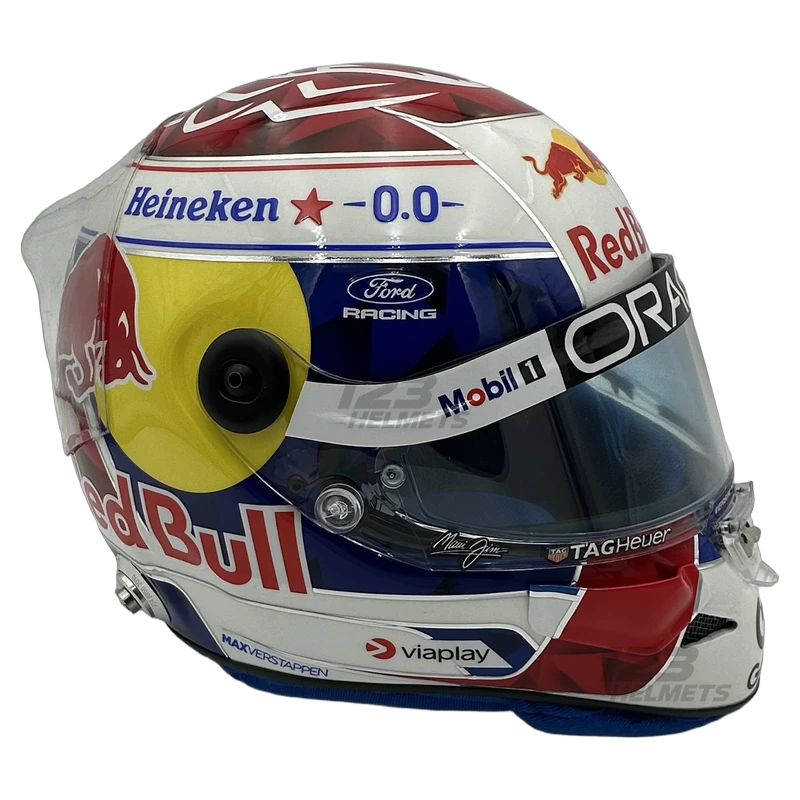
During the Monaco Grand Prix weekend, the FIA quietly informed teams of the first ADUO outcome — Formula 1’s catch-up mechanism for power unit manufacturers. Red Bull Ford Powertrains emerged as the benchmark, prompting a formal review request that has delayed the public announcement by more than two weeks beyond the Canadian Grand Prix deadline. For collectors tracking the visual heritage of this title fight, the helmet and livery stories from the Monaco paddock are already shaping the next wave of display-quality 1:1 replicas.
Key Takeaways
Red Bull Ford Powertrains is the benchmark engine in the first ADUO period announced during the Monaco GP weekend
Mercedes trails by 2-4% on ICE power, earning 1 upgrade in 2026 and 1 more in 2027
Ferrari, Audi and Honda sit more than 4% behind, granting them 2 upgrades this season and 2 more next year
The FIA review began on Monday and is expected to take 7 to 10 days before official publication
Monaco weekend: the paddock learns the ADUO verdict
The 2026 Monaco Grand Prix weekend was billed as a street-circuit spectacle, but the most consequential conversation happened behind closed doors. All four power unit manufacturers were informed of the first ADUO period results — the Additional Upgrade and Development Opportunities framework written into the 2026 regulations to prevent a runaway engine champion from dominating the entire rule cycle.
The headline: Red Bull Ford Powertrains, in its debut season as a fully independent manufacturer, set the benchmark on internal combustion engine output. For a project that only became a standalone power unit operation a few seasons ago, topping the ICE table at the first measurement window is a result that will define the visual identity of the 2026 campaign — and the helmets, race suits and livery details that come with it.
The paddock atmosphere was unusual. Engineers carried the data in their heads; team principals refused to confirm it on camera. Yet within 48 hours of the chequered flag in Monaco, the figures were an open secret across the pit lane.
How the 2-4% and 4%+ thresholds reshape the grid
The ADUO framework uses two clear bands. Manufacturers trailing the benchmark by between 2% and 4% on ICE power receive 1 additional upgrade slot for the current 2026 season and 1 more for 2027. Manufacturers more than 4% behind receive 2 upgrades this year and 2 more next year.
Mercedes lands in the 2-4% band. Ferrari, Audi and Honda all fall into the more-than-4% category. That places three of the four chasing manufacturers in the maximum catch-up bracket — a scenario the regulators did not consider the most likely outcome when the framework was drafted.
What the numbers mean in practice
For Red Bull, the benchmark status is a double-edged sword. There is no penalty for being on top — but no upgrade tokens either. Every rival receives at least one development window, and three of them receive two. By the start of 2027, the chasing pack will have used between 2 and 4 separate ADUO interventions while Red Bull stays on its homologated specification.
The numerical summary
- Red Bull Ford Powertrains: benchmark, 0 ADUO upgrades
- Mercedes: 2-4% deficit, 1 + 1 upgrades
- Ferrari, Audi, Honda: more than 4% deficit, 2 + 2 upgrades
Why Red Bull asked the FIA for an additional review
The FIA had publicly committed to releasing the ADUO results no later than two weeks after the Canadian Grand Prix. That deadline has passed without an official statement. The reason is procedural: one manufacturer — understood to be Red Bull — asked for an additional verification.
The check is not a protest. Red Bull cannot formally protest the ADUO outcome under the current regulations. The review is a factual audit: the FIA is re-verifying that every sensor on every dyno run functioned correctly and that the analysed data is accurate. The process began on Monday and is expected to last between 7 and 10 days.
The deeper problem with ADUO
Even once the numbers are confirmed, a structural issue remains. Only the internal combustion engine is measured for the benchmark calculation. But once a manufacturer qualifies for an ADUO window, it is also permitted to modify electrical components — including the battery and the MGU-K.
Under the 2026 power unit regulations, the electrical side accounts for roughly half of total output. A manufacturer that qualifies on an ICE-only deficit can therefore upgrade hardware that was never part of the measurement. That mismatch is what Red Bull’s engineers are pointing to in private — and what makes the next 7-10 days of review so politically charged.
Monaco helmet and livery moments worth displaying
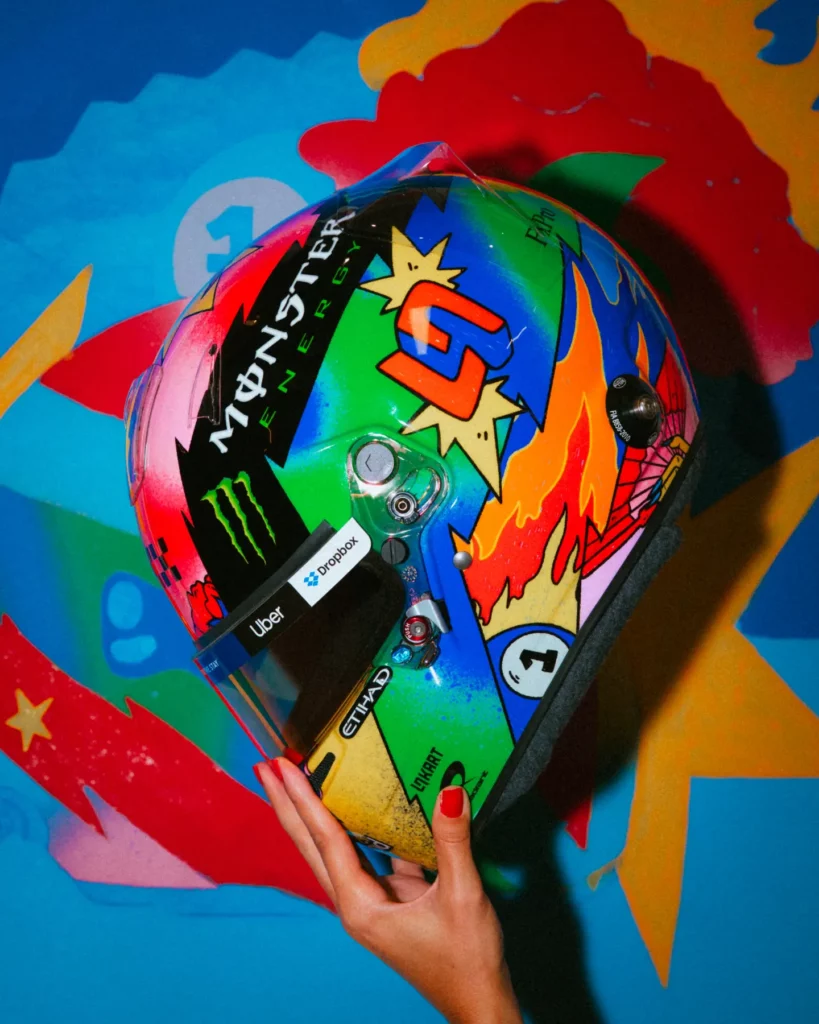
While the engine politics played out in the motorhomes, the on-track product gave collectors a fresh set of visual references. Monaco remains the most photographed weekend on the calendar, and the 2026 grid delivered designs that translate directly into full-size 1:1 collector replicas.
Red Bull’s Monaco specification
Max Verstappen ran a one-off blue and matte-gold Monaco helmet finish, a continuation of his tradition of producing a unique design for the principality. The crown graphic wrapped from the top centre down toward the rear, with sponsor logos rearranged to give the matte panels more visual weight under the harbour lights. For a display piece, the contrast between the gloss base and matte crown is the detail that defines the build quality of an exhibition-grade replica.
Yuki Tsunoda’s lid carried a refined version of his samurai-inspired graphic — the kanji along the chin bar slightly enlarged compared to the early-season specification, making the helmet read more clearly on a shelf at standard 29 × 25 × 35 cm display height.
The chasing pack’s visual identity
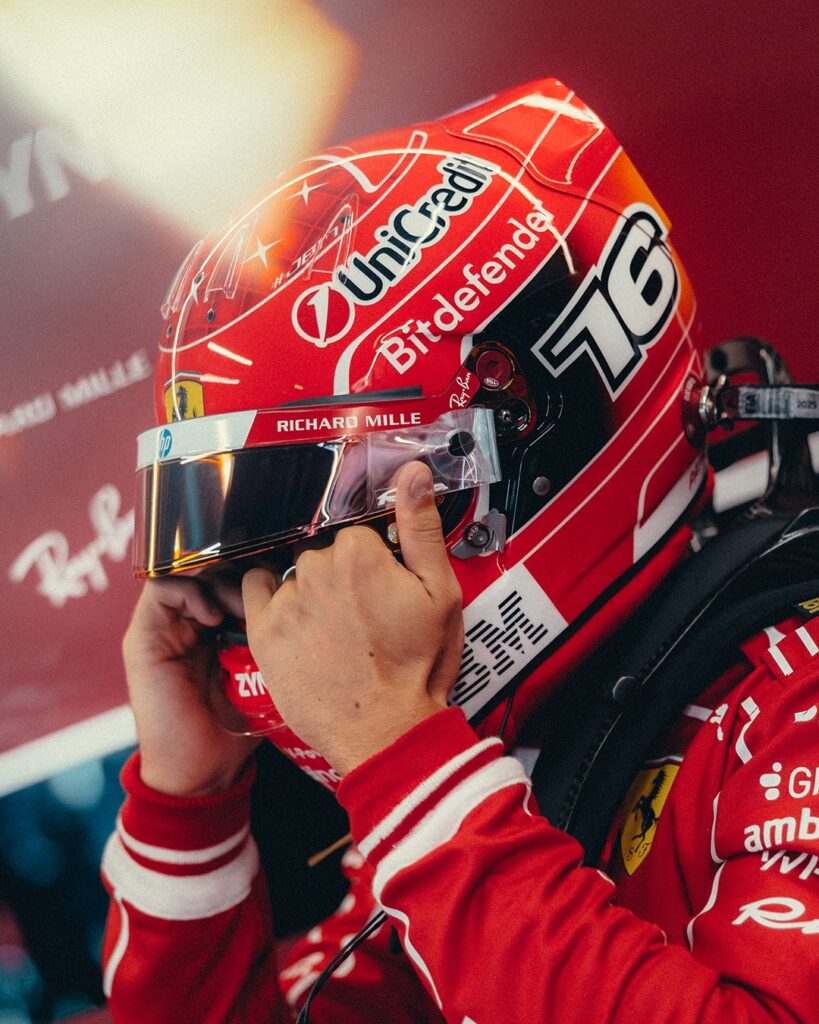
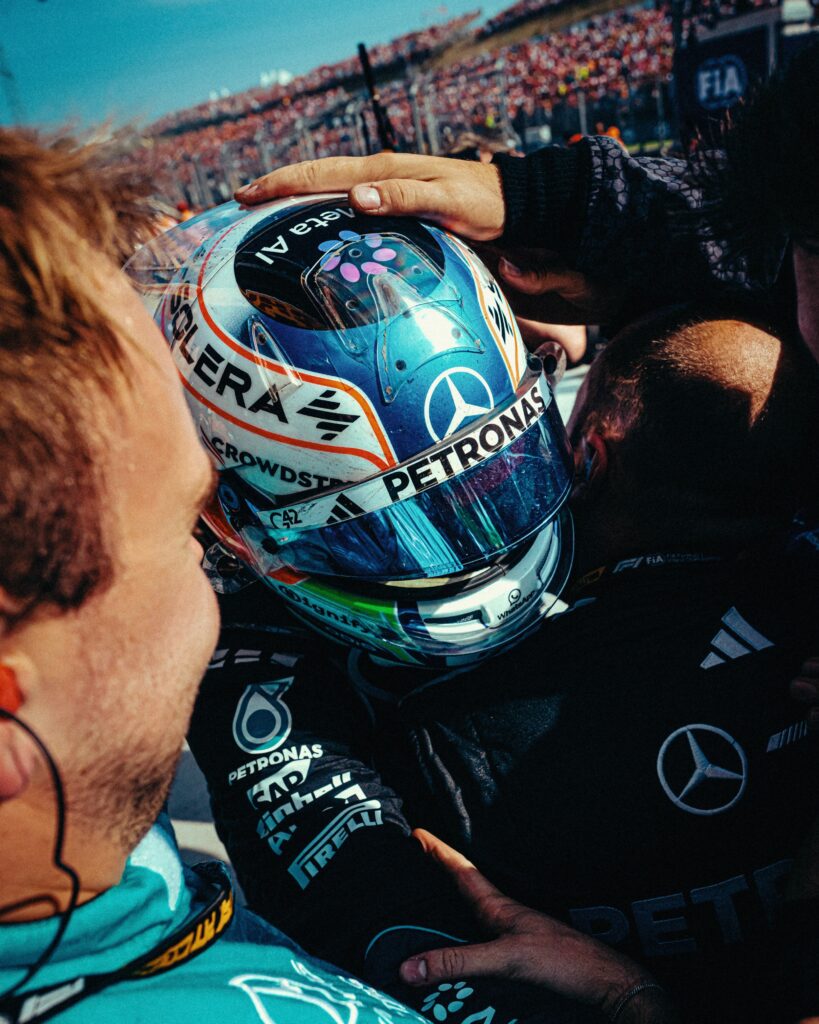
Ferrari ran its traditional yellow accents on both cars, with Charles Leclerc’s helmet adding a discreet Monégasque red-and-white band around the lower edge. Mercedes kept its black base livery on the W17, while George Russell switched to a chrome-finish top section that catches light beautifully under display LEDs — a detail that matters when a collector positions the helmet on a rotating stand.
For Honda-powered cars and the new Audi project, Monaco was the first weekend where the full corporate livery specification was visible in race trim. Audi’s silver-and-red base, combined with the engineering-grade matte black around the cockpit surround, is already being studied by replica makers planning 2026 reference pieces.
What collectors should watch for next
The ADUO verdict shapes more than the championship. It shapes the narrative that future replica buyers will associate with each helmet from this season. A 2026 Red Bull display piece will, in retrospect, be a marker of the benchmark year. A Ferrari, Audi or Honda helmet from the same window will be tied to the maximum-catch-up storyline.
Reference points for exhibition-quality builds
Full-size 1:1 collector replicas of 2026 helmets are typically produced to the standard reference dimensions used across the display market — around 29 × 25 × 35 cm overall envelope, finished weight in the 1.2–1.5 kg range depending on shell construction, and visor thickness in the 3 mm category for show pieces. These are exhibition specifications, not protective ones. The point is visual fidelity: the same paint layering sequence as the real helmet, the same logo placement to within a millimetre, and the same finish hierarchy between gloss base and matte accents.
The next measurement window
The ADUO framework includes a second measurement period later in the season. If Red Bull’s review confirms the current data, the chasing manufacturers will deploy their first upgrade slot before that window closes. The visual record of which races run which engine specification will become a reference point for any serious collector cataloguing the 2026 season — and a reason to lock in display pieces tied to specific Grand Prix weekends before the narrative crystallises.
“The benchmark status confirms what the dyno data has shown for months, but the framework around it needs a closer look before anyone celebrates.”
— Paddock engineering source, Monaco GP weekend
FAQ
Q: What does ADUO stand for in the 2026 F1 regulations?
ADUO is the Additional Upgrade and Development Opportunities mechanism — a catch-up framework that allows power unit manufacturers trailing the benchmark to introduce extra upgrades during the regulation cycle.
Q: Why did Red Bull request an FIA review if it is the benchmark?
Red Bull cannot protest the ADUO outcome, but it asked for a factual verification that all sensors and analysed data were correct. The FIA began the review on a Monday and it is expected to take 7 to 10 days.
Q: How big is the gap between Red Bull and the rest on ICE power?
Mercedes trails by 2-4%. Ferrari, Audi and Honda are all more than 4% behind on internal combustion engine output, according to the first ADUO period results.
Q: Are the 2026 Red Bull and Ferrari helmets available as collector replicas?
Yes. Full-size 1:1 display replicas of current-season helmets are produced as exhibition pieces only. They are collector items for display and not certified for any protective use.
Q: What dimensions are typical for a 1:1 F1 display helmet?
Standard exhibition-grade replicas use a roughly 29 × 25 × 35 cm envelope, finished weight around 1.2–1.5 kg, and a 3 mm visor — built purely for visual fidelity on a display stand.
Browse F1 Helmet Collection
Display and collector replicas only. Not certified for protective use. Full-size 1:1 scale.
This article was written with the help of AI tools. Editorial policy