
Blog
Monaco Pit Lane Error: Inside Russell’s Costly Penalty and the Mercedes Strategy Breakdown
 123Helmets Editorial Team
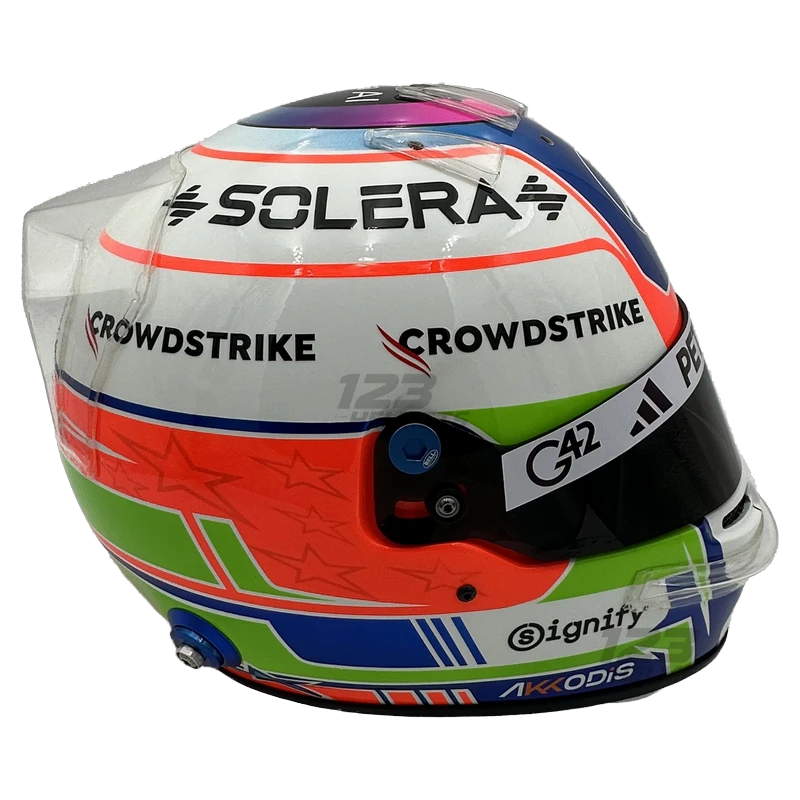
Monaco rarely forgives a single error, and on race day George Russell paid the full price. A five-second pit lane speeding penalty turned into a point-less afternoon when Mercedes failed to relay one critical message during a Safety Car window. Andrew Shovlin’s post-race explanation reveals how a lapped car, a leading team mate, and a Safety Car routed through the pits combined to undo the W16’s weekend — and why the silver-and-petronas-green livery on Russell’s helmet display will be remembered for what didn’t happen on the timing screen.
Key Takeaways
Russell received a 5-second penalty for exceeding the pit lane speed limit on his first stop.
Mercedes failed to relay the ‘stay in fast lane’ message during the Safety Car period, voiding the served penalty.
Andrea Kimi Antonelli leading the race added strategic complication, lapping Russell shortly before the Safety Car.
The Monaco silver-and-green Mercedes livery makes Russell’s W16 helmet a defining 2025 display piece for collectors.
How a 5-Second Penalty Became a Point-Less Sunday
The Monaco Grand Prix is the shortest lap on the calendar at 3.337 km, and the pit lane is among the tightest in Formula 1. That combination turned a single procedural slip into a race-defining error for George Russell. On his first stop, Russell exceeded the 80 km/h pit lane speed limit and was handed a 5-second time penalty — a manageable cost on a normal Sunday, but on Monaco’s narrow ribbon every second compounds.
The plan was straightforward: serve the 5 seconds at the next stop, change tyres, rejoin. What unravelled it was the Safety Car deployment that coincided with team mate Andrea Kimi Antonelli leading the race and having just lapped Russell. Mercedes’ trackside engineering team was running parallel calculations on two cars in opposite strategic positions — one defending a lead, one trying to salvage a points finish.
Head of trackside engineering Andrew Shovlin laid out the sequence clearly: the initial Safety Car call brought Antonelli in, Russell was held out, then a second window opened. When Mercedes called Russell in to finally serve the penalty, the message came through that the Safety Car would route via the pit lane — and the one instruction that needed to land in Russell’s ear never arrived in time.
The Message That Never Reached the Cockpit
The mechanics of a served time penalty are unforgiving. The car must stop in its pit box for the full penalty duration before any work begins on the tyres. If the crew touches the car before the clock expires, the penalty is voided and converted to a heavier sanction.
Shovlin’s account: “What we failed to do was get the message to George to stay in the fast lane. Both sets of tyres were there, that’s normal, you do that in a Safety Car because your plans can change depending on what the other teams do. Although we told George to stay out, when they came through the pit lane, he saw his tyres, we didn’t have time to get a message to him to stay in the fast lane.”
Russell saw the tyres, the crew was set, and the stop happened — without the 5 seconds being served. The conversion of an unserved time penalty in race conditions removed any realistic path back into the points on a circuit where overtaking is effectively impossible.
Why Monaco Magnifies Every Error
On a circuit where the average qualifying gap between P1 and P10 was under 0.6 seconds across the weekend, strategy is the only real lever. With track position locked from lap 1, any procedural penalty in the pit lane is functionally a race-ending event. Mercedes knew the maths — Shovlin admitted the team had already calculated Russell would not clear Isack Hadjar if pitted in the first Safety Car window, which is why he was kept out initially.
Antonelli’s Lead and the Two-Car Headache
The forgotten piece of the story is that Mercedes were managing a race lead. Antonelli, in his rookie season, had overtaken Russell on track and was running at the front when the Safety Car appeared. That single fact changed everything.
Shovlin: “It was at a very complicated point of the race because Kimi had just overtaken George, so George was a lapped car. When the safety car came out the plan was to bring Kimi in. We were just doing the calculations and working out for George, with his pit stop, with the penalty and now the added fact that he had to wait for Kimi’s car to be serviced, whether he would still be ahead of Hadjar. We concluded he would not, so we told George to stay out.”
The pit crew can only service one car at a time. Stacking Russell behind Antonelli would have added roughly 3-4 seconds of dead time on top of the 5-second penalty. The decision tree was logical at every step — until the routing of the Safety Car through the pit lane introduced a variable the radio loop didn’t catch.
The Antonelli Factor for 2025 Collectors
Antonelli’s debut Monaco lead is itself a future display centrepiece. The Italian rookie’s helmet — running the green-and-black graphics that mark his arrival year — pairs naturally with the Mercedes W16 livery in any two-helmet shelf arrangement. Full-size 1:1 replica builders capture the matte-and-gloss split panels that define the 2025 Mercedes graphic identity.
Russell’s Monaco Helmet: A Display-Worthy 2025 Piece
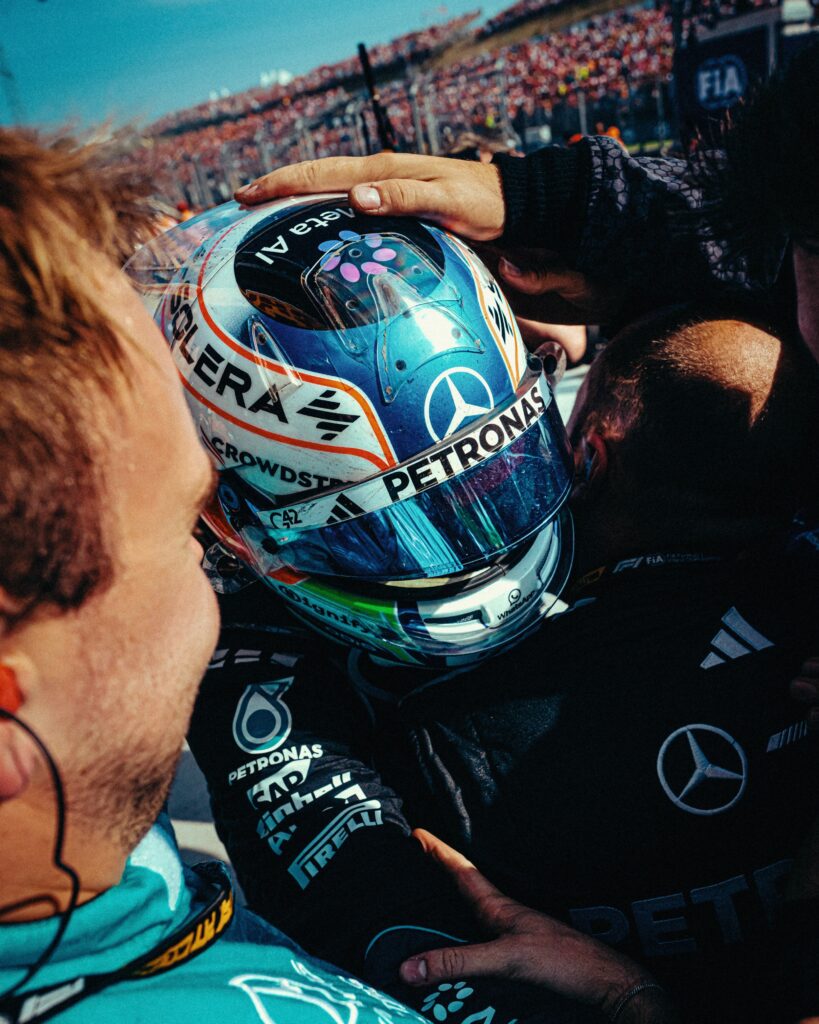
For collectors, Russell’s 2025 helmet is one of the cleanest designs on the grid. The base shell carries the deep matte black crown with the angular silver flash sweeping from temple to chin bar — a graphic language that traces back to his earlier seasons but with sharper geometry for the W16 era. The Petronas turquoise accents pick up the team’s primary brand tone, and the rear plate carries Russell’s personal monogram in a single silver stroke.
A full-size 1:1 collector replica of this design captures several details that catch light on a display shelf:
- The 5 mm matte-to-gloss transition line along the silver flash, hand-masked layer by layer.
- The 27 cm shell width that matches the production helmet outline for accurate 1:1 scale presentation.
- The dark-tinted visor in display-quality acrylic, mimicking the iridium finish without claiming protective function.
- The Mercedes star and Petronas mark applied as separate decal layers, finished under clear coat to a depth that reads cleanly under shelf lighting.
The Monaco weekend, painful as it was on the timing screen, gave this helmet a story. Display pieces gain value when they’re tied to specific narrative moments — the 2025 Monaco Grand Prix is now one of those reference points for the Russell collection.
Pairing Suggestions for a 2025 Mercedes Shelf
A two-helmet Mercedes 2025 arrangement — Russell’s silver-flash design alongside Antonelli’s green-and-black rookie graphics — captures the team’s full-season identity on a single shelf. Add the Monaco-specific livery details, and the display becomes a date-stamped record of the season’s most controversial Sunday for the Brackley team.
What the Penalty Cost in Championship Terms
Russell entered Monaco with a points haul already shaped by strong early-season weekends. A points finish in the Principality — even a P9 or P10 — would have added to a tally that Mercedes need to defend across the second half of the year. Losing that potential outright, on a circuit where recovery is structurally impossible, was the worst combination of error and venue.
The lesson Mercedes will carry into the next round: under Safety Car conditions with a routed pit lane, the radio loop priority needs a hard-coded checklist for any car serving a penalty. Shovlin’s transparency in the post-race video — laying out the calculation, the call, and the failure — is rare. Most teams bury the mechanics. Mercedes published it, which speaks to confidence that the process can be patched without rebuilding it.
For Russell, the Monaco Grand Prix joins the small list of weekends defined by a single missed message. For the helmet collection, it becomes the marker for a 2025 display piece with a documented backstory — the kind of detail that separates a casual replica purchase from a curated shelf.
“What we failed to do was get the message to George to stay in the fast lane. Both sets of tyres were there, that’s normal, you do that in a Safety Car because your plans can change.”
— Andrew Shovlin, Mercedes Head of Trackside Engineering
“We concluded he would not be ahead of Hadjar, so we told George to stay out.”
— Andrew Shovlin, Mercedes Head of Trackside Engineering
FAQ
Q: Why did George Russell get a penalty at the Monaco Grand Prix?
Russell received a 5-second time penalty for exceeding the pit lane speed limit during his first pit stop. The penalty was meant to be served at his next stop but the crew began work on the car before the 5 seconds had elapsed.
Q: What did Mercedes say went wrong with the pit stop?
Andrew Shovlin explained the team failed to radio Russell to stay in the fast lane when the Safety Car was routed through the pit lane. Russell saw his tyres ready in the pit box and stopped, and the crew began the stop without serving the penalty first.
Q: How did Antonelli’s race position affect Russell’s strategy?
Antonelli was leading the race and had just lapped Russell before the Safety Car. Mercedes prioritised servicing the lead car, calculated Russell would not rejoin ahead of Hadjar, and initially kept him out — which created the complicated sequence that led to the error.
Q: What makes Russell’s 2025 Monaco helmet a good display piece?
The design combines a matte black crown, an angular silver flash, and Petronas turquoise accents on a 27 cm full-size 1:1 collector shell. The Monaco weekend gives the helmet a documented narrative reference point for collectors.
Q: Are these helmets certified for racing or road use?
No. The replicas sold at 123Helmets.com are display and collector pieces only — full-size 1:1 exhibition quality. They are not certified for protective, racing, or road use.
Shop Mercedes Helmets
Display and collector replicas only. Not certified for protective use. Full-size 1:1 scale.
This article was written with the help of AI tools. Editorial policy