Blog
Vasseur: Pace, Not Strategy, Cost Ferrari in Austria
 123Helmets Editorial Team
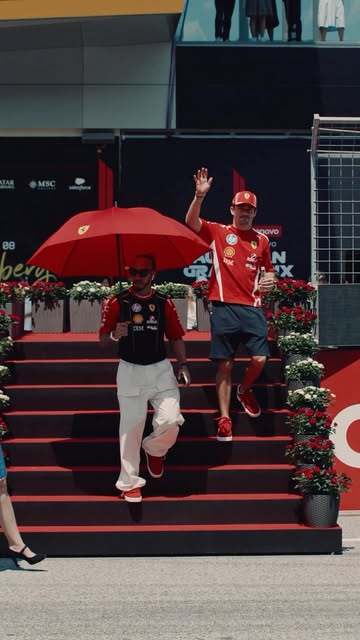
Fred Vasseur admitted after the 2026 Austrian Grand Prix that Ferrari’s fifth and eighth-place finishes at the Red Bull Ring came down to a raw pace deficit against Mercedes and Max Verstappen — not the three-stop strategy the team was forced to adopt under punishing tyre degradation.
Key Takeaways
Vasseur confirmed Ferrari’s pace gap to Mercedes and Verstappen — not strategy — as the primary cause of their Austrian GP struggles.
Both Hamilton and Leclerc ran three-stop strategies after tyre degradation worsened in hot race-day conditions at the Red Bull Ring.
Hamilton finished fifth and Leclerc eighth, a sharp contrast to their P2 and P3 grid positions secured on Saturday.
Vasseur noted Ferrari over-pushed in the opening laps trying to stay with the leaders, which compromised their tyre life across the full race distance.
A Hard Sunday at the Red Bull Ring
Ferrari’s 2026 Austrian Grand Prix ended with Lewis Hamilton in fifth and Charles Leclerc in eighth — a result that made their Saturday qualifying performance of P2 and P3 feel like a distant memory by Sunday evening. The Red Bull Ring had punished the Scuderia across all four tyre stints, exposing a pace gap to the leading group that strategy alone could not paper over.
The weekend had already carried warning signs. Charles Leclerc described Friday at the Austrian venue as a “particularly difficult” day for the team, suggesting the SF-26 was not finding the same rhythm it had shown just two weekends earlier at Circuit de Barcelona-Catalunya. Saturday’s qualifying lap masked the underlying issues temporarily, but race day stripped them bare.
Both drivers were pushed onto a three-stop strategy as tyre degradation accelerated in what Vasseur acknowledged were genuinely hot conditions. The extra stop cost track position and net race time, dropping Ferrari well outside the podium places they had lined up for on the grid.
Vasseur’s Post-Race Diagnosis
Ferrari Team Principal Fred Vasseur was direct when speaking to F1 TV after the race: the strategy was not the issue at the 2026 Austrian Grand Prix — the pace gap was. His words left little room for interpretation.
“Oh, the strategy is not the issue, I think the issue is that we didn’t have the pace of the Mercedes and [Max] Verstappen. We tried to compensate taking risks on the strategy, but it was not a good fight. I think it was more a matter of pace, and we paid also [the price for] the poor Friday we had.”
That framing matters. When a team principal publicly separates strategy from pace as the root cause, he is signalling that the car’s fundamental performance window at this particular circuit was simply narrower than their rivals’. The three-stop strategy was not a miscalculation — it was the team’s best available response to a problem that had no clean fix once the lights went out.
Vasseur also drew a distinction between Ferrari’s competitiveness relative to McLaren versus their deficit to Mercedes and Max Verstappen. “I think compared to McLaren we are there,” he said, “compared to Mercedes and Max it was more difficult.” That split tells you where the genuine performance gap sat in Austria.
The Opening Laps That Decided the Race
Ferrari’s race unravelled most critically in the first two laps, when the team attempted to run with the pace-setters and paid a heavy tyre penalty for it. Vasseur was candid: “We overpushed probably the first couple of laps to stay with them, and we destroyed a bit everything.”
That admission explains why a three-stop race became unavoidable rather than strategic. Tyre life that might have covered a two-stop window was consumed in the opening push, forcing Ferrari into reactive pit calls rather than proactive ones. In a race of around 71 laps at the Red Bull Ring — a circuit whose short lap length amplifies the cost of every extra pit stop — losing 20-plus seconds to an unplanned third stop is effectively race-ending for a podium challenge.
Lewis Hamilton, who had taken the victory at the preceding Barcelona round, crossed the line in fifth. Charles Leclerc finished eighth. Both results sit well below where their grid slots had suggested they might end the afternoon, and the cause traces directly to those overworked opening kilometres.
Ferrari’s Recent Form in Context
The 2026 Austrian Grand Prix result represents a significant swing in Ferrari’s fortunes relative to the Barcelona victory just two weeks prior. Hamilton’s win at Circuit de Barcelona-Catalunya had put the team in an optimistic frame heading into the Austrian double-header phase of the calendar, but the Red Bull Ring exposed circuit-specific weaknesses the Spanish venue had concealed.
Leclerc’s difficult Friday — and the team’s admission that they never fully recovered from it — points to a setup window that Ferrari could not open at this particular track. The characteristic demands of the Red Bull Ring, with its high-speed corners and aggressive kerb usage, place specific loads on tyres and mechanical grip that may not have suited the SF-26’s balance in its current specification.
Vasseur’s reference to a “poor Friday” as a contributory factor alongside the pace deficit suggests the team entered race day without the baseline they needed. Whether that gap is a circuit-specific anomaly or a sign of something broader in the 2026 development trajectory will become clearer as the season progresses to the next rounds.
Podium Visuals and the Collector Angle
When Race Helmets Tell the Story
The 2026 Austrian Grand Prix, even in a difficult result, produced visually striking moments that will be remembered by collectors of Ferrari memorabilia. The Red Bull Ring’s alpine setting — framed against a backdrop that the team’s scarlet livery contrasts sharply against — gives any weekend at this venue a cinematic quality that translates directly into display appeal.
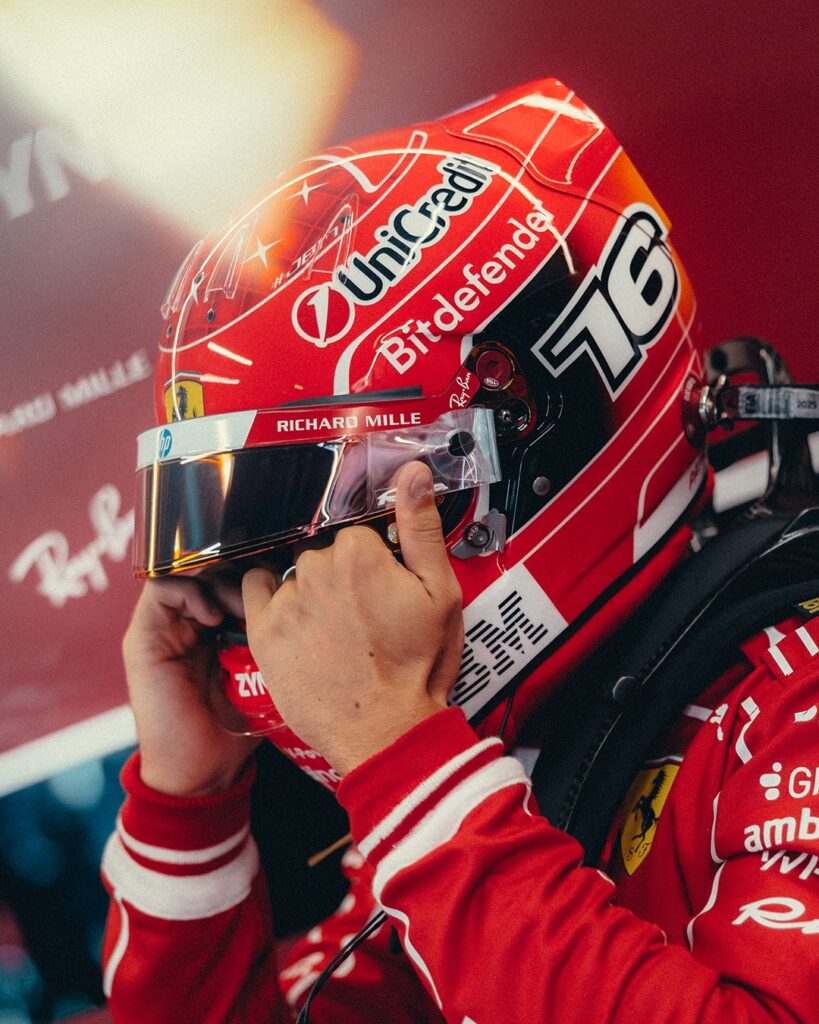
Hamilton’s race helmet for Austria continued the design language he has carried through the 2026 campaign in Ferrari red, a visual shift from his silver Mercedes years that still carries enormous collector interest. Leclerc’s helmet work has similarly evolved alongside Ferrari’s updated 2026 livery direction. Both drivers occupied the front two rows of the grid at the start — footage and imagery from that formation lap represent some of the most display-worthy moments of the weekend, even if the race itself did not deliver the result Ferrari had targeted.
Full-size 1:1 replica helmets capturing either driver’s 2026 Austrian GP specification are exhibition-quality display pieces, scaled at true 1:1 proportions. As collector items they document a season moment at one of F1’s most historic circuits, regardless of the final classification. The race date of 2026 and the specific livery context mark these replicas as distinct from Barcelona-spec or Monaco-spec versions from the same calendar year.
Display Context for the Red Bull Ring Round
For collectors building a circuit-by-circuit 2026 season display, the Austrian GP represents one of the more visually compelling rounds on the calendar. The combination of Ferrari’s scarlet and the Red Bull Ring’s compact, dramatic layout creates reference imagery that holds well in exhibition settings. A full-size 1:1 replica helmet placed alongside race-weekend photography from 2026-06-29 provides clear provenance context for the display.
What Comes Next for Ferrari in 2026
Ferrari’s immediate task after Austria is understanding whether the pace deficit to Mercedes and Verstappen is a Red Bull Ring anomaly or a recurring pattern. Vasseur’s comment that “compared to McLaren we are there” suggests the team is not in structural trouble, but the gap to the top two in Austria was wide enough to demand attention before the next round.
The team will also need to address their Friday setup process. A “particularly difficult” Friday that feeds directly into tyre degradation problems on Sunday is a compounding issue — each weak session makes the next harder to recover from. Closing that gap in practice efficiency will be as important as any aerodynamic or mechanical update brought to the next circuit.
Hamilton’s return to form in Barcelona — the win that now sits just two races behind them — remains the reference point for what the SF-26 can do when conditions suit it. Replicating that performance window more consistently across different circuit types is the central 2026 development challenge for the Maranello operation. Austria confirmed the work still ahead; Barcelona confirmed the ceiling is genuinely high.
“The strategy is not the issue, I think the issue is that we didn’t have the pace of the Mercedes and Verstappen. We tried to compensate taking risks on the strategy, but it was not a good fight.”
— Fred Vasseur, Ferrari Team Principal, F1 TV post-race interview, 2026 Austrian GP
“We overpushed probably the first couple of laps to stay with them, and we destroyed a bit everything.”
— Fred Vasseur, Ferrari Team Principal, 2026 Austrian GP
FAQ
Q: Why did Ferrari struggle at the 2026 Austrian Grand Prix?
Ferrari lacked the outright pace to match Mercedes and Max Verstappen at the Red Bull Ring. Team Principal Fred Vasseur stated directly that the pace deficit — not the strategy — was the primary issue, compounded by a difficult Friday that left the team without the setup they needed for race day.
Q: What strategy did Hamilton and Leclerc run in Austria 2026?
Both Hamilton and Leclerc ran three-stop strategies after suffering higher-than-expected tyre degradation in hot conditions. The extra stop was a reactive response to tyre life lost in the opening laps rather than a pre-planned race approach.
Q: Where did Hamilton and Leclerc finish at the 2026 Austrian GP?
Hamilton finished fifth and Leclerc finished eighth. Both had qualified on the second row of the grid — P2 and P3 — making the race result a significant drop from their starting positions.
Q: Are Ferrari 2026 Austrian GP replica helmets available as collector items?
Full-size 1:1 replica helmets based on Hamilton’s and Leclerc’s 2026 Austrian GP specifications are available as display and collector pieces. These are exhibition-quality replicas, not certified for any protective or wearable use, designed for display purposes only.
Q: How did Ferrari’s Austria result compare to their Barcelona performance?
The Austrian result was a sharp contrast to Barcelona, where Hamilton won the race just two weeks earlier. Vasseur noted the team is broadly competitive with McLaren but faced a larger gap to Mercedes and Verstappen at the Red Bull Ring specifically, pointing to circuit-specific rather than season-wide decline.
Shop Ferrari Helmets — full-size 1:1 collector replicas from the 2026 season, including Austrian and Spanish GP specifications. Display pieces only. Not for protective use.
Display and collector replicas only. Not certified for protective use. Full-size 1:1 scale.
This article was written with the help of AI tools. Editorial policy