Blog
Lance Stroll Molten Minerals British GP Helmet 2026
 123Helmets Editorial Team
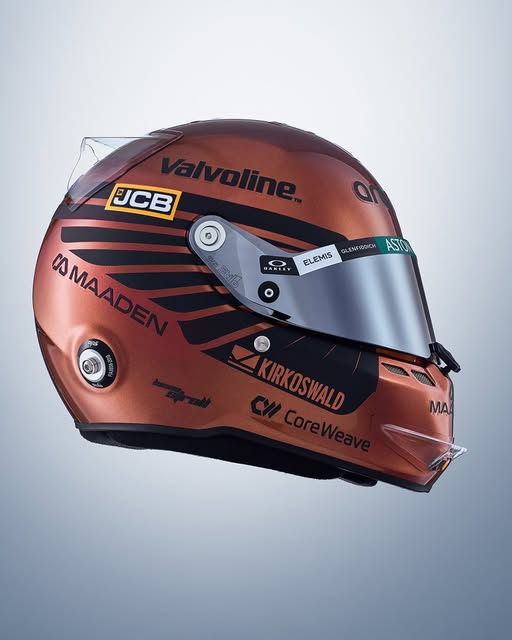
Aston Martin Aramco revealed Lance Stroll’s special helmet for the 2026 British Grand Prix on 1 July 2026 — a full-size 1:1 display replica that any collector will want to own.
Key Takeaways
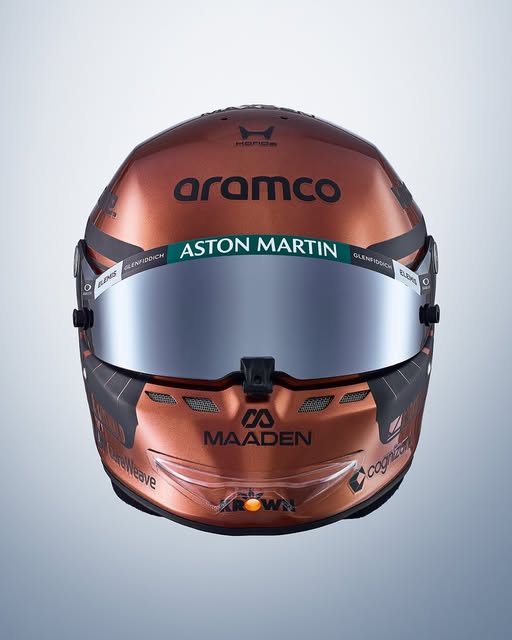
The shell carries a metallic copper / molten-bronze finish with black raked diagonal strata lines sweeping across both sides — a direct visual nod to Aston Martin’s mining partner Ma’aden and the team’s #UnearthYourGreatness STEM Racing campaign.
An Aston Martin racing green band wraps the visor opening and carries the ‘ASTON MARTIN’ wordmark in white, anchoring the brand identity against the warm copper shell.
Eleven sponsor wordmarks — Valvoline, JCB, Ma’aden, Kirkoswald, CoreWeave, aramco, Honda, Glenfiddich, Elemis, Cognizant and Oakley — appear in black across the shell and chin in a clean, high-contrast layout.
The full-size 1:1 display replica of this helmet preserves every graphic detail of the race weekend original, making it a museum-quality collector piece tied to a specific event: Silverstone, 3–5 July 2026.
The Reveal: Aston Martin Drops a Copper Bombshell for Silverstone
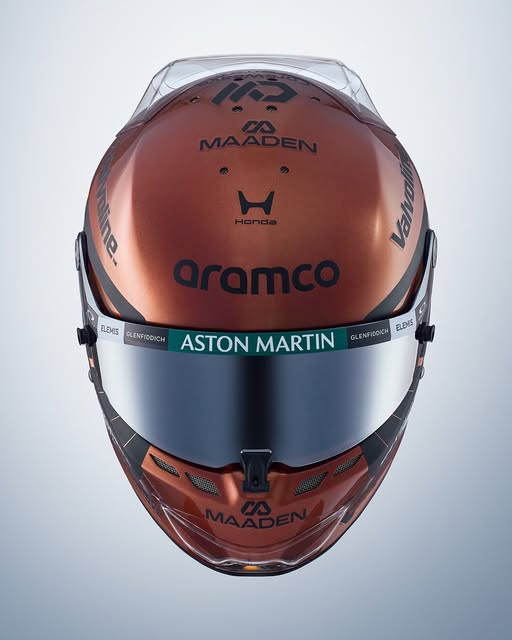
Aston Martin Aramco F1 Team posted Lance Stroll’s 2026 British Grand Prix helmet on the team’s official Instagram on 1 July 2026, exactly 48 hours before the race weekend opens at Silverstone on 3 July 2026. The caption read: ‘Molten minerals. Future minds. British GP ready.’ — framed under the hashtags #UnearthYourGreatness and #STEMRacing. The reveal is a deliberate event-specific design, not a standard-season lid, which immediately positions the full-size 1:1 display replica as a collector piece anchored to a single race date.
British Grand Prix weekend runs from 3 to 5 July 2026 at the Silverstone Circuit in Northamptonshire. The team’s choice to publish the reveal on 1 July gives a precise provenance date for collectors: this design is documented, timestamped and tied to one of the oldest rounds on the F1 calendar. For anyone building a display collection around individual race moments, that specificity is exactly what separates a helmet like this from a generic season-livery piece.
The language of the reveal — minerals, unearthing, future minds — signals that the design concept runs deeper than aesthetics. It connects to Aston Martin’s partnership with Saudi Arabian Mining Company Ma’aden, one of the world’s largest mining conglomerates, and to the team’s ongoing STEM Racing educational campaign. The copper shell is not decoration for its own sake; it is a legible argument about where the team’s commercial and philosophical identity sits in 2026.
Molten Minerals: Reading the Shell Design
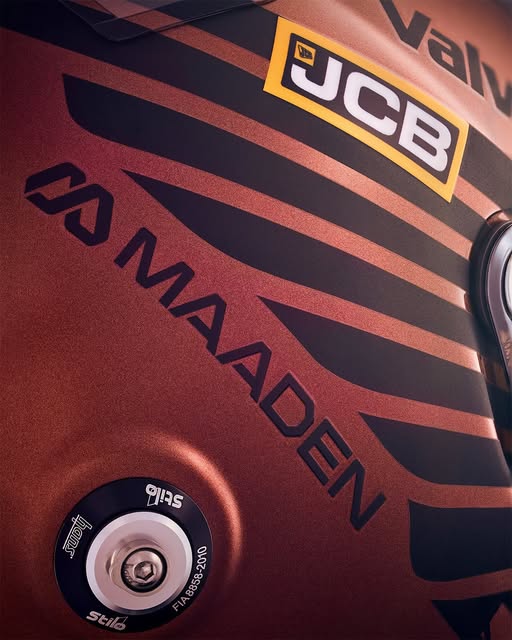
The dominant finish is a metallic copper — specifically a molten-bronze tone that catches light the way raw ore does, with warm amber highlights giving way to darker oxide shadows depending on the viewing angle. This is not a flat copper wrap; the metallic base coat reads differently under artificial pit-lane lighting than under the open Silverstone sky, which means a display replica placed under gallery-standard spot lighting will express a different character from the same piece shown against natural daylight.
Across both sides of the shell, black raked diagonal striations sweep backward from the brow toward the rear. These lines are not random graphic marks — they read as layered mineral strata, the kind of cross-section illustration you would find in a geological survey. The rake angle is consistent across the full arc of the shell, so the motif reads as continuous even as it curves around the helmet’s three-dimensional form. Against the warm copper ground, the black strata create a high-contrast graphic that is immediately legible at the distance a display piece is typically viewed.
There is no figurative illustration, no portrait, no flag motif. The entire visual language is geological and abstract, which gives the design an unusual quietness for a special-edition race helmet. It does not announce itself through complexity; it announces itself through the quality of the single dominant finish and the precision of the strata lines.
The Visor Band
An Aston Martin racing green band — the team’s signature dark bottle-green — wraps the full circumference of the visor opening. It is narrow enough not to compete with the copper shell above it, wide enough to carry the ASTON MARTIN wordmark in white across the front. The wordmark sits cleanly on the green ground, readable at the distance a display cabinet creates between object and viewer. The combination of racing green against copper is not arbitrary: these two colours sit on opposite sides of the warm-cool spectrum, and the contrast keeps the visor band from disappearing into the shell.
The Visor
The visor itself is a dark chrome / silver mirror finish. Against the warm copper shell and the deep green band, the mirror visor introduces a cool, reflective plane that completes the helmet’s three-material visual logic: warm metal above, botanical green at the horizon, reflective chrome at the face. On a display stand the mirror visor acts almost as a lens, picking up and distorting the surrounding room — which makes the replica behave differently in every display environment.
Sponsor Layout: Eleven Marks, One Visual System
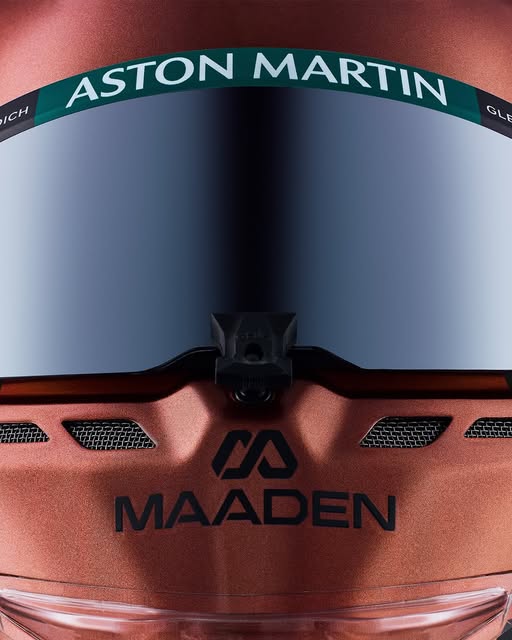
All eleven sponsor wordmarks on the 2026 British GP helmet appear in black, giving the commercial layer a unified typographic tone that does not compete with the copper shell. The marks are: Valvoline, JCB, Ma’aden (MAADEN), Kirkoswald, CoreWeave, aramco, Honda, Glenfiddich, Elemis, Cognizant and Oakley. Their placement across the shell and chin follows the logic of the strata lines — the marks sit in the lighter copper zones, where black text achieves maximum contrast without requiring a reversed white-out panel behind them.
Ma’aden’s placement carries the most conceptual weight: the Saudi mining company’s wordmark appears on a helmet whose entire visual identity references the mineral world Ma’aden operates in. The STEM Racing hashtag in the reveal caption reinforces that this is not a standard sponsor placement but a coordinated communication between the team and the partner. For a collector, that layer of brand narrative adds documentary value to the display piece — you are not simply displaying a helmet, you are displaying an object that records a specific commercial and cultural relationship in 2026 F1.
Aramco, Honda and Cognizant are long-standing Aston Martin Aramco team partners and their presence grounds the helmet within the team’s 2026 identity even as the copper finish makes it event-specific. Glenfiddich, Elemis and Kirkoswald contribute the heritage and lifestyle tier of the sponsorship portfolio, while CoreWeave signals the team’s technology and cloud-computing partnerships. Oakley’s inclusion is notable given it covers eyewear, completing a full-spectrum display of the team’s commercial ecosystem in one object.
The Ma’aden Connection and STEM Racing Campaign
Ma’aden — Saudi Arabian Mining Company — is the explicit commercial origin of the ‘Molten Minerals’ concept: the copper finish, the strata motif and the hashtag #UnearthYourGreatness all trace back to this partnership. Ma’aden is one of the world’s largest diversified mining companies, operating phosphate, aluminum, gold and copper extraction across Saudi Arabia. The helmet design translates its industrial identity into a wearable — and displayable — graphic language.
The #STEMRacing hashtag connects the design to Aston Martin’s educational outreach programme, which uses the team’s F1 presence to promote science, technology, engineering and mathematics engagement, particularly among younger audiences. The phrase ‘Future minds’ in the reveal caption positions this helmet not just as a race-day object but as a communication to an audience outside the paddock. That dual function — racing artefact and campaign vehicle — is rare in helmet design and gives the collector replica an additional dimension of cultural documentation.
The British Grand Prix weekend of 3–5 July 2026 is the contextual container for all of this. Silverstone, as one of the oldest and most storied circuits in F1 history, amplifies the significance of an event-specific design. A display replica of this helmet therefore sits at the intersection of three narratives: a specific circuit weekend, a specific commercial partnership, and a specific educational campaign — all resolved into a single copper-finish object.
Collecting the 2026 British GP Helmet: What a Full-Size Replica Delivers
A full-size 1:1 display replica of Lance Stroll’s 2026 British GP ‘Molten Minerals’ helmet replicates every graphic element of the race-day original at the exact dimensions of a competition helmet shell, making it the correct object for a serious display collection. The scale is not approximate — 1:1 means the copper shell, the strata lines, the green visor band, the mirror visor and all eleven sponsor wordmarks appear at the size a human head would fill them, which is the only scale at which the proportional relationships between design elements read as the designer intended.
For collectors who organize their displays by event, this piece carries a precise identity: Lance Stroll, Aston Martin Aramco, British Grand Prix, Silverstone, 3–5 July 2026. That five-point provenance is fixed. It will not drift or generalize over time the way a standard season livery helmet can. The specific event-date also means the replica can be displayed alongside other Silverstone-specific pieces — from other seasons, other drivers, other teams — as part of a thematically organized British GP showcase.
The metallic copper finish requires display conditions that respect its reflective properties. Direct spot lighting at approximately 45 degrees to the shell surface will draw out the warm amber-to-oxide gradient that defines the ‘molten’ quality of the finish. The dark chrome mirror visor will function as a reflective element in any display environment, so the background colour and lighting temperature of the display space will influence the appearance of the visor plane. These are not problems — they are the characteristics that make this object visually active at every viewing angle, unlike a flat-paint display piece that reads the same from every position.
Display and Exhibition Quality
Exhibition-quality replicas of this type are finished to the graphic standard of the original, with the sponsor wordmarks silk-screened or decal-applied at the correct typographic weight and positioning documented in the official reveal imagery. The green visor band is painted and lacquered, not a separate applied tape, so the transition between copper shell and green band is a smooth, display-grade finish. This is the standard that separates a genuine collector display piece from a generic souvenir item.
Lance Stroll at Silverstone: The Driver Behind the Helmet
Lance Stroll represents Aston Martin at the 2026 British Grand Prix, a circuit that has hosted F1 since 1950 and carries particular weight for the team given Aston Martin’s deep roots in British motorsport culture. Stroll has raced for the Aston Martin Aramco F1 Team since the team’s 2021 rebrand from Racing Point, giving him a multi-season history in the team’s livery that collectors of Stroll-specific pieces will want to document across its evolution.
The 2026 British GP helmet is one of the most graphically distinctive Stroll helmets in the team’s recent history, precisely because it departs from the standard-season livery logic and commits entirely to the Ma’aden mineral concept. For a collector building a Stroll display set, this piece marks a specific moment of design ambition that will stand out from the season-standard lids on either side of it in the calendar.
The Silverstone race weekend — Practice, Qualifying and Race across 3, 4 and 5 July 2026 — gives the helmet three potential display association points. A collector who attended qualifying on 4 July 2026 has a personal date-anchor for displaying this replica. A collector who watched the race on 5 July 2026 has another. These personal associations are part of what gives event-specific display replicas their long-term value in a collection — they are not just objects, they are coordinates in personal and sporting time.
“Molten minerals. Future minds. British GP ready.”
— Aston Martin Aramco F1 Team — official Instagram reveal caption, 1 July 2026
FAQ
Q: What is Lance Stroll’s ‘Molten Minerals’ helmet for the 2026 British GP?
It is a special-edition race helmet designed exclusively for the 2026 British Grand Prix at Silverstone (3–5 July 2026), revealed by Aston Martin Aramco on 1 July 2026. The shell carries a metallic copper / molten-bronze finish with black raked strata lines, an Aston Martin racing green visor band with the ‘ASTON MARTIN’ wordmark in white, a dark chrome mirror visor, and eleven sponsor wordmarks in black across the shell and chin.
Q: What is the design concept behind the copper finish and strata lines?
The design references Aston Martin’s partnership with Ma’aden (Saudi Arabian Mining Company) and the team’s #UnearthYourGreatness STEM Racing campaign. The metallic copper shell represents the mineral world Ma’aden operates in, and the black raked diagonal strata lines replicate the visual language of layered geological cross-sections — mineral strata as seen in a geological survey.
Q: Which sponsors appear on Stroll’s 2026 British GP helmet?
Eleven sponsor wordmarks appear on the helmet, all in black: Valvoline, JCB, Ma’aden (MAADEN), Kirkoswald, CoreWeave, aramco, Honda, Glenfiddich, Elemis, Cognizant and Oakley. They are positioned across the shell and chin in the lighter copper zones to maximize contrast against the metallic background.
Q: Why is an event-specific helmet replica more collectible than a standard season livery?
An event-specific helmet carries a five-point provenance — driver, team, circuit, event and date — that a standard season livery does not. Stroll’s 2026 British GP helmet is documented to Lance Stroll, Aston Martin Aramco, Silverstone, the British Grand Prix and the dates 3–5 July 2026, making it an object with a fixed, permanent identity in F1 history rather than one that generalizes across a full calendar year.
Browse F1 Helmet Collection
Display and collector replicas only. Not certified for protective use. Full-size 1:1 scale.
This article was written with the help of AI tools. Editorial policy