
Blog
It’s Not Overtaking, It’s ‘Avoiding Action’ — Why Alonso Says F1 Lost a Full Decade of ‘Pure Racing’
 123Helmets Editorial Team
It’s Not Overtaking, It’s ‘Avoiding Action’ — Why Alonso Says F1 Lost a Full Decade of ‘Pure Racing’
Fernando Alonso has never been one to bite his tongue, and his latest verdict on modern Formula 1 has reignited a debate that runs to the very soul of the sport. According to the two-time world champion, what fans now celebrate as overtaking is often nothing more than ‘avoiding action’ — a consequence of regulations, tyre management and DRS-dependent racing that, in his words, has cost the championship a full decade of pure wheel-to-wheel combat. From a collector’s standpoint, that decade also produced some of the most visually iconic helmets and liveries of the modern era, including Alonso’s own evolving Asturian-green Aston Martin identity.
Key Takeaways
Alonso argues modern overtakes are often defensive ‘avoiding action’ rather than genuine combat
The hybrid era reshaped racecraft, tyre management and DRS dependency from 2014 onwards
Alonso’s Aston Martin green helmet remains one of the most display-worthy designs of the grid
Collectors increasingly value full-size 1:1 replica helmets that capture this transitional decade
The verdict that lit the paddock
Fernando Alonso’s comments did not arrive as a casual aside. Speaking after another weekend in which strategic tyre saving dominated the storyline, the Spaniard offered a damning summary of where Formula 1 finds itself: drivers, he suggested, are no longer racing each other in the traditional sense, but managing systems, gaps and degradation while DRS does the heavy lifting on the straights. His phrase — ‘it’s not overtaking, it’s avoiding action’ — has since travelled around the paddock and beyond, because it captures something fans have privately felt for years.
The argument is simple. When a car arrives behind another with a 15 km/h delta thanks to DRS and an out-of-window tyre, the defending driver often has no real choice but to concede the corner rather than risk contact. That, Alonso contends, is not racing. It is geometry. And in his view, the sport has lived inside that geometry for the best part of ten years.
Why this decade matters for collectors
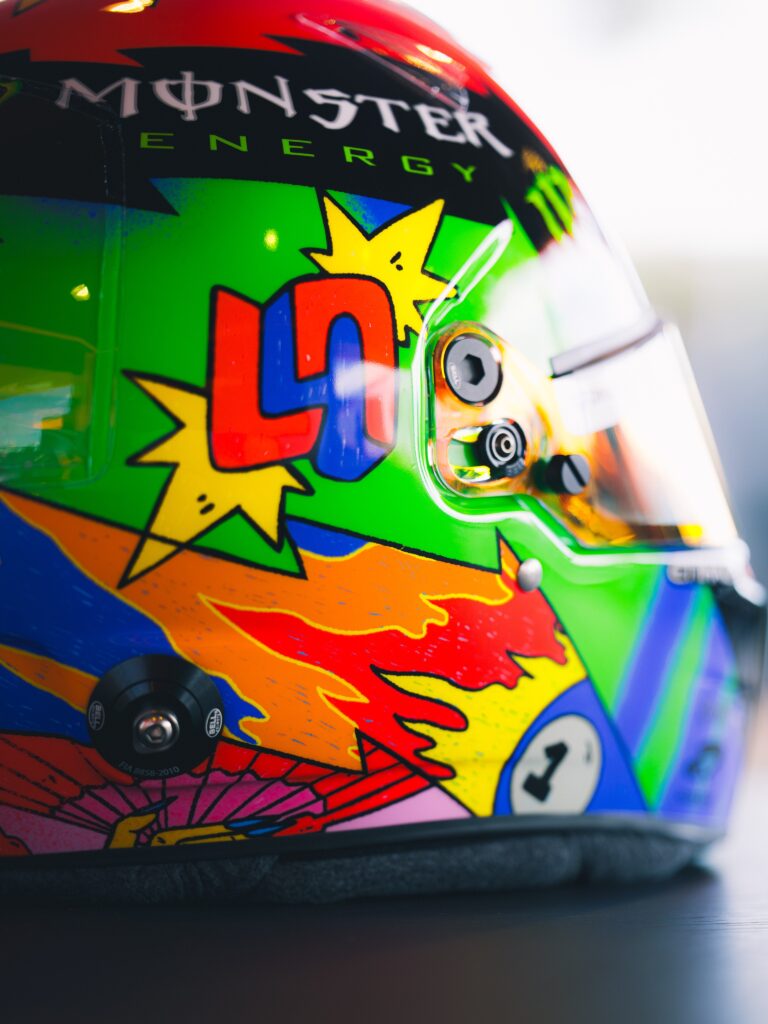
For those of us who curate full-size 1:1 replica helmets as display pieces, Alonso’s framing is unexpectedly useful. The 2014–2024 window he criticises sportingly is, paradoxically, one of the richest periods ever for helmet design. Manufacturers embraced matte finishes, chromework, fluorescent accents and personalised one-off liveries for marquee races. The on-track product may have evolved into something more clinical, but the visual identity of the drivers — Alonso included — has rarely been more collectable.
Race recap: a weekend that proved his point
The Grand Prix that framed Alonso’s remarks followed a now-familiar script. Pole position converted into a controlled opening stint. The leading group settled into a delta dictated by tyre temperature rather than ambition. Mid-race, the only meaningful position changes came through the pit window, not through the corners. By lap 40, the broadcast graphic showing ‘DRS enabled’ had appeared more often than any onboard duel.
Alonso himself ran a measured race, conserving the rear tyres of the Aston Martin and picking up positions as faster cars ahead suffered degradation. It was, by any modern metric, a strong drive. But in the post-race interviews he was visibly frustrated, not with his own team, but with the spectacle. ‘I overtook three cars,’ he reportedly noted, ‘but I did not race any of them.’
The podium visual
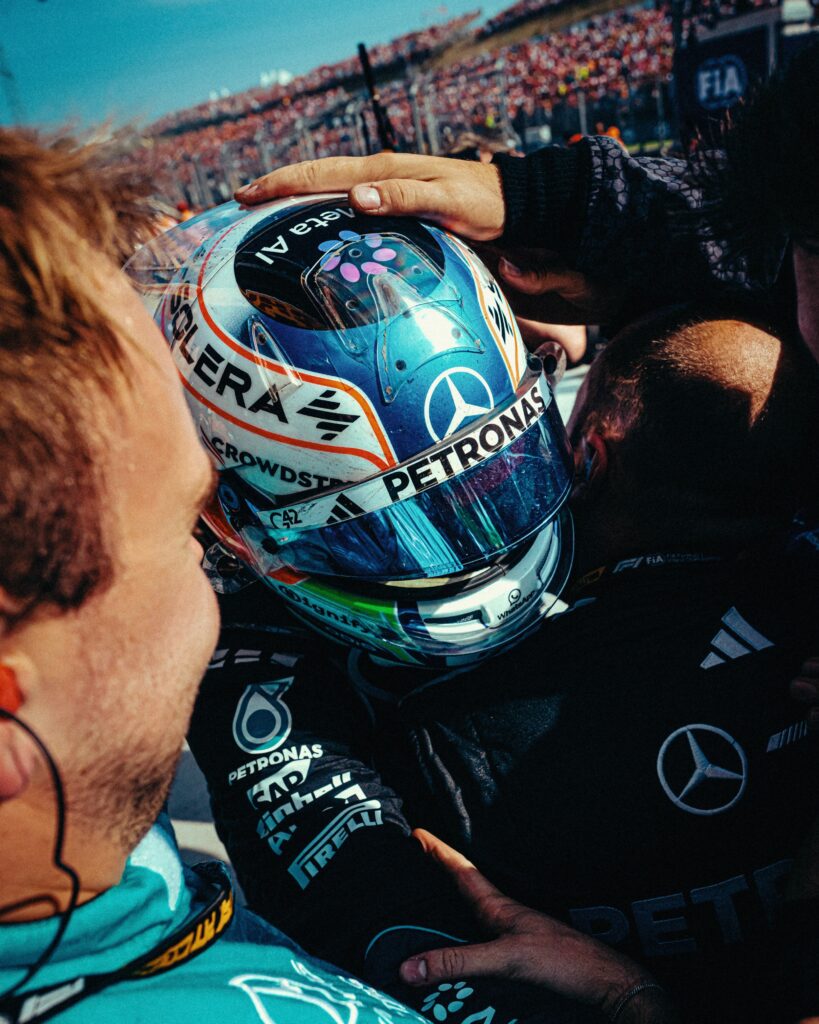
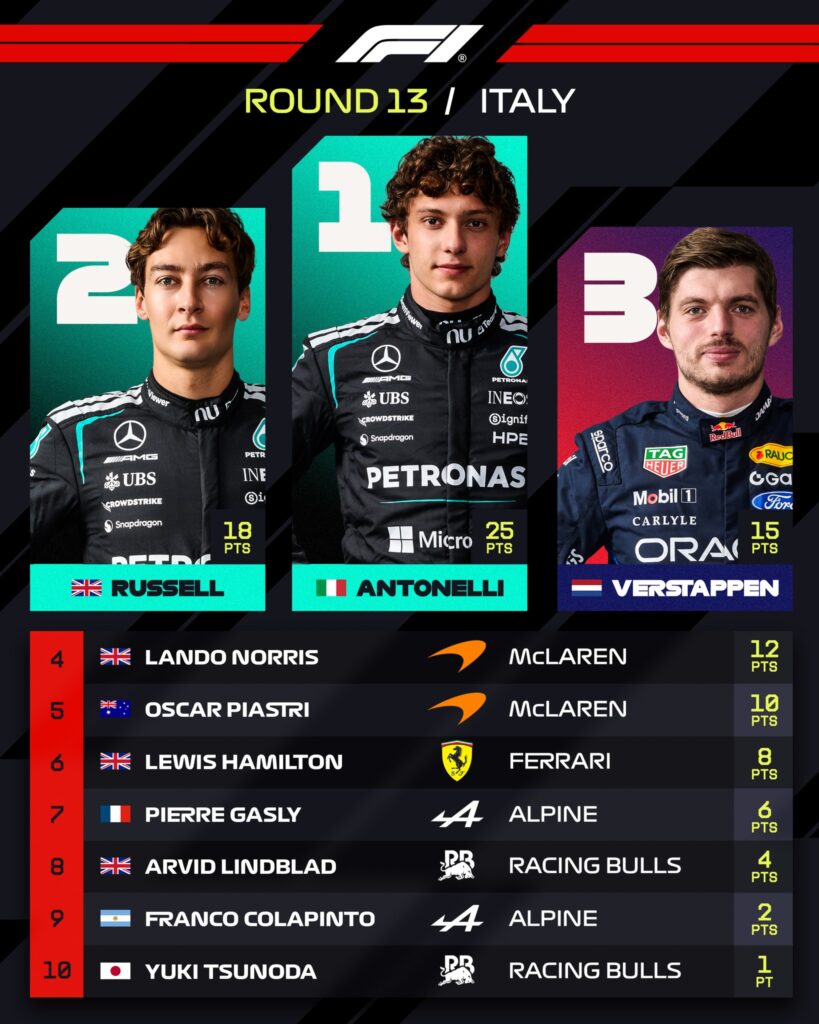
Even so, the podium itself was a feast for the eye and for the display-cabinet imagination. Three helmets, three radically different design languages: the deep racing green of Aston Martin’s camp paired with Alonso’s signature Asturian flag motif; the bolder primary palette of the race winner; and a third helmet whose chrome accents caught the late-afternoon light. For collectors, moments like these are exactly why full-size 1:1 replica helmets exist — to freeze the visual story of a season in exhibition-quality form on a shelf at home.
Alonso’s helmet: a design built for the display shelf
Fernando Alonso’s current helmet is, arguably, one of the most coherent designs on the grid. The dominant Aston Martin green flows into the Asturian yellow and blue cross, with subtle personal references to his karting roots and his ’14’ race number. There is restraint where many rivals opt for noise, and that restraint is precisely what makes it such a strong display item.
Key design elements that translate beautifully to a 1:1 replica
- Asturian flag detailing across the crown, instantly recognisable even at a distance
- Matte-to-gloss transitions on the visor surround that catch ambient light in a display case
- The signature ’14’, a number with deep personal meaning for Alonso, rendered in clean typography
- Aston Martin racing green base, a colour that photographs as well under gallery lighting as it does on a race weekend
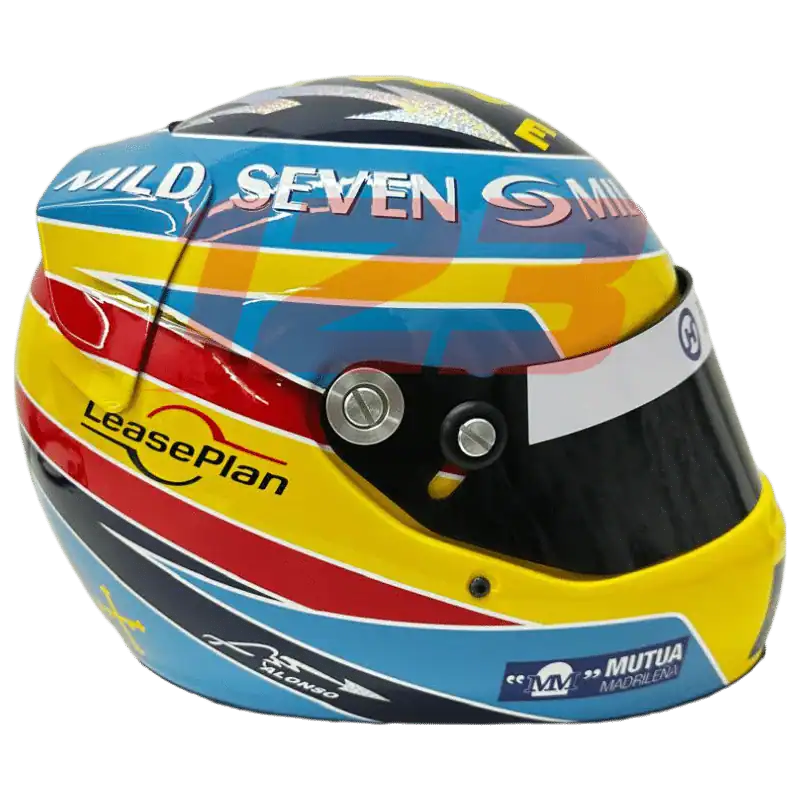
As a collector item, this helmet works because it tells a story without needing a caption. Place it next to a Renault-era yellow-and-blue Alonso replica and a Ferrari-era red, and you have a three-piece narrative of one of the most storied careers in modern Formula 1 — all in exhibition-quality scale.
The ‘lost decade’ argument unpacked
Alonso’s central claim deserves scrutiny rather than instant agreement. Did F1 truly lose a decade of pure racing? The honest answer is nuanced. The hybrid era, from 2014 onwards, produced extraordinary engineering and several genuinely thrilling championships. Yet the dominant racecraft pattern shifted. Drivers were rewarded for tyre management, energy deployment and DRS positioning rather than for the late-braking, side-by-side bravery of earlier generations.
What changed, in plain terms
Three factors converged. First, increasingly degradation-sensitive tyres turned every stint into a maths problem. Second, DRS — introduced as a temporary fix — became structural, normalising straight-line passes that require no real defensive engagement. Third, the cars themselves grew larger and heavier, narrowing the windows in which two drivers can genuinely dispute the same piece of tarmac.
Alonso, having raced before, during and after this transition, is uniquely placed to comment. He knows what a 2005 Imola defence felt like against Michael Schumacher. He knows what a 2023 DRS-assisted swap feels like. The gap between those experiences is, in his view, the lost decade.
The visual silver lining
And yet — and this matters for the collector community — the same decade gave us some of the most ambitious helmet liveries in the sport’s history. Tribute helmets, one-off home-race designs, Las Vegas specials, Monaco specials, anniversary editions. The on-track product may have narrowed, but the visual library expanded. Full-size 1:1 replicas of these helmets are, in many ways, the most honest souvenirs of an era that prized show as much as sport.
What Alonso’s words mean for 2026 and beyond
The timing of Alonso’s intervention is not accidental. With sweeping new regulations on the horizon, the sport is being asked to rediscover its racing identity. Active aerodynamics, revised power units and a renewed focus on close-quarters combat are all on the table. If the 2026 rules deliver, Alonso’s ‘lost decade’ framing could become the inflection point that defined the conversation.
For collectors, that prospect is exciting. New regulations almost always trigger fresh helmet design cycles, new livery identities and commemorative editions. The end of an era is, traditionally, when the most desirable display pieces are produced — the helmets worn in the final season of a rule set tend to become the most sought-after exhibition items years later.
How to prepare a collection now
- Identify the drivers whose careers have spanned the criticised decade — Alonso, Hamilton, Verstappen
- Prioritise full-size 1:1 replicas that capture distinct era-defining liveries
- Display them chronologically to tell the visual story Alonso himself is narrating verbally
- Treat helmets purely as collector items and exhibition pieces, never as protective equipment
“It’s not overtaking, it’s avoiding action. We have lost a decade of pure racing.”
— Fernando Alonso, post-race media pen
FAQ
Q: What exactly did Alonso mean by ‘avoiding action’?
He argued that many modern overtakes are not genuine duels but defensive concessions, where the defending driver yields rather than fight a DRS-assisted, tyre-advantaged attacker. In his view, that is not racing in the traditional sense.
Q: Is Alonso’s current Aston Martin helmet a good display piece?
Yes. The Aston Martin green base, Asturian flag detailing and signature ’14’ make it one of the most visually coherent designs on the grid, ideal as a full-size 1:1 collector replica for exhibition display.
Q: Which Alonso helmet eras are most collectable?
His Renault yellow-and-blue championship-era helmets, his Ferrari red period and his current Aston Martin green design form a natural three-piece collector narrative spanning his entire top-flight career.
Q: Are these helmets suitable for any on-track or protective use?
No. The replicas we discuss are strictly display and collector items, full-size 1:1 in scale and exhibition quality. They are not intended for protective use of any kind.
Q: Will the 2026 regulations change the helmet collector market?
Almost certainly. Major rule changes traditionally trigger new livery cycles and commemorative final-season designs, which historically become the most desirable display pieces in subsequent years.
Shop Fernando Alonso Collection
Display and collector replicas only. Not certified for protective use. Full-size 1:1 scale.