- Keke Rosberg
- Nigel Mansell
- Jenson Button
- Nico Rosberg
- Gilles Villeneuve
- Mika Hakkinen
- Jackie Stewart
- Charles Leclerc
- Lewis Hamilton
- Max Verstappen
- Lando Norris
- Ayrton Senna
- Michael Schumacher
- Fernando Alonso
- Oscar Piastri
- George Russell
- Kimi Antonelli
- Nico Hülkenberg
- Gabriel Bortoleto
- Pierre Gasly
- Franco Colapinto
- Carlos Sainz
- Oliver Bearman
- Sergio Pérez
- Valtteri Bottas
- Isack Hadjar
- Alain Prost
- James Hunt
Antonelli’s Track Limit Penalty That Never Was: A Barcelona Race Recap
Posted by
 123Helmets Editorial Team
123Helmets Editorial Team
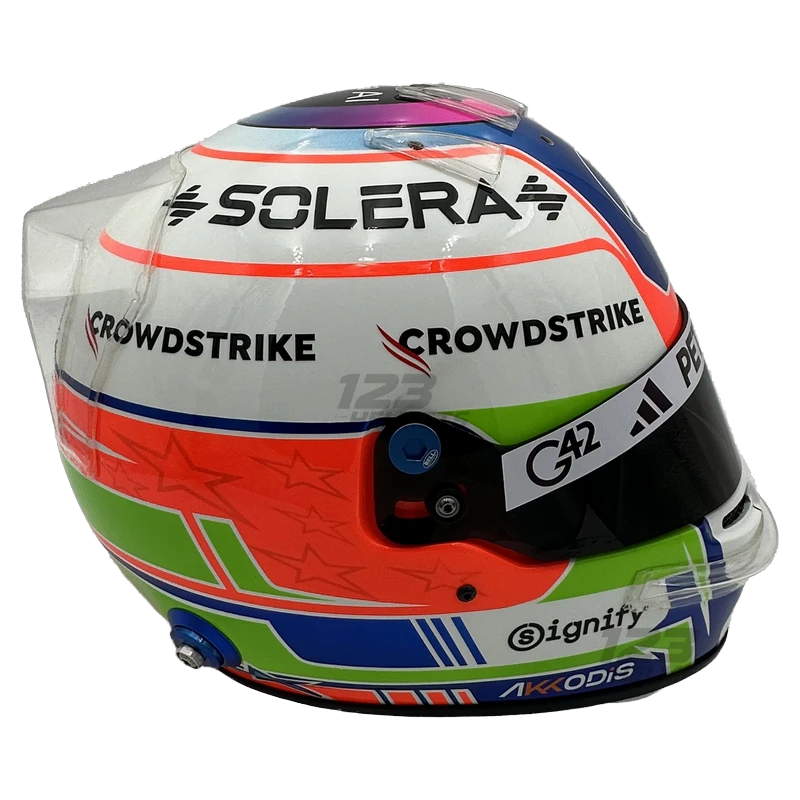
Barcelona-Catalunya GP
Kimi Antonelli crossed the track limit line four times at Turn 10 during the Barcelona-Catalunya Grand Prix — and the stewards missed it until it was too late. The five-second penalty that should have cost him a position over Lando Norris was confirmed only after Antonelli had already retired from the race, leaving one of the most visually striking Mercedes debuts of the 2025 season wrapped in both drama and regulatory ambiguity.
Key Takeaways
Antonelli exceeded track limits four times at Turn 10, triggering an automatic five-second penalty that was identified by stewards too late to be applied before his second pit stop.
The fourth breach occurred 12 minutes before Antonelli’s second pit stop; had the penalty been issued in time, he would have lost a position to Lando Norris.
Because Antonelli retired from the race, FIA guidelines state the unserved single five-second penalty does not convert into a grid penalty for a subsequent race.
The stewards acknowledged the black-and-white flag was shown after the fourth infringement rather than the third, due to a delayed detection — and flagged potential ambiguity in the current driving standards guidelines.
What the Stewards Actually Found at Turn 10
Kimi Antonelli committed four track-limit breaches at Turn 10 during the Barcelona-Catalunya Grand Prix, one more than stewards initially recorded during the race. The automatic threshold under FIA regulations is four breaches, which triggers a mandatory five-second time penalty. Stewards originally logged three violations, all at Turn 10, and only identified the fourth breach later in the race — after the window to enforce it cleanly had passed.
Race engineer Peter Bonnington had already warned Antonelli early in the race that he had exceeded track limits three times and was therefore one repeat away from a penalty. Separately, Lando Norris’s race engineer flagged to his driver that they believed Antonelli had already crossed the four-breach threshold — a read that turned out to be correct, even as the official stewards’ count still showed three.
The fourth breach at Turn 10 occurred 12 minutes before Antonelli made his second pit stop. At that moment, the stewards had only identified three violations. Had they confirmed the fourth breach in time and issued the penalty before that stop, Antonelli would have served five additional seconds in the pit lane — long enough to hand the position to Norris.
The Timeline That Changed the Outcome
Stewards confirmed the fourth Turn 10 breach later in the race, at which point the five-second penalty was formally due. But Antonelli retired before he could serve it. Under FIA penalty guidelines for stewards: a single five-second penalty that a driver is unable to serve due to retirement will not be converted into a grid penalty for a subsequent race. The penalty, in practical terms, evaporated with the retirement.
The stewards’ own statement acknowledged a procedural gap: Antonelli received a black-and-white flag after his fourth infringement rather than after his third, because the earlier breach was only detected retrospectively. Despite that sequencing error, the stewards were clear that the delayed detection did not exempt Antonelli from the regulations. The obligation to comply with track-limit rules, they stated, is independent of when the flag is shown.
Regulatory Ambiguity and What the Stewards Conceded
The stewards openly acknowledged potential ambiguity in the current driving standards guidelines — a rare admission that the rulebook itself may need tightening. Their statement noted that while Antonelli was not exempt from the regulations, the way the breach sequence played out raised enough questions to warrant a review of how the guidelines are written and applied.
Specifically, the stewards confirmed: “The stewards acknowledge that the driver did not receive a black and white flag after his third infringement but rather after his fourth infringement as one earlier infringement was only detected later in the race. However, based on the current regulations and Driving Standards Guidelines, this does not exempt the driver from complying with the regulations.”
The admission that guidelines may contain ambiguity is significant. Track-limit enforcement has been a recurring flashpoint in Formula 1, particularly at circuits like Barcelona-Catalunya where Turn 10 offers an aerodynamic advantage if a driver runs wide. The four-breach threshold is designed to be automatic and objective, but the system depends entirely on stewards identifying each breach in real time — something that clearly did not happen in this instance.
Norris’s Team Spotted It First
The detail that Norris’s race engineer flagged the four-breach count before official stewards confirmed it points to a gap in the monitoring pipeline. Team engineers monitoring competitor telemetry and GPS data were ahead of the official tally. That asymmetry — where a rival team’s data analysts outpaced the stewards’ own detection system — is precisely the kind of procedural inconsistency the FIA will need to address if track-limit enforcement is to carry any real deterrent weight.
Antonelli’s Barcelona Livery: A Display-Worthy Moment Frozen in Controversy
Antonelli’s 2025 Barcelona helmet and Mercedes livery combination produced some of the most photographed cockpit visuals of the season to date, making the race a reference point for collectors tracking the young Italian’s early career arc. The Mercedes W16 ran in its characteristic silver-and-black livery with Antonelli’s personal helmet design — a clean, high-contrast graphic scheme that photographs sharply against the Catalunya pit lane backdrop.
For collectors of full-size 1:1 display replicas, the Barcelona round carries particular weight. It is the race where Antonelli’s name first appeared in stewards’ documents as the subject of a penalty decision — a milestone moment in any driver’s career record. Display helmets tied to specific race weekends gain context from exactly this kind of documented controversy; a Barcelona 2025 Antonelli replica sits within a race narrative that includes a contested Turn 10 incident, a retirement, and a formal stewards’ acknowledgment of procedural ambiguity.
The Visual Language of the Antonelli Helmet
The Antonelli helmet design for the 2025 season uses a structured graphic layout that reads cleanly at exhibition scale. Full-size 1:1 collector replicas reproduce the helmet at actual race dimensions, capturing the sponsor decal placement, visor surround finish, and livery colourways that were on track at Barcelona. These are display pieces and collector items only — not certified for any protective use — but they carry the visual record of a race weekend that will be referenced in Formula 1 regulatory discussions for some time.
The helmet’s graphic scheme, when reproduced at 1:1 scale as an exhibition-quality replica, preserves the exact proportions worn during a race that ended in retirement but generated more post-race documentation than many race wins. That is the kind of contextual weight that makes a specific race-edition display helmet worth tracking for a serious F1 collection.
What Retirement Means Under FIA Penalty Rules
A single unserved five-second penalty that cannot be completed due to race retirement does not carry over as a grid penalty to the next event, under FIA guidelines currently in force. This rule is explicit: the stewards’ penalty guidelines state that in cases where there is a single five-second penalty which a driver is unable to serve due to retirement, the stewards will not convert it into a grid penalty for a subsequent race.
That distinction matters for understanding what the Barcelona outcome actually means for Antonelli’s championship position and race record. The penalty existed — it was formally confirmed — but its consequences were nullified by the retirement. No points were deducted, no starting position for the following race was affected, and the matter is formally closed under current regulations.
Four Breaches, One Missed Window
The 12-minute gap between Antonelli’s fourth breach and his second pit stop is the critical number in this story. That window — 12 minutes — was the enforcement opportunity the stewards did not use, because they had not yet confirmed the fourth breach. Once the stop was completed without the penalty served, and Antonelli subsequently retired, the regulatory path closed. The stewards had no mechanism under current rules to apply a post-race time penalty or convert the single five-second sanction into something carried forward.
It is a scenario that highlights how time-sensitive track-limit enforcement genuinely is. A 12-minute identification lag turned a clear-cut penalty into a resolved non-event, at least in terms of sporting consequences.
Barcelona as a Collector Reference Point in Antonelli’s Career
The 2025 Barcelona-Catalunya Grand Prix is already a documented chapter in Antonelli’s rookie season — a race that combined early-career pace, a regulatory incident, and a retirement into one compact and well-documented weekend. For collectors building a chronological display of Antonelli’s Formula 1 career, Barcelona 2025 represents an early inflection point.
Full-size 1:1 display replicas of Antonelli’s 2025 helmet are exhibition-quality collector items that capture the livery and graphic scheme active during this specific phase of his career. The Barcelona round is the kind of race that gets referenced repeatedly in career retrospectives — not because of a podium, but because of what happened in the stewards’ room afterwards. A display piece tied to that weekend carries that context into any collection.
Podium Visuals and the Broader Race Picture
While Antonelli did not reach the podium at Barcelona, the race produced strong visual material across the field. The Catalunya circuit’s long straight and technical middle sector create extended camera exposure for cockpit liveries, making Barcelona one of the broadcast-richest rounds of the calendar for helmet identification. Norris’s McLaren livery and the top-three finishers generated the official podium imagery for the round, but Antonelli’s helmet was among the most tracked during the race itself — both by teams monitoring the track-limit situation and by collectors following his 2025 campaign.
For anyone building a display collection around the 2025 season, the Barcelona round provides a concrete narrative anchor. A full-size 1:1 Antonelli replica from this period of his career — presented as a display piece, not a functional helmet — sits within one of the more discussed regulatory moments of the early 2025 calendar. That specificity is what separates a contextual display collection from a generic replica shelf.
“The stewards acknowledge that the driver did not receive a black and white flag after his third infringement but rather after his fourth infringement as one earlier infringement was only detected later in the race. However, based on the current regulations and Driving Standards Guidelines, this does not exempt the driver from complying with the regulations.”
— FIA Stewards’ Statement — Barcelona-Catalunya Grand Prix 2025
“In cases where there is a single five second penalty which a driver is unable to serve due to retirement, the stewards will not convert that into a grid penalty for a subsequent race.”
— FIA Penalty Guidelines for Stewards
FAQ
Q: Why did Antonelli not receive his five-second penalty at the Barcelona Grand Prix?
The stewards did not identify Antonelli’s fourth track-limit breach at Turn 10 until after his second pit stop had already been completed, meaning the penalty window was missed. He subsequently retired from the race, and under FIA guidelines, a single unserved five-second penalty is not converted into a grid penalty for the next event when a driver retires.
Q: How many times did Antonelli exceed track limits at Barcelona?
Antonelli exceeded track limits four times during the Barcelona-Catalunya Grand Prix, all at Turn 10. The stewards initially recorded only three breaches and identified the fourth later in the race. Four breaches trigger an automatic five-second time penalty under FIA regulations.
Q: Would Antonelli have lost a position if the penalty had been applied on time?
Yes. The fourth breach occurred 12 minutes before Antonelli’s second pit stop. Had the stewards identified it in time and the five-second penalty been served at that stop, Antonelli would have lost a position to Lando Norris.
Q: Does the missed Barcelona penalty affect Antonelli’s grid position for the next race?
No. The FIA penalty guidelines explicitly state that a single five-second penalty which a driver cannot serve due to retirement will not be converted into a grid penalty for a subsequent race. The penalty has no carry-over effect on Antonelli’s next starting position.
Q: What makes the Antonelli Barcelona 2025 helmet a notable collector display item?
The Barcelona 2025 race is a documented moment in Antonelli’s rookie season — a weekend that generated formal stewards’ documents, a contested track-limit decision, and a retirement, all in one round. Full-size 1:1 display replica helmets from this period of his career capture the livery and graphic scheme active during one of the more discussed regulatory incidents of the early 2025 Formula 1 calendar. These are exhibition-quality collector pieces only, not certified for protective use.
Shop Kimi Antonelli Collection — full-size 1:1 display replica helmets capturing the livery and graphic scheme of his 2025 Formula 1 season. Exhibition-quality collector pieces. Not certified for protective use.
Display and collector replicas only. Not certified for protective use. Full-size 1:1 scale.