Blog
Why Monaco Stays the Race Drivers Want to Win the Most
 123Helmets Editorial Team
An F1 presenter has explained, once again, why the Monaco Grand Prix holds the strongest pull on the grid. For collectors, the appeal is the same: no other round produces as many display-worthy helmet liveries, podium frames and 1:1 replica references as the 3.337 km street circuit through Monte Carlo.
Key Takeaways
Monaco’s 78-lap format and 3.337 km layout produce the most photographed helmet visuals of the F1 season.
Drivers consistently rank the Monaco win above any other trophy, including Monza and Silverstone.
Special one-off helmet liveries for Monaco are among the most requested 1:1 display replicas.
Podium framing on the royal box steps creates reference imagery used by collectors and replica painters worldwide.
What the presenter actually said
The argument from the broadcast booth was simple: ask any driver on the current grid which single race they would trade the rest of their season for, and the answer comes back the same. Monaco. Not the championship round, not the home race, not the high-speed showpiece at Monza. Monaco.
The presenter framed it around three points that matter to anyone who collects F1 helmets as display pieces. First, Monaco is the only circuit where the helmet is visible to the trackside crowd for almost the entire 78-lap distance, because the cars run within touching distance of the barriers. Second, the podium sits on the steps of the royal box, which produces a frame nobody else on the calendar can match. Third, the trophy is handed over by Prince Albert II, and the photograph of that handshake becomes the reference image teams use when they commission commemorative 1:1 replica helmets months later.
That is why the race still matters in an era of 24 rounds. The Monaco win is the one line on a CV that ages well.
The circuit that built the helmet tradition
The Circuit de Monaco runs 3.337 km per lap across 19 corners, from Sainte Dévote down to the Rascasse hairpin and back up to the start-finish straight on Boulevard Albert 1er. The race distance is set at 78 laps, the shortest full-distance Grand Prix on the calendar, and the only one where the regulation 305 km minimum is waived.
For helmet collectors, those numbers translate directly into display value. The slow average speed — historically the lowest of the season — means television cameras hold tight on the driver’s head for longer than at any other round. A one-off Monaco livery gets more on-screen seconds than a livery designed for Spa or Suzuka, which is why teams and drivers reserve their most ambitious paint schemes for this weekend.
Why the tunnel matters for replica reference
The 360-metre tunnel section produces the lighting condition replica painters care about most: a sudden shift from bright Mediterranean daylight to enclosed sodium tones, then back out again at the chicane. Photographers shoot the tunnel exit specifically because the helmet catches both colour temperatures in a single frame. Those frames become the master references for clear-coat depth, metallic flake density and visor tint matching when a 1:1 display replica is commissioned later in the year.
Podium visuals worth displaying
The Monaco podium is not a podium in the conventional sense. The top three drivers walk up the steps of the royal box, line up in front of the Grimaldi family, and receive their trophies at roughly eye level with the dignitaries. The framing is tighter than at any other Grand Prix. There is no champagne platform towering above a pit straight. There is no neutral grey backdrop. There is red carpet, gold detailing on the trophy, and the harbour behind.
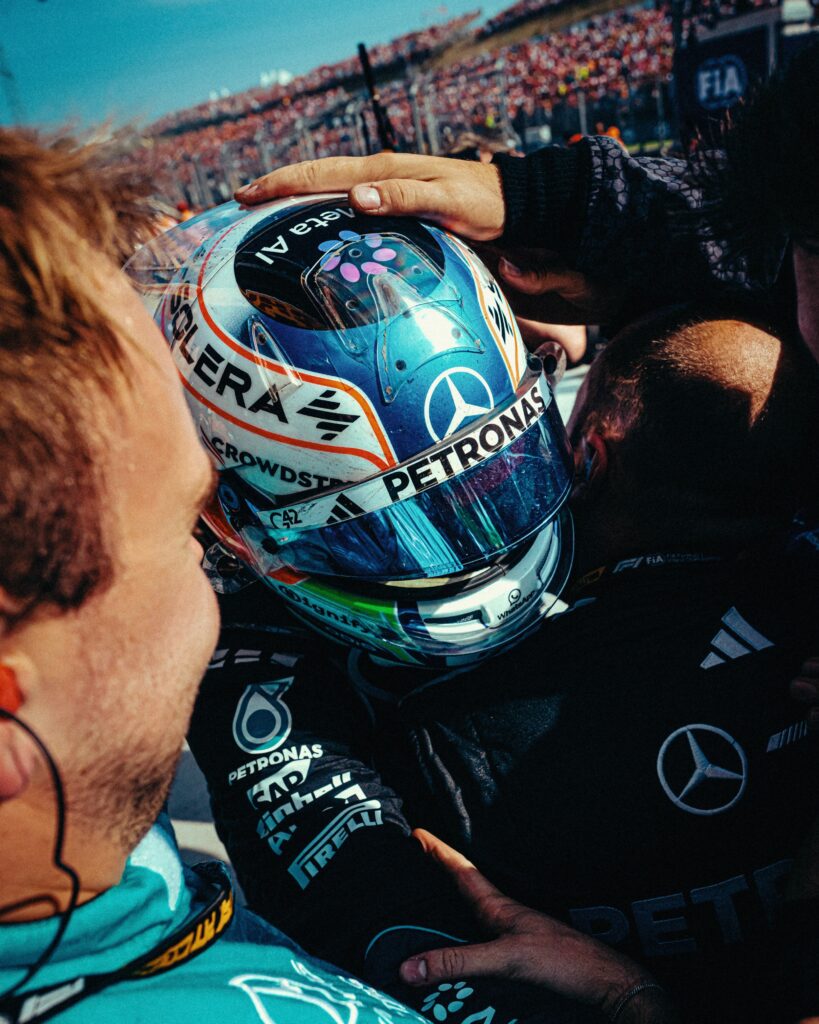
For a collector building a Monaco-themed display shelf, that single frame justifies the entire arrangement. A 1:1 replica helmet placed next to a printed podium photograph from the same year creates a self-contained display module. The helmet supplies the three-dimensional reference; the photograph supplies the context. Nothing else on the F1 calendar offers that kind of pairing.
The trophy itself
The Monaco winner’s trophy is a silver cup roughly 45 cm tall, handed over by the reigning monarch. It is one of the few trophies in the sport that drivers ask to be photographed with again, weeks after the race, for personal collections. Replica helmet displays referencing a Monaco win frequently include a scaled trophy reference card in the same display case.
Helmet liveries the race has produced
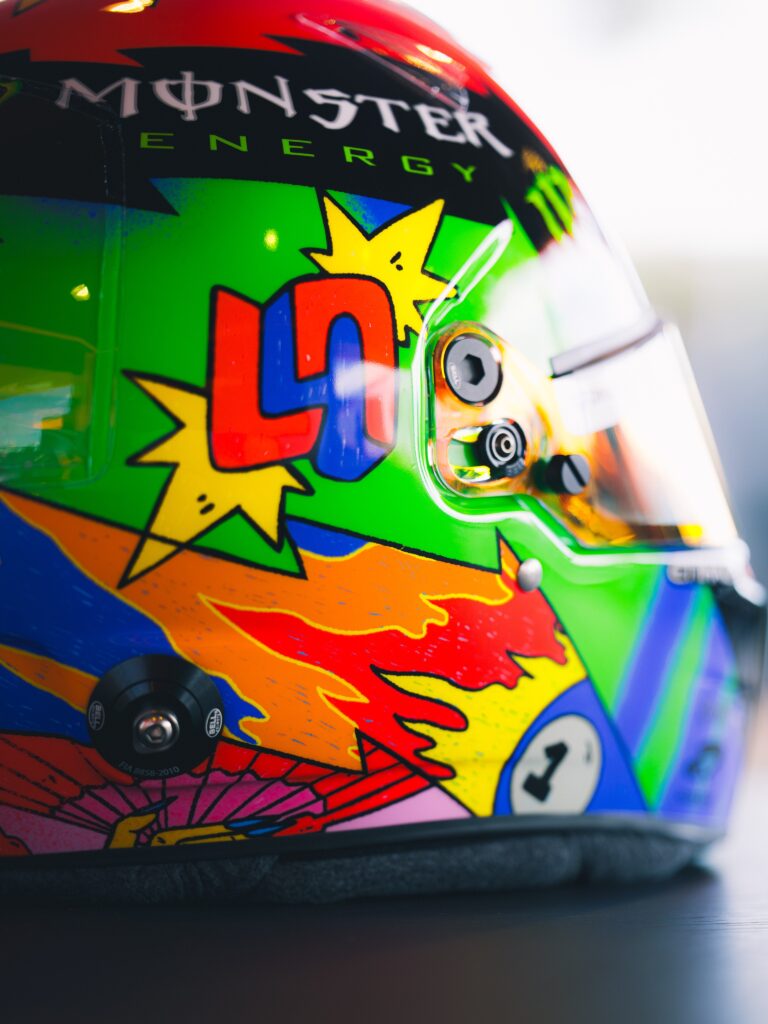
Almost every driver on the current grid has run at least one Monaco-specific helmet design. The pattern is consistent: a base shell in the driver’s standard season colours, then localised detailing referencing the principality — harbour blues, red and white from the national flag, gold leaf accents, or hand-painted views of the skyline above the visor aperture.
From a collector’s perspective, these are the most valuable display pieces a season produces. A standard-season helmet might be repeated across 20-plus rounds. A Monaco one-off exists for a single weekend. When that helmet is then recreated as a full-size 1:1 collector replica, the rarity of the source design carries directly into the rarity of the display piece.
Paint complexity
Monaco helmets routinely use 8 to 12 paint layers, compared with 5 to 7 on a standard-season shell. The extra layers come from metallic base coats, candy finishes over chrome, hand-applied detailing, and a thicker clear coat to protect intricate work under display lighting. A replica painter working from photographs of a Monaco helmet has to match every one of those layers to produce an exhibition-quality result.
Why drivers still rank it above everything
The presenter’s closing argument came back to legacy. A driver can win 10 Grands Prix in a career and still be defined, in public memory, by whether one of them was Monaco. Senna won there six times. Graham Hill won there five times and earned the nickname Mr Monaco. Schumacher won there five times. Hamilton, three. The list of repeat winners reads like a list of the sport’s most displayed helmets.
That is the loop the race has built around itself. Win at Monaco, and the helmet from that weekend becomes a reference for replica painters for the rest of the driver’s career. Win again, and the cumulative display value compounds. No other circuit on the calendar produces that effect at the same intensity.
The collector reading
From a 1:1 display perspective, Monaco is the round where the helmet stops being equipment and becomes an object. The slow speeds, the close barriers, the tunnel lighting, the royal box framing — every element of the weekend is designed, almost accidentally, to maximise the visual presence of the helmet itself. That is why drivers still want to win it. And that is why the replicas of those winning helmets remain the most-requested pieces in any serious F1 display collection.
“Ask any driver what they would trade their season for. The answer is always the same race.”
— F1 broadcast presenter
“Monaco is the only round where the helmet stays on camera longer than the car.”
— Replica paint studio reference note
FAQ
Q: How long is the Monaco Grand Prix?
The race covers 78 laps of the 3.337 km Circuit de Monaco, the shortest full-distance round on the F1 calendar.
Q: Why are Monaco helmet liveries so collectible?
They are one-off designs used for a single weekend, often built with 8 to 12 paint layers, which makes the resulting 1:1 display replicas considerably rarer than standard-season pieces.
Q: What makes the Monaco podium different?
It is held on the steps of the royal box rather than on a conventional platform, producing a tighter and more recognisable photographic frame than any other Grand Prix.
Q: Are the 1:1 replicas wearable?
No. These are display and collector replicas only, produced at full-size 1:1 scale as exhibition pieces. They are not certified for protective use.
Q: Who has won Monaco most often?
Ayrton Senna holds the record with six wins, followed by Graham Hill and Michael Schumacher on five wins each.
Browse F1 Helmet Collection
Display and collector replicas only. Not certified for protective use. Full-size 1:1 scale.