
Blog
Facts, Stats and Trivia Ahead of the 2026 Canadian GP: A Collector’s Preview of Montreal
 123Helmets Editorial Team
Facts, Stats and Trivia Ahead of the 2026 Canadian GP: A Collector’s Preview of Montreal
The Circuit Gilles Villeneuve has always been a stage where helmet design and livery storytelling reach their peak. Ahead of the 2026 Canadian Grand Prix, we revisit the numbers, the trivia and the visual moments that make this round one of the most coveted in any display-worthy F1 collection.
Key Takeaways
Montreal consistently produces some of the most photographed podium and helmet visuals of the F1 calendar.
The Circuit Gilles Villeneuve has hosted F1 since 1978, building decades of livery and helmet heritage.
Special one-off helmet designs for Canada are a recurring tradition, making them prized full-size 1:1 replica display pieces.
The 2026 edition arrives during a pivotal regulation era, adding fresh collector value to liveries and helmet artwork.
Montreal in Numbers: A Circuit Built for Drama
The Circuit Gilles Villeneuve sits on Île Notre-Dame, a man-made island in the Saint Lawrence River, and has been part of the Formula 1 calendar almost continuously since 1978. Its 4.361 kilometres are split between long full-throttle straights, tight chicanes and the infamous Wall of Champions at the final corner, a feature that has caught out world champions and rookies alike. For collectors, this combination matters: drama on track translates directly into iconic visuals, and iconic visuals translate into helmets and liveries that become must-have display pieces.
Statistically, Canada has been one of the highest-incident races of recent decades, with safety car interventions in a remarkably high percentage of editions. That unpredictability has produced surprise podiums, emotional victories and several first-time winners, each one stamping their helmet design into the visual memory of the sport. From Jean Alesi’s only F1 win in 1995, scored on his birthday in a Ferrari, to Robert Kubica’s emotional 2008 triumph for BMW Sauber, Montreal has a habit of writing stories that look magnificent on a shelf.
Lap Records and Layout Trivia
The race lap record stands as a benchmark hunted by every modern generation of cars. With the 2026 power unit and chassis regulations introducing new aerodynamic philosophies, lap times in Montreal are expected to shift again, and that recalibration is part of why this season’s helmets and liveries will carry extra weight in the long term as collectible 1:1 exhibition replicas.
Helmet Heritage: Why Canada Is a Designer’s Playground
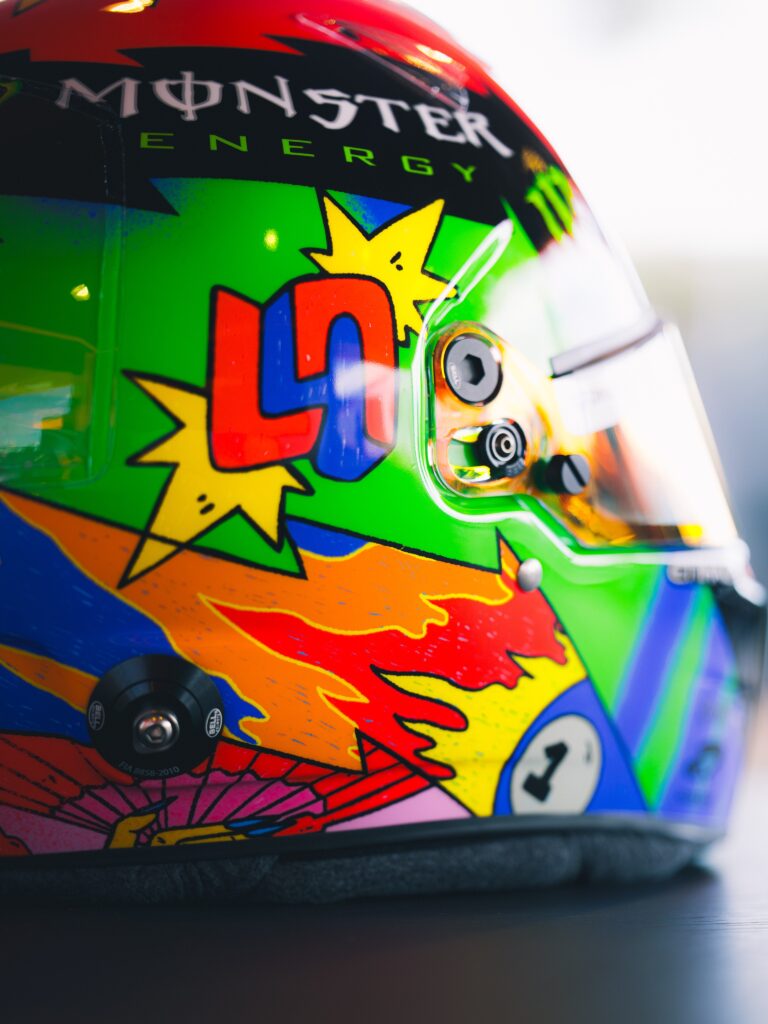
Few rounds attract as many one-off helmet liveries as the Canadian Grand Prix. The reasons are partly commercial, partly emotional. Canada is one of the most multicultural fan markets in F1, home to a passionate francophone audience, a strong Italian-Canadian Ferrari following and a dedicated base of Lance Stroll supporters. Drivers and their helmet artists routinely respond with tributes, flag motifs and references to Canadian icons, from the maple leaf to the legacy of Gilles Villeneuve himself.
For the collector, these special editions are gold. A one-off helmet worn in only one weekend, captured in podium photography and television broadcasts, becomes a closed-edition piece of design history. As a full-size 1:1 replica, it is the kind of item that anchors a display cabinet and starts every conversation in the room.
The Villeneuve Tribute Tradition
Many drivers have paid homage to Gilles Villeneuve over the years through their helmet artwork in Montreal. Jacques Villeneuve, his son and a 1997 World Champion, carried a version of his father’s red and black design throughout his career. Modern drivers occasionally borrow colour blocks, fonts or numeral styles from that era, creating a thread of visual continuity that collectors love to chase across generations of replicas.
What to Watch on the 2026 Grid
Expect at least a handful of teams to introduce subtle livery accents for Montreal, and several drivers to unveil bespoke lids. These moments are precisely when collectors should be paying attention, because the window between debut and quiet retirement of a one-off design can be a single weekend.
Podium Visuals: The Montreal Look
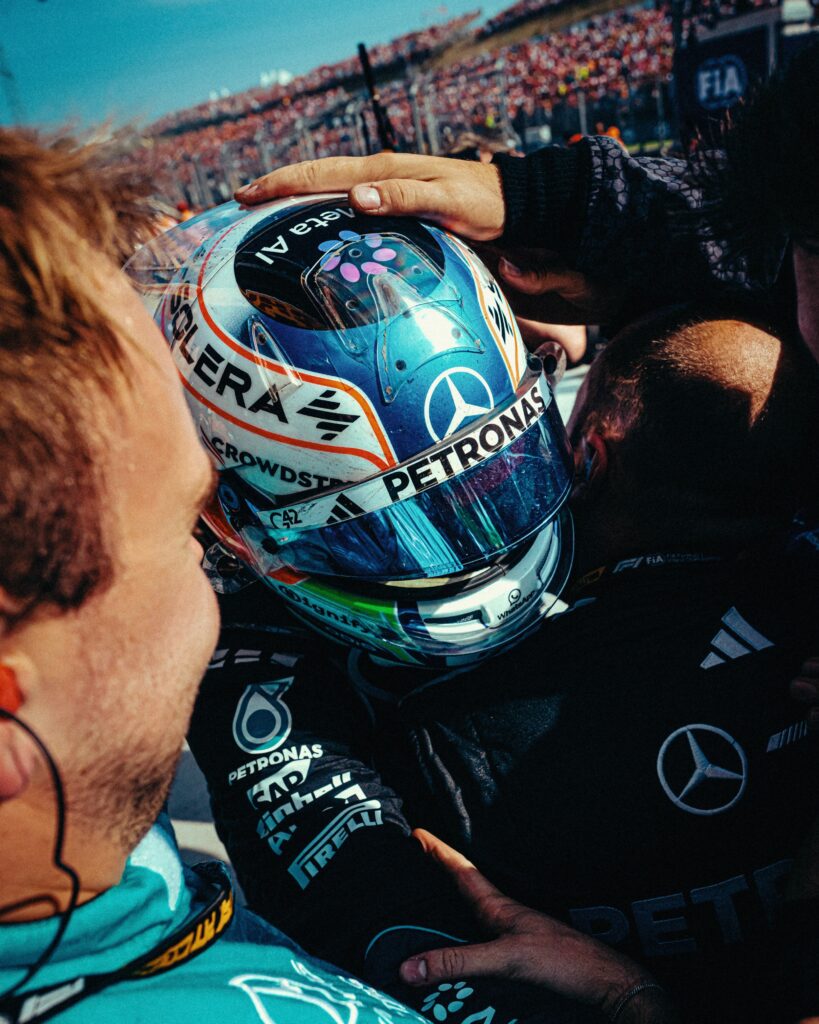
Television directors love Montreal because the podium framing, the trophy presentations and the champagne celebrations all benefit from the natural light over the Saint Lawrence and the deep green of the surrounding park. Helmets held aloft on this podium photograph beautifully, with the chrome and matte finishes catching the late afternoon sun in ways that flat studio shots can never replicate.
Three Montreal podium visuals consistently rank among the most reproduced images in F1 collector circles: Lewis Hamilton’s seventh Canadian victory in 2019, Max Verstappen’s commanding win in 2022 that confirmed Red Bull’s dominance of the new ground-effect era, and the Ferrari one-two of 2004 with Michael Schumacher and Rubens Barrichello. Each of those moments produced helmet imagery that has since been replicated, displayed and traded by enthusiasts around the world as full-size 1:1 collector items.
Colour and Contrast on the Podium
One reason Montreal podiums look so striking is the colour contrast between team liveries and the Canadian backdrop. Red Ferrari helmets, papaya McLaren designs, dark blue Alpine lids and the deep navy of Williams all pop against the green and grey of the venue. For anyone building a themed display cabinet, a Montreal-spec replica almost always sits well next to teammates and rivals because the colour balance has been refined by decades of podium photography.
Livery Stories That Belong on a Shelf
Beyond the helmets themselves, the cars that have won in Montreal carry their own visual mythology. The black and gold Lotus liveries of the late 1970s, the red and white Marlboro McLarens of the late 1980s, the Rothmans Williams blue and white of the mid 1990s and the modern matte black Mercedes era have all claimed Canadian victories. Each design tells a story not only of an era but of a specific weekend in Montreal where everything came together.
The 2026 Regulation Shift
The new 2026 technical rules bring revised aerodynamic surfaces, recalibrated power units with a larger electrical component, and in many cases redesigned liveries to highlight new sponsors and a cleaner overall look. Montreal will be one of the first opportunities for fans and collectors to see those liveries under the unique Canadian light, and to judge how the design language of this new era translates into display-worthy form.
Why Era-Defining Liveries Matter
Collectors often build their cabinets around eras rather than individual seasons. A 2026 Canadian GP helmet replica is therefore not just a souvenir of one weekend, but a foundational piece for any 2026-era display, especially given how significantly the regulations reshape the visual identity of the field.
Trivia and Curiosities for the True Enthusiast
Montreal is a circuit dense with stories that go beyond the headline results. Did you know that the famous Wall of Champions at the exit of the final chicane earned its name in 1999, when three world champions, Michael Schumacher, Damon Hill and Jacques Villeneuve, all crashed into it in the same race? Or that the circuit is built on the site of Expo 67, and that the lake inside the track was originally part of the Olympic rowing basin for the 1976 Montreal Games?
Quick-Fire Facts
- The circuit has hosted F1 every year since 1978 with a small number of exceptions, including 1987 and 2020 and 2021.
- Gilles Villeneuve won the inaugural Canadian Grand Prix at this circuit in 1978, the same year it opened, in a Ferrari 312T3.
- Lewis Hamilton holds the record for most wins at this venue in the modern era.
- Robert Kubica’s 2008 victory came just one year after his violent accident at the same circuit in 2007, an emotional bookend that defines Montreal’s storytelling tradition.
Helmet Trivia Worth Remembering
Sebastian Vettel raced in Montreal in 2019 with a helmet design that referenced classic Ferrari heritage colours, a livery that has since become one of the most replicated in collector circles. Daniel Ricciardo, winner of the 2014 Canadian GP, wore a helmet whose Honey Badger logo and bold yellow accents are now considered an essential piece of any modern display cabinet. Each of these stories adds depth to the items that sit on a shelf and gives every replica its own conversation.
Building a 2026 Canadian GP Display
If you are planning to commemorate the 2026 Canadian Grand Prix in your collection, think in layers. The first layer is the headline driver’s helmet of the weekend, ideally with any one-off Canadian artwork. The second layer is a teammate or rival lid that contextualises the result and provides colour balance. The third layer is historical depth, perhaps a classic Villeneuve-era tribute or a previous Montreal winner’s helmet, placed alongside to create a narrative arc across decades.
Lighting and Presentation
Montreal helmets reward warm, directional lighting. Because so many Canadian liveries feature metallic finishes, chrome accents and bright contrast colours, a single warm spotlight from slightly above the front of the helmet recreates the podium aesthetic that made the original image so memorable. Pair that with a matte background and you have an exhibition-quality presentation.
Final Thought Before Race Weekend
Whether or not the 2026 Canadian GP delivers a classic on track, the visuals it produces will become part of F1’s collective collector memory. Be ready to identify the helmets and liveries that matter, and remember that the best display pieces are not always the winners. Sometimes the most interesting story belongs to a midfield driver with a one-off design that nobody saw coming.
“Montreal has always been a circuit where the visuals are as memorable as the results. The light, the podium, the helmets — everything photographs beautifully.”
— 123Helmets editorial desk
FAQ
Q: Why is the Canadian GP so popular with helmet collectors?
Because Montreal regularly attracts one-off helmet designs, tributes to Gilles Villeneuve and bespoke liveries that exist for only one weekend. These limited-window designs translate beautifully into full-size 1:1 replicas for display.
Q: What makes Montreal podium photography so distinctive?
The combination of natural late-afternoon light over the Saint Lawrence River, the deep green surroundings of Île Notre-Dame and the contrast with team colours produces some of the most reproduced visuals of the F1 season.
Q: Are 2026 helmets significantly different from previous seasons?
While helmet shapes follow general technical standards, the artwork and liveries around the 2026 regulation shift often change considerably, making this season’s designs particularly interesting as collector pieces.
Q: Which historic Canadian GP helmets are most sought after?
Tribute designs linked to Gilles Villeneuve, Jacques Villeneuve’s championship-era lid, Sebastian Vettel’s heritage Ferrari designs and Lewis Hamilton’s multiple Canadian victory helmets are among the most popular as 1:1 display replicas.
Q: How should I display a Canadian GP helmet replica at home?
Use a warm directional light from slightly above the front of the helmet, place it against a matte neutral background, and consider pairing it with another lid from the same era to create a podium-style storytelling arrangement.
Browse F1 Helmet Collection
Display and collector replicas only. Not certified for protective use. Full-size 1:1 scale.