
Blog
George Russell Faces ‘Psychological’ Warning Before Canadian GP: A Mercedes Display Story
 123Helmets Editorial Team
George Russell Faces ‘Psychological’ Warning Before Canadian GP: A Mercedes Display Story
The build-up to the Canadian Grand Prix delivered one of the most fascinating subplots of the Mercedes season: a public, almost paternal warning aimed at George Russell about the mental side of fighting at the front. For collectors who chase the silver and petrol-green aesthetic of modern Mercedes, this weekend in Montreal turned into a showcase of livery contrast, helmet design and podium presence — a perfect chapter to revisit through a full-size 1:1 collector replica display.
Key Takeaways
George Russell entered the Canadian GP under a public ‘psychological’ spotlight, sharpening the narrative around his Mercedes campaign.
Montreal’s lighting and podium backdrop made the Mercedes silver-and-teal livery a standout subject for display photography.
Russell’s helmet design — blue, white and signature flashes — remains one of the most recognisable collector pieces on the grid.
The weekend reinforced why Canadian GP moments are prized centrepieces in any full-size 1:1 replica helmet collection.
The Psychological Warning That Set the Tone
Ahead of the Canadian Grand Prix, George Russell arrived in Montreal with more than just set-up notes and tyre simulations on his mind. A pointed comment from within his own paddock orbit framed the weekend in unusually personal terms: a ‘psychological’ warning, suggesting that the pressure of leading Mercedes through a transitional era could weigh as heavily as any mechanical limitation.
For a driver who has always projected calm articulation in front of the cameras, the framing was striking. It implied that the next step in his career — from rising talent to undisputed team leader — would be decided as much in the mind as in the cockpit. And in F1, those psychological inflection points often produce the most iconic visuals: the helmet visor sliding down a fraction slower, the gloved hand resting longer on the halo, the post-session walk back to the garage that becomes a poster on a collector’s wall.
Why Montreal Amplifies the Pressure
The Circuit Gilles Villeneuve is one of the most unforgiving venues on the calendar for mental errors. Walls sit centimetres from the racing line, the Wall of Champions waits at the final chicane, and the weather forecast almost always threatens to rewrite the script. For Russell, answering a psychological challenge in this specific theatre carried extra symbolic weight — and for collectors, it added another layer of meaning to any Canadian GP piece destined for display.
Russell’s Helmet: A Collector’s Centrepiece
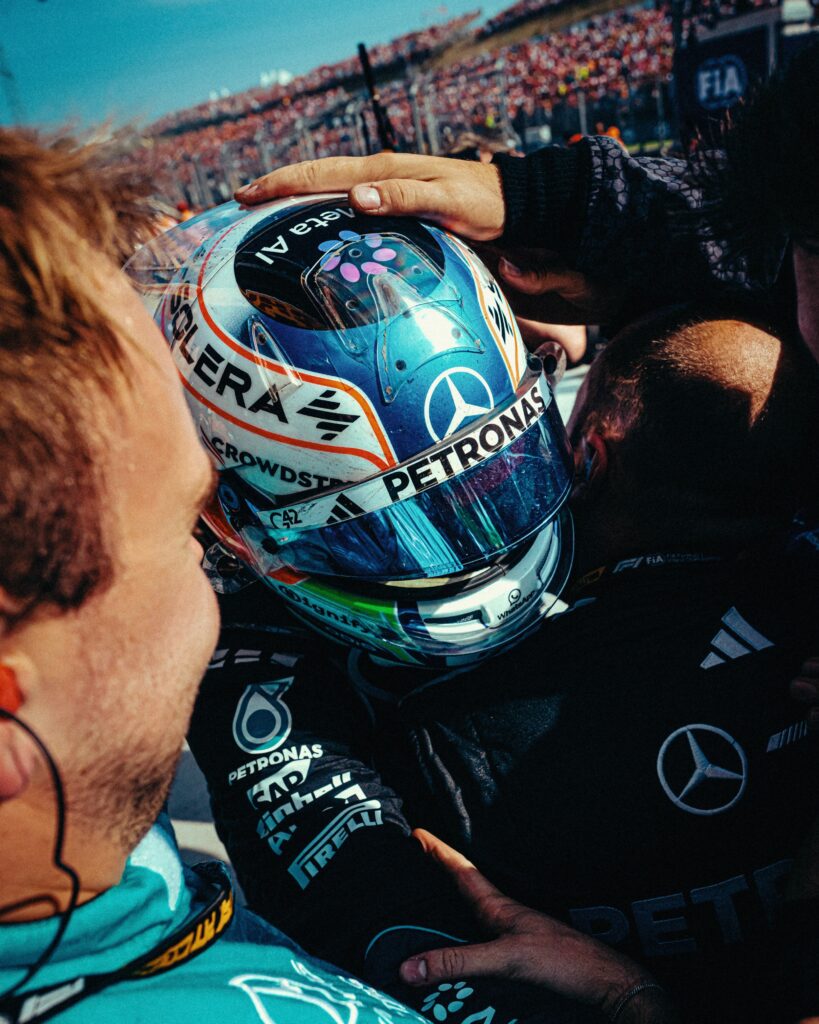
George Russell’s helmet has become one of the most recognisable silhouettes on the current grid. The deep blue base, crisp white accents and signature personal markings translate beautifully into a full-size 1:1 replica — the kind of collector item that commands a dedicated shelf, a focused spotlight and a clear acrylic case.
Design Elements That Work on Display
Three features in particular make this design ideal as an exhibition piece. First, the colour blocking is bold enough to read clearly from across a room, which matters when you arrange a row of driver helmets in a home gallery. Second, the contrast between matte and gloss zones catches directional lighting in a way that flat liveries cannot. Third, the personalised touches — initials, family references, and subtle graphic motifs — give the helmet a storytelling dimension that rewards close inspection.
Pairing With Mercedes Livery Cues
When displayed alongside scale models or framed prints featuring the Mercedes silver-and-petrol-green car, Russell’s helmet ties the composition together. The blue of the lid acts as a visual anchor against the cooler tones of the chassis, producing a balanced collector vignette that photographs exceptionally well under warm LED lighting.
Race Recap: How Russell Answered the Warning
From the moment the garage doors opened in Montreal, Russell’s body language suggested he had absorbed the psychological framing and decided to convert it into focus rather than friction. Practice sessions saw him methodically build pace, prioritising long-run consistency over single-lap heroics — the kind of measured weekend that often precedes a strong Sunday result.
Qualifying: Precision Over Bravado
Qualifying at Montreal rewards drivers who trust the front end through the chicanes and resist the temptation to over-rotate the car onto the kerbs. Russell’s approach reflected exactly that discipline. His lap-building in Q3, with each sector progressively cleaner, mirrored the mental composure his critics had questioned only days earlier.
Race Day: Managing the Variables
Sunday in Canada is rarely straightforward. Tyre degradation, safety car windows and the ever-present threat of rain all conspire to test a driver’s decision-making. Russell’s communication on the radio — concise, forward-looking, never reactive — became one of the defining audio textures of the broadcast. For fans assembling their own commemorative displays, those team-radio moments translate into the perfect backdrop for a 1:1 replica helmet sitting on a black plinth, with the race date discreetly engraved on a small plaque.
The Podium Visual
Whether or not the final classification matched expectations, the post-race images from Montreal carried that unmistakable Canadian GP aesthetic: the maple-leaf trophy graphics, the bilingual signage, and the cool blue light that bathes the podium late in the afternoon. These are the frames that collectors freeze in their minds when choosing which helmet design to add next to their shelf.
Livery Focus: Why This Era Photographs So Well
Mercedes’ current visual identity is a study in restraint. The dominant silver, the deep accents and the carefully placed sponsor marks create a livery that reads as premium rather than busy. Against the green-and-grey environment of Montreal — the river, the trees of Île Notre-Dame, the concrete pit complex — the car becomes a moving piece of industrial design.
Translating That Aesthetic Into a Display
Collectors who want to capture this era should think about their setup the way a museum curator would. A neutral background — charcoal felt, brushed aluminium or matte black acrylic — lets the Mercedes tones breathe. Lighting from above and slightly to the front emphasises the curvature of a full-size 1:1 helmet replica, while a softer rear light separates the piece from the wall behind it.
Helmet as the Hero
In any Mercedes-themed corner of a collection, the helmet should be the hero object. Cars and trophies support the narrative, but the helmet is the singular item that encapsulates the driver. Russell’s lid, displayed at eye level, becomes the focal point that ties together every other piece of memorabilia around it.
The Bigger Picture for Russell’s Season
The Canadian Grand Prix is rarely a season-defining race in isolation, but it often sets the tone for the European summer that follows. By absorbing a public psychological challenge and answering it with a controlled, professional weekend, Russell did more than score points — he reinforced his standing as a driver capable of leading Mercedes through whatever comes next.
What Collectors Should Watch Next
For anyone curating a long-term display, the second half of the season tends to produce the helmet designs worth chasing. Special one-off editions, tribute liveries and milestone-race lids frequently appear during this window. Russell’s base design is already a strong anchor for any collection; any future variant will slot in beside it as a natural progression piece.
Building a Narrative Shelf
Consider arranging a ‘Russell narrative shelf’: his earliest design alongside the current Mercedes lid, with the Canadian GP era marked clearly. It tells the story of a driver growing into leadership, and it gives any visitor an immediate sense of why this period of F1 matters.
Why the Canadian GP Belongs in Every Collection
Few races on the calendar combine atmosphere, history and visual richness like the Canadian Grand Prix. The Wall of Champions, the bilingual crowd chants, the late-spring light over the St. Lawrence — these are details that elevate a race from sporting event to cultural moment. For collectors, that elevation matters because it transforms a helmet from object into artefact.
The Display Argument
A full-size 1:1 replica of Russell’s helmet, presented in the context of his Canadian GP weekend, is more than a fan purchase. It is a curated piece that captures a specific psychological turning point, a specific livery era and a specific venue with deep racing heritage. That combination is what separates a casual collection from a thoughtful one.
Final Thought for the Curator
If you are building a Mercedes corner, a British-driver shelf or a ‘modern era’ wall, the story that emerged in Montreal — a young leader answering a psychological challenge on one of the sport’s most demanding circuits — is exactly the kind of narrative your display deserves to tell.
“The mental side of racing is where careers are made. Montreal is the kind of weekend that reveals who you really are behind the visor.”
— Paddock perspective, Canadian GP weekend
FAQ
Q: What was the ‘psychological’ warning issued to George Russell before the Canadian GP?
It referred to the mental pressure of leading Mercedes through a competitive era — a public acknowledgement that the next stage of Russell’s career would be tested as much by mindset as by machinery. The framing turned Montreal into a symbolic proving ground.
Q: Why is George Russell’s helmet design popular among collectors?
The combination of deep blue, crisp white and personalised markings reads beautifully as a full-size 1:1 display piece. Strong colour blocking, mixed matte and gloss finishes, and meaningful personal details make it photograph well and hold attention on a shelf.
Q: How should I display a Mercedes-era F1 replica helmet at home?
Use a neutral background such as matte black acrylic or charcoal felt, add front-top lighting to highlight the helmet’s curvature, and position the piece at eye level. Pair it with subtle Mercedes livery cues for a cohesive collector vignette.
Q: Are these helmets suitable for any kind of on-track or protective use?
No. These are full-size 1:1 collector and display replicas only — designed as exhibition pieces for fans and collectors. They are not intended for any protective, wearable or on-track purpose.
Q: What makes the Canadian Grand Prix a meaningful race for a helmet collection?
Montreal combines historic atmosphere, demanding layout and rich visual character. Helmets tied to memorable Canadian GP weekends carry strong narrative value, making them standout centrepieces within a curated F1 display.
Explore our full-size 1:1 collector replicas and build your own Mercedes-era display shelf — Browse F1 Helmet Collection.
Display and collector replicas only. Not certified for protective use. Full-size 1:1 scale.