
Blog
Circuit Gilles Villeneuve: The Complete Guide to Montreal’s Iconic F1 Stage
 123Helmets Editorial Team
Circuit Gilles Villeneuve: The Complete Guide to Montreal’s Iconic F1 Stage
From the Wall of Champions to legendary podium helmets, the Circuit Gilles Villeneuve has produced some of Formula 1’s most unforgettable visuals — and some of the most coveted display-worthy helmet liveries ever painted.
Key Takeaways
The Circuit Gilles Villeneuve has hosted the Canadian Grand Prix since 1978, named after Ferrari legend Gilles Villeneuve.
The Wall of Champions has claimed multiple world champions, becoming one of F1’s most photographed barriers.
Montreal podiums have featured some of the most collectible one-off helmet liveries in modern F1 history.
The semi-street layout creates dramatic light, color and helmet visibility — a dream for collectors of 1:1 display replicas.
A Circuit Born From Tragedy and Triumph
The Circuit Gilles Villeneuve sits on the Île Notre-Dame, a man-made island in the Saint Lawrence River created for Expo 67. When Formula 1 needed a permanent home in Canada after the closure of Mosport and a brief stint at Circuit Mont-Tremblant, Montreal answered the call. The first race on the island layout took place in 1978, and in a moment of pure cinematic destiny, the winner was a young French-Canadian driver in a red Ferrari: Gilles Villeneuve.
When Villeneuve tragically lost his life at Zolder in 1982, the circuit was renamed in his honour. Few F1 venues carry such a personal, emotional foundation. Every visit to Montreal is, in some sense, a tribute lap. That emotional weight is part of why helmets worn at this circuit so often become coveted collector pieces — drivers know the history, and they paint accordingly.
The Layout: Fast, Brutal, Beautiful
Stretching 4.361 kilometres across 14 corners, the Circuit Gilles Villeneuve is a hybrid — not quite a street circuit, not quite a permanent track. It blends long flat-out straights with tight chicanes, heavy braking zones and barriers that loom uncomfortably close. There is no margin for error, and that is precisely the point.
The track flows from the Senna Curve (Turn 1-2) through fast chicanes, the iconic Casino hairpin, the back straight known as Droit du Casino, and finally into the legendary final chicane guarded by the Wall of Champions. It rewards bravery, punishes ego, and creates the kind of racing that fills highlight reels — and helmet display cabinets — for decades.
The Wall of Champions: F1’s Most Famous Barrier
Exiting the final chicane onto the main straight, drivers face a concrete wall painted with the words Bienvenue au Québec. In 1999, that wall earned a darker nickname when three world champions — Damon Hill, Michael Schumacher and Jacques Villeneuve — all crashed into it during the same Grand Prix weekend. The Wall of Champions was born, and it has been claiming victims ever since.
Why It Matters for Helmet Collectors
The Wall of Champions has produced some of the most photographed onboard footage in F1 history — and those onboards have immortalised certain helmet designs. Sebastian Vettel’s matte navy Montreal special, Jenson Button’s mirrored white-and-gold lid from his 2011 victory, Lewis Hamilton’s Canadian-flag tribute helmets — these designs gained iconic status precisely because the cameras lingered on them during dramatic Montreal moments.
For collectors building a curated display, Montreal-era helmets carry a unique provenance. They represent precision under pressure, the visual identity of a driver staring down concrete at 320 km/h. A full-size 1:1 collector replica of one of these designs is not simply décor — it is a freeze-frame of a circuit that demands everything from its visitors.
Defining Moments and Podium Visuals
Jenson Button, 2011: The Greatest Comeback
In a rain-soaked four-hour epic, Jenson Button came from last place after a collision, multiple stops and a drive-through penalty to win on the final lap as Sebastian Vettel locked up at the final chicane. The podium image — Button in his white McLaren helmet, drenched, grinning — remains one of the most reproduced photographs in modern F1. The helmet design from that weekend is a centerpiece in countless private collections.
Lewis Hamilton’s Montreal Dominance
With seven Canadian Grand Prix victories, Hamilton owns Montreal. His evolving helmet liveries across these wins — from the early yellow-and-purple Mercedes-era designs to the bold pink, purple and stars-and-stripes specials — create a chronological narrative that maps perfectly onto a serious display shelf. Each one captures a different chapter of his career, all bound by the same backdrop of the Saint Lawrence skyline.
Daniel Ricciardo, 2014: A First Win and a Smile
The Australian’s first Grand Prix victory came in Montreal, and the moment was magnified by his bright honey-badger-inspired helmet design — a livery that became immediately collectible. The contrast of his beaming face on the top step against the cool grey of the podium structure remains one of F1’s great visual juxtapositions.
Robert Kubica, 2008: The Polish Triumph
Kubica’s only F1 victory came at Montreal, exactly one year after his terrifying 2007 crash at the same venue. His red-and-white BMW Sauber helmet, with the Polish flag prominently displayed, became an instant icon. Few Montreal helmets carry more emotional weight, and replicas of that design hold a special place in collections devoted to F1’s most poignant storylines.
The Visual Identity of a Montreal Weekend
What makes the Circuit Gilles Villeneuve so photogenic? It is a combination of factors that no other venue quite replicates. The June light over the Saint Lawrence creates long, warm shadows during evening practice sessions. The trackside greenery contrasts sharply with the red-and-white pit buildings. And the proximity of barriers to racing line means every onboard camera captures helmet designs in stunning clarity.
A Photographer’s and Collector’s Dream
Television broadcasts from Montreal traditionally feature more close-up helmet shots than almost any other round. The combination of slow chicanes, tight hairpins and dramatic braking zones lets cameras dwell on the driver’s visor and crown design. For someone curating a 1:1 collector display, this means Montreal helmets often have the strongest reference photography available — every line, sponsor placement and finish detail well-documented from multiple angles.
The podium itself, framed by the modernist pit complex and crowded with passionate fans waving Quebec flags, provides one of the most distinctive backdrops on the calendar. Montreal podium photos are immediately recognisable, and the helmets featured in those photographs become natural anchors for any thoughtful collection.
Tifosi, Maple Leaves and the Atmosphere of Île Notre-Dame
Montreal hosts one of the most cosmopolitan crowds in F1. A massive Tifosi contingent crosses the border from across North America to support Ferrari. Canadian fans turn up in their thousands for the legacy of Gilles and Jacques Villeneuve. European visitors arrive for the city itself — bilingual, vibrant, food-obsessed. The result is an atmosphere unlike any other venue.
Why the Ferrari Connection Endures
The Villeneuve name is sacred to Ferrari fans, and the Scuderia always shows up with extra emotional investment in Montreal. Charles Leclerc’s helmet designs have repeatedly nodded to the venue’s history, and Ferrari livery elements — the red, the Cavallino Rampante, the yellow shield — pop against the Montreal skyline in a way that makes Ferrari helmets from this race especially desirable as full-size display pieces. The combination of red lid, red car and the spirit of Gilles is, for many collectors, the holy trinity of F1 nostalgia.
Building a Montreal-Inspired Helmet Display
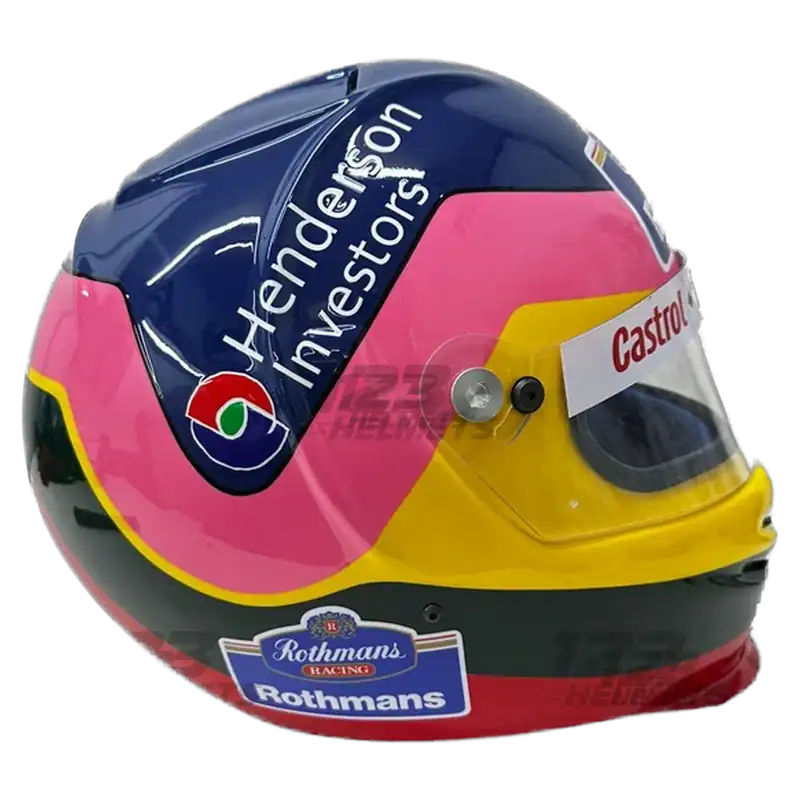
A curated Montreal collection tells a story across decades. Start with the foundational moment — a Gilles Villeneuve 1978 Ferrari helmet replica — and trace the lineage forward. Add Jacques Villeneuve’s 1997 championship-era design for the father-son chapter. Bring in Schumacher and Hamilton for the dominant-era statements. Conclude with the modern era: Leclerc, Verstappen, Norris and Russell, each with their own evolving Canadian Grand Prix specials.
Display Considerations
Montreal-themed displays benefit from lighting that mimics that famous June afternoon glow — warm, directional, with enough intensity to bring out metallic flakes, chrome accents and matte textures. Full-size 1:1 collector replicas demand proper shelving depth and angled mounting that respects the helmet’s silhouette. A Montreal display works particularly well when paired with framed podium photography or circuit-map art, creating a coherent visual narrative.
These are not protective items, and they are not meant to be. They are exhibition-quality tributes — sculptural objects designed to celebrate the artistry of helmet design and the history of one of motorsport’s most evocative venues. The Circuit Gilles Villeneuve, with its emotion, its danger and its visual drama, deserves nothing less.
“Montreal is special. You feel the history every lap, and you know one mistake at the final chicane and the wall is waiting.”
— Paddock sentiment, Canadian GP
FAQ
Q: When did the Circuit Gilles Villeneuve first host Formula 1?
The circuit hosted its first Canadian Grand Prix in 1978, with the inaugural race famously won by Gilles Villeneuve himself in a Ferrari. The venue was renamed in his honour following his death in 1982.
Q: What is the Wall of Champions?
It is the concrete barrier on the exit of the final chicane, painted with ‘Bienvenue au Québec’. In 1999, three reigning or future world champions — Hill, Schumacher and Villeneuve — all crashed into it during the same weekend, giving the wall its legendary nickname.
Q: Why are Montreal helmet designs popular with collectors?
The circuit produces unusually dramatic onboard footage and close-up television coverage, meaning helmet designs from Canadian Grand Prix weekends are exceptionally well-documented. Many drivers also run special one-off liveries in Montreal, making them prized full-size 1:1 collector replicas.
Q: How long is the Circuit Gilles Villeneuve?
The current layout measures 4.361 kilometres across 14 corners, blending long straights with tight chicanes in a semi-permanent layout on the man-made Île Notre-Dame.
Q: Are 123Helmets replicas suitable for racing or track use?
No. All 123Helmets pieces are full-size 1:1 collector and display replicas, designed as exhibition-quality items for collectors, fans and showrooms. They are not certified for any protective or wearable application.
Explore Montreal-era liveries and other legendary designs in our full-size 1:1 collector range.
Display and collector replicas only. Not certified for protective use. Full-size 1:1 scale.