Blog
Canadian Grand Prix Weather Forecast: What Collectors Should Watch on the Montréal Skyline
 123Helmets Editorial Team
Canadian Grand Prix Weather Forecast: What Collectors Should Watch on the Montréal Skyline
The Canadian Grand Prix at the Circuit Gilles Villeneuve is famous for two things: extraordinary racing on the Île Notre-Dame, and a weather forecast that can flip the entire weekend on its head. From bright Saint Lawrence sunshine to violent summer thunderstorms rolling in off the river, Montréal weather has produced some of the most visually unforgettable races in modern F1 — and, by extension, some of the most coveted helmets and liveries in the collector world. In this recap-style preview, we look at what the forecast typically delivers, how it shapes the podium visuals, and which display-worthy moments turn a regular race weekend into something a 1:1 replica owner will treasure for decades.
Key Takeaways
Montréal’s June micro-climate routinely mixes sunshine, humidity and thunderstorms, producing dramatic visual contrasts on helmets and liveries.
Wet sessions at the Circuit Gilles Villeneuve historically generate the most iconic podium imagery — and the most collectible 1:1 replica helmets.
Forecast volatility forces drivers and teams toward bolder visor tear-off strategies and reflective finishes that photograph beautifully under grey skies.
For collectors, a Canadian GP-spec helmet is one of the strongest centerpiece pieces for any full-size display because of its narrative weight.
Montréal in June: a forecast built for drama
The Canadian Grand Prix sits in one of the most meteorologically unstable windows on the calendar. Mid-June in Montréal usually means daytime highs between 22°C and 28°C, but the real story is the humidity climbing off the Saint Lawrence and the cold fronts sweeping down from the Laurentians. The result is a forecast that rarely commits: morning sun, afternoon clouds, and an evening thunderstorm probability that hovers stubbornly between 30% and 60% across the three-day weekend.
For television viewers and trackside photographers, this is a gift. The light at the Circuit Gilles Villeneuve changes constantly — warm gold in qualifying, slate grey by the formation lap, and sometimes a bright post-storm rainbow over the Biosphère by the chequered flag. That shifting palette is exactly what turns ordinary helmet liveries into collector-grade visual moments, and it explains why so many of the most sought-after full-size 1:1 replicas in private collections carry a Canadian GP backstory.
Why the forecast matters for visuals, not just strategy
Most weather coverage of a Grand Prix focuses on tyre choice and race pace. For us, the forecast matters for a different reason: it dictates how a helmet looks on camera. A matte-finish lid that appears understated in dry Bahrain sunshine can transform into a mirror-like sculpture under Montréal’s wet asphalt reflections. Metallic flakes pop. Chrome accents catch the floodlights. Even sponsor logos read differently when the visor is streaked with rain and tear-offs.
Wet-weather Canadian GPs and their collector legacy
Ask any long-time fan to name the most visually iconic Canadian Grands Prix and the list will lean heavily wet. The 2011 race — six hours of intermittent monsoon, red flags, and a final-lap pass under a brightening sky — remains a benchmark for podium imagery. The 2008 wet-dry chaos, the 2019 cool and overcast classic, and several rain-affected qualifying sessions all share one trait: the helmets on screen became characters in their own right.
When water beads on a clear-coated carbon shell, the underlying graphic seems to lift off the surface. Maple leaves, fleur-de-lis tributes, and bilingual messages added by drivers for the Canadian round suddenly read with extra depth. This is precisely why a Canada-spec helmet, even as a display-only replica, tends to anchor a collection. It carries the memory of conditions that no studio photograph can fake.
Special editions inspired by Montréal
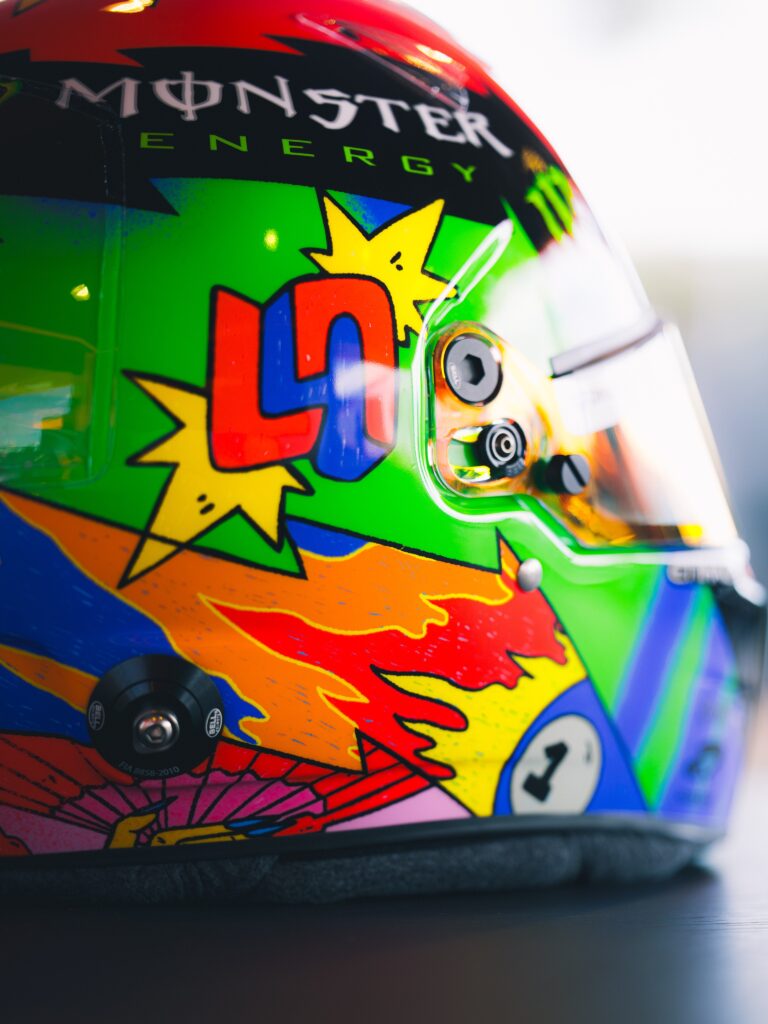
Several drivers have, over the years, prepared one-off or accent-modified designs specifically for the Canadian round. Red and white panels, subtle maple-leaf placements on the chin bar, and tributes to Gilles Villeneuve himself have all appeared. As collector items, these helmets travel exceptionally well in display cabinets: the color story is instantly readable from across a room, and the narrative — “this is the Montréal helmet” — is easy to share with visitors who may not know every technical regulation.
How drivers visually prepare for an uncertain forecast
Behind the helmet bag in the garage, the variables multiply when the forecast is mixed. Drivers and their helmet technicians prepare multiple visor configurations: dark tints for the rare full-sun qualifying hour, medium-iridium options for the typical overcast session, and clear or low-light visors for a wet race. Each visor frame can subtly change the front-on silhouette of the helmet, which is why detailed 1:1 replicas often include multiple visor styles for owners who like to rotate the display look.
The role of tear-offs and finish coatings
Tear-off strips are functional, but they also affect the visual texture of the helmet during the race. A driver in a heavy spray battle on lap 40 of the Canadian GP will have a visor that looks completely different to the one that lined up on the grid — slightly diffused, edge-stacked, and catching light unevenly. For collectors building a faithful exhibition piece, this is one of the small details that separates a casual replica from a true exhibition-quality display item: the finish should suggest the conditions of the race, not just the cleanliness of the launch photo.
Equally, the clear-coat layer on the shell itself is chosen with weather in mind. Montréal’s combination of UV, humidity and sudden rain favours a deep, glossy lacquer that resists micro-scratching from tear-off debris. Replicate that on a display helmet and the piece will photograph beautifully under any household lighting — warm bulbs, daylight LEDs, or a single spotlight in a glass cabinet.
Podium visuals: where weather and livery meet
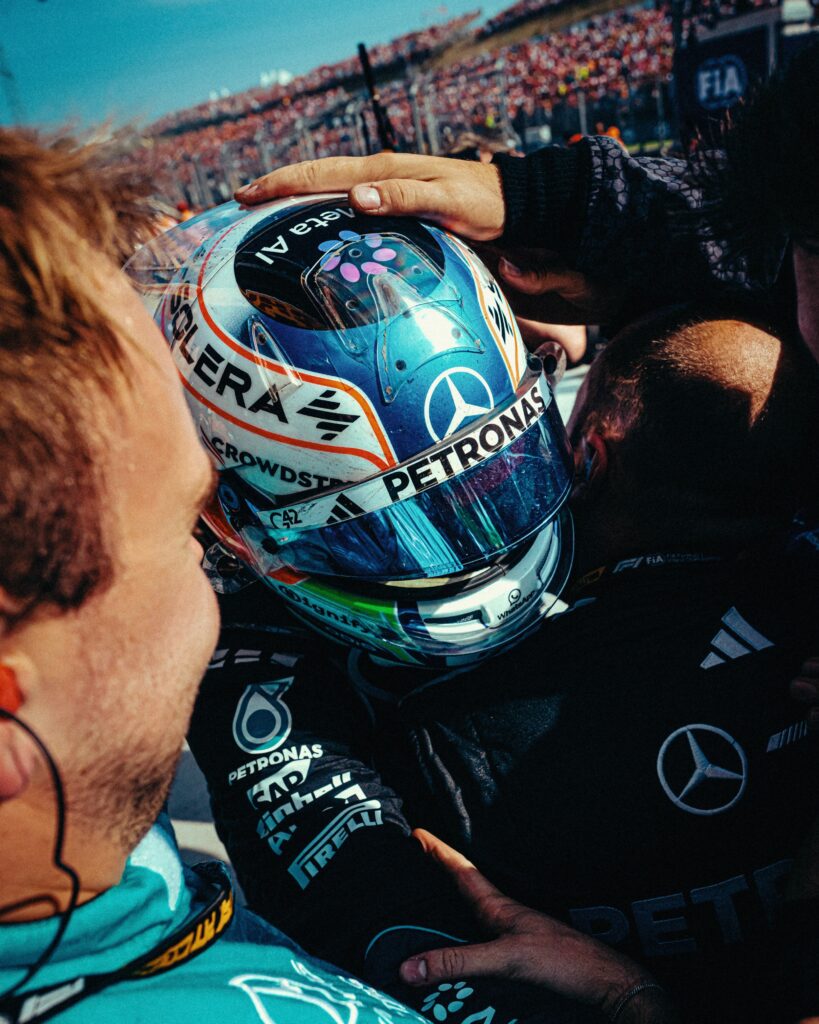
The Canadian GP podium is one of the most distinctive in the sport. The structure sits above the pit lane with the city skyline behind it, and depending on the day’s weather the backdrop ranges from luminous blue to dramatic charcoal. When the top three step forward holding their helmets, every reflective surface — visor, chin bar, top blade — picks up that backdrop and folds it into the image.
Why this matters for a display collection
A helmet held aloft on a sunlit Montréal podium reads as celebratory and warm. The same helmet under storm-grey skies reads as heroic and earned. When you place a full-size 1:1 replica in your home or office, you are choosing which of those moods you want the piece to project. Many collectors deliberately pair their Canadian GP replicas with cool-tone lighting to evoke the overcast podium aesthetic, because it amplifies the metallic and pearlescent layers within the paintwork.
It is also worth noting how trophies, champagne and team caps interact with the helmet in podium photographs. A great replica captures not just the paint scheme but the proportions and visor angle that made those podium frames work. That is the difference between a generic souvenir and a true exhibition-quality collector piece.
Building a Canadian GP-themed display at home
If the weather forecast for this year’s race is once again mixed — and history suggests it will be — there is a strong case for organising a small Montréal-themed corner in your collection. A full-size 1:1 replica helmet sits at the heart of it, but the surrounding elements amplify the story.
Suggested display elements
- A circuit map print of the Île Notre-Dame, ideally in a muted palette so the helmet remains the focal point.
- A neutral plinth or acrylic riser that lifts the helmet to roughly eye level when seated — the same vertical relationship as a podium photograph.
- Soft, directional lighting from above and slightly to the side, mimicking overcast Montréal daylight rather than harsh spotlights.
- A second piece — perhaps a scaled steering wheel replica or a framed race poster — to give the helmet a contextual partner without crowding it.
Rotating the centerpiece by season
Serious collectors often rotate which helmet sits in the prime display position depending on the time of year. A Canadian GP-spec replica naturally takes centre stage in late spring and early summer, when the real-world race weekend is approaching and conversation among visitors will gravitate to Montréal anyway. Come autumn, you might rotate in a different circuit story. This kind of curatorial thinking is what elevates a casual fan’s shelf into a genuine display collection.
What to watch this weekend — from a collector’s eye
When the forecast firms up in the final 48 hours before lights out, look beyond the lap times. Watch how the light falls on the front row in the parade lap. Note which helmets seem to glow under cloud cover and which disappear into the background. Pay attention to the post-race podium frames — the angle of the chin bar, the way the visor catches the sky, the brief seconds when a driver lifts the lid above their head with the Montréal skyline behind them. Those are the frames that, years from now, will define which Canadian GP replicas become the most prized.
A note on narrative value
Every helmet in a serious collection should carry a story. The Canadian Grand Prix, more than almost any other round, hands collectors a ready-made narrative: the unpredictable weather, the historic circuit, the bilingual fan culture, and the layered Villeneuve legacy. A 1:1 display helmet that captures even one of those threads is doing real cultural work in your home — it is not just an object, it is a conversation starter.
“Montréal weather is the weekend’s third driver — it shapes every photograph, every podium silhouette, and every helmet that ends up on a collector’s shelf.”
— 123Helmets editorial desk
FAQ
Q: What is the typical weather forecast for the Canadian Grand Prix?
Mid-June in Montréal usually delivers daytime temperatures between 22°C and 28°C with high humidity off the Saint Lawrence. Thunderstorm probability across the three-day weekend regularly sits between 30% and 60%, which is why the race so often features mixed conditions and dramatic visual moments.
Q: Why does weather matter for helmet collectors specifically?
Weather changes how a helmet reads on camera. Reflective finishes, metallic flakes and pearlescent layers behave very differently under bright sun versus overcast or wet skies. Canadian GP conditions tend to flatter complex paintwork, which is why Montréal-spec replicas often become centerpiece display pieces.
Q: Are Canadian GP helmets usually special one-off designs?
Not always full one-offs, but many drivers have, over the years, added subtle Canadian accents — maple-leaf placements, red-and-white panels, or tributes to Gilles Villeneuve. These details translate beautifully into full-size 1:1 replicas for collectors who value narrative as well as aesthetics.
Q: How should I light a Canadian GP-themed display helmet at home?
Soft, directional lighting from above and slightly to the side works best, mimicking overcast Montréal daylight. Avoid harsh single spotlights, which flatten the paintwork. Cool-tone LEDs can evoke the storm-grey podium mood that defines many of the most memorable Canadian Grands Prix.
Q: Are these helmets suitable for any kind of on-track or protective use?
No. The pieces we feature are display and collector replicas only, built as full-size 1:1 exhibition items. They are designed to be admired, photographed and curated as part of a home or office collection, not used in any active context.
Browse F1 Helmet Collection
Display and collector replicas only. Not certified for protective use. Full-size 1:1 scale.