Blog
Max Verstappen’s F1 Return: Re-Adapting After His Nürburgring GT3 Adventure
 123Helmets Editorial Team
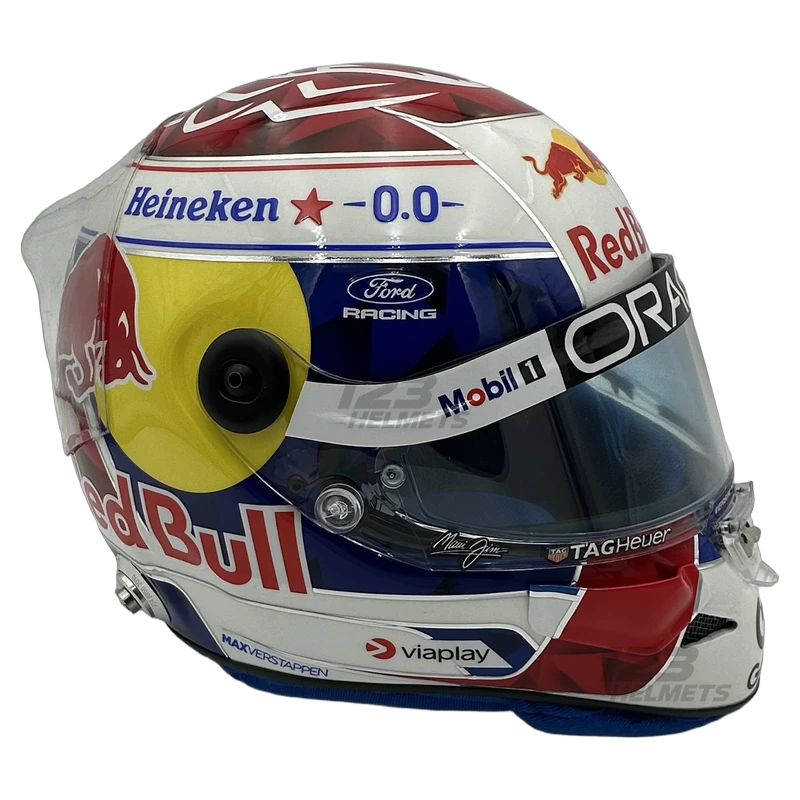
Max Verstappen’s F1 Return: Re-Adapting After His Nürburgring GT3 Adventure
After turning laps around the legendary Nordschleife in a GT3 machine, Max Verstappen now faces the curious challenge of re-tuning his instincts to the razor-sharp world of Formula 1. For collectors and display-focused enthusiasts, the contrast between his GT helmet livery and his familiar F1 colours offers a fascinating visual study — and a reminder of why his crash helmet remains one of the most coveted full-size 1:1 replicas on the shelves.
Key Takeaways
Verstappen’s Nürburgring GT3 outing offered a rare livery contrast versus his usual F1 helmet design — a dream pairing for display shelves.
Returning to F1 requires recalibrating throttle response, braking points, and aerodynamic feel after the heavier GT3 cockpit.
His current F1 helmet remains a signature collector item, instantly recognisable in navy, red and white tones.
Full-size 1:1 replicas capture the exact graphic detail seen on the podium — ideal exhibition pieces for fans.
From Nordschleife Mist to F1 Precision
There are few sights in modern motorsport as evocative as Max Verstappen threading a Ferrari 296 GT3 through the fog-touched corners of the Nürburgring Nordschleife. The Dutchman, already a four-time Formula 1 World Champion, used a recent break in the calendar to indulge a long-held passion: tackling the 20.8 km Green Hell in earnest, racking up laps, earning his permit, and ultimately competing in NLS rounds. For a driver of his calibre, it was less a holiday than a deliberate craft session — a chance to test himself in a totally different discipline.
And yet, with the F1 circus rolling on, the question becomes immediately practical: how does Verstappen recalibrate his hands, feet, and eyes from a GT3 car weighing roughly 1,300 kg with treaded tyres to a sub-800 kg ground-effect F1 machine that responds to inputs measured in milliseconds? The answer lies partly in his preparation, partly in his preternatural feel — and partly in the visual cues he carries with him, from his helmet design to the colours of his current team environment.
A Tale of Two Helmets
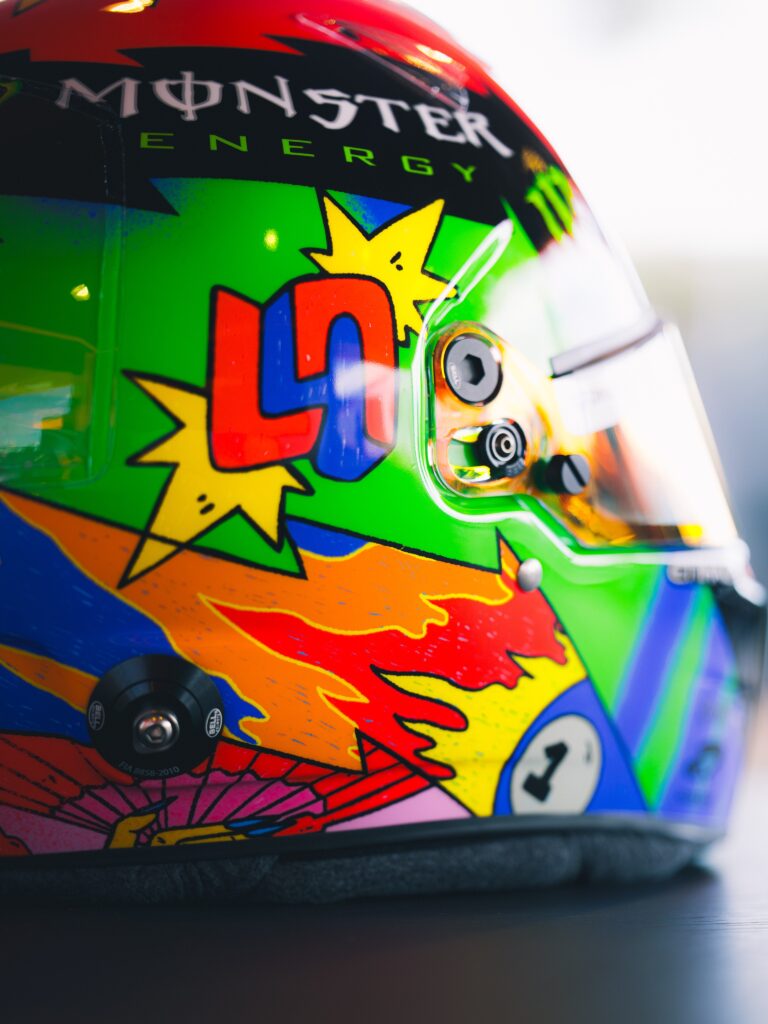
For collectors, the most striking element of Verstappen’s Nürburgring adventure was the helmet itself. His GT outings have at times featured subtly different graphics — a touch more matte finish, a different chin treatment, occasionally a homage to endurance racing traditions. Placed side-by-side with his F1 helmet on a display shelf, the contrast tells a story of two motorsport worlds colliding in one driver’s career. As a full-size 1:1 replica, either piece becomes a conversation starter; together, they form a genuinely exhibition-quality pairing.
The Physical Re-Adaptation Challenge
Reflexes, G-Forces and Cockpit Feel
A GT3 car, no matter how sophisticated, simply does not punish the body the way a modern F1 car does. Cornering loads in F1 routinely exceed 5G in high-speed sections; braking decelerations can crush a driver’s helmet forward against the HANS tethers with stunning force. After several days in a GT3, where the loads are real but markedly lower, the neck and core musculature adapt downward. Verstappen, famous for his year-round training regime with trainer Bradley Scanes, will have ramped up specific neck work in the days leading back into F1 duty.
Throttle Mapping and Braking Points
Then comes the throttle. A GT3 engine, governed by Balance of Performance and torque maps designed for endurance racing, delivers power in a relatively progressive manner. An F1 power unit — with its hybrid harvesting, deployment strategies, and immediate torque from the MGU-K — feels like a different beast entirely. Verstappen’s instinct for modulating throttle on corner exit, particularly in tricky low-speed traction zones, has to snap back to F1 calibration almost instantly.
Braking is similarly transformed. Carbon-carbon brakes on an F1 car only function in their narrow optimal temperature window, and the braking distances are absurdly short compared with anything a GT3 will reproduce. The first few laps of any F1 session post-Nordschleife will involve deliberate over-braking until the feel returns.
Helmet Livery as a Mental Anchor
The Power of Familiar Colours
One under-appreciated element of a driver’s re-adaptation is the psychological role of the helmet. When Verstappen pulls his F1 helmet over his head, the familiar interior scent, the precise foam pressure, the framed view through the visor — these are all triggers that snap him back into F1 mode. His current design, dominated by deep navy with red and white accents and his signature lion motif, is among the most recognisable in the sport.
For collectors building a serious display, this is exactly why a full-size 1:1 replica matters. The detail of the lion graphic, the layered red flashes, the crisp white lettering — all of it needs to be reproduced at exhibition quality to honour the original. A scaled-down piece simply cannot deliver the same presence on a shelf, in a study, or in a dedicated motorsport room.
Podium-Worthy Visuals
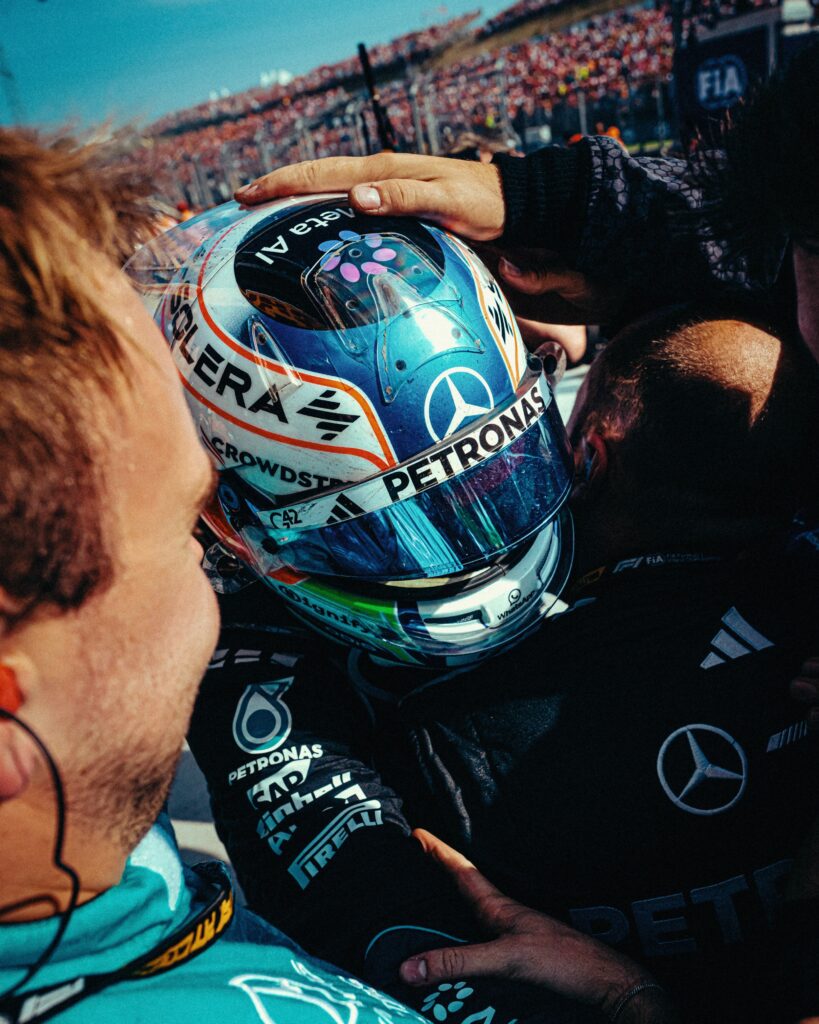
Verstappen’s podium appearances throughout this era have created an extensive library of helmet imagery for fans and replica makers alike. The way the helmet catches the champagne spray, the way the lion glints under stadium lighting at Singapore or Las Vegas, the matte-meets-gloss interplay in different weather conditions — these are the moments that define why his helmet has become one of the most collected display pieces in modern F1.
What the Stopwatch Will Tell Us
FP1 as the True Test
The opening practice session of his return weekend will be the most telling. Verstappen’s reference benchmark is his own previous data; engineers will overlay throttle traces, brake pressure curves, and steering inputs against his pre-Nürburgring baseline. Any lingering GT3 habits — slightly earlier braking, marginally smoother throttle application, a fractionally different line through medium-speed corners — will show up immediately.
History, however, suggests Verstappen adapts faster than anyone. His ability to jump into a simulator, a karting session, or indeed a GT car and immediately set competitive times has been documented throughout his career. There is no real reason to expect his Nürburgring adventure will have dulled his F1 edge in any meaningful way. If anything, the variety may have sharpened his sensory toolkit.
Tyre Feel and Aero Confidence
The bigger unknowns are tyre feel and aerodynamic confidence. F1 tyres operate in working windows that GT3 tyres simply do not approach, and the aerodynamic platform of a modern ground-effect F1 car rewards drivers who trust the floor at high speed. Verstappen’s confidence in carrying entry speed through fast corners is one of his defining attributes; rebuilding that trust over a single Friday is a real task, but one he has mastered repeatedly.
The Collector’s Perspective
Why This Era Matters for Display Shelves
For anyone curating a serious F1 helmet display, the current Verstappen era represents a high-water mark. Multiple championships, era-defining helmet artwork, and now this unusual GT3 chapter that adds depth and narrative to his story — all of it elevates the appeal of a full-size 1:1 collector replica. These are not pieces designed for the track; they are exhibition items meant to capture a moment, a livery, a career chapter.
The choice between his standard F1 design, a special-edition helmet from a one-off race like Zandvoort or Monaco, or one of his GT3 lids becomes a genuine curatorial decision. Many serious collectors are now opting for at least two pieces — one to represent his championship years, one to reflect his expanding motorsport identity beyond F1.
Display Tips for the Verstappen Helmet
A full-size 1:1 replica deserves proper presentation. Acrylic display cases protect against dust without obscuring the graphics. LED strip lighting positioned above and slightly forward of the helmet will highlight the depth of the lion motif and the crispness of the red accents. Keeping the helmet at eye level, rather than tucked away on a high shelf, allows visitors to appreciate the visor tear-off layers, the chin spoiler detail, and the precise paint transitions that define the original.
Looking Ahead: The Verstappen Brand Endures
A Career That Keeps Expanding the Lore
Whatever the result on his return weekend, Verstappen has already done something that enriches his story: he has stepped sideways into another discipline, learned, raced, and returned. That kind of breadth is what separates great champions from merely great drivers, and it is exactly the kind of narrative that gives replica collections their soul. A shelf showing his early Toro Rosso helmet, his championship-winning designs, and a hint of his Nürburgring chapter becomes more than memorabilia — it becomes a documented journey.
The F1 paddock will be watching closely as he laps the next circuit, but for collectors, the watching has already begun. Every podium photograph, every press conference image, every onboard shot adds detail to the reference library that helmet artisans use to craft exhibition-quality replicas. Verstappen’s helmet, in all its forms, continues to be one of the most rewarding pieces a serious F1 fan can own.
“Driving the Nordschleife properly is something I’ve wanted to do for a long time. It teaches you so much — different rhythm, different patience.”
— Max Verstappen, paddock comments
FAQ
Q: Does Verstappen use a different helmet design for GT3 races?
His GT outings have featured subtly varied graphics at times, though the core identity — the lion motif and signature colour palette — remains. The variations make for fascinating display contrasts when paired with his F1 helmet as full-size 1:1 replicas.
Q: How quickly can an F1 driver re-adapt after racing a GT car?
Top drivers like Verstappen typically need only a few laps in FP1 to recalibrate. Neck training in the days before, simulator work, and reference data overlays help speed the process.
Q: Why is Verstappen’s helmet such a popular collector piece?
The combination of multiple championships, a bold and instantly recognisable graphic, and an expanding motorsport story makes his helmet one of the most desirable exhibition-quality replicas in modern F1.
Q: What scale is best for a serious display?
Full-size 1:1 replicas are the standard for serious collectors. They capture every detail of the original livery and create genuine presence on a shelf — something scaled-down miniatures cannot replicate.
Q: How should I display a Verstappen helmet replica at home?
An acrylic case at eye level, with soft LED lighting from above, showcases the graphics best. Avoid direct sunlight to preserve the paint finish over time. These are display and collector items, not items intended for any protective use.
Shop Max Verstappen Collection
Display and collector replicas only. Not certified for protective use. Full-size 1:1 scale.