Blog
Question of the Week: Is More Overtaking in F1 Always Better?
 123Helmets Editorial Team
Question of the Week: Is More Overtaking in F1 Always Better?
Every race weekend reignites the same debate in paddock conversations and living rooms alike: does Formula 1 need more overtaking to be truly compelling? As collectors of full-size 1:1 replica helmets, we view each Grand Prix through a different lens — the visual storytelling, the livery contrasts on the grid, the iconic crest of a champion’s lid catching the sun on the podium. This week, we unpack the eternal question through the prism of recent race recaps, podium aesthetics, and the display-worthy moments that make Formula 1 the world’s most visually rich motorsport.
Key Takeaways
Overtaking quantity does not always equal racing quality — strategy, tension and rivalry matter just as much for memorable Grands Prix.
Some of the most iconic helmet and livery moments in F1 history came from low-overtake, high-drama races where visuals took centre stage.
Podium ceremonies remain the ultimate stage for full-size 1:1 replica helmets, where crest, colourway and champagne spray create collector imagery.
A balanced race — combining tactical depth with selective passes — generates the most desirable exhibition references for display collectors.
The Eternal Debate: Quantity vs. Quality of Wheel-to-Wheel Action
Formula 1 has wrestled with the overtaking question for decades. Every regulation cycle — from the ground-effect revival of 2022 to the upcoming 2026 power unit shake-up — has been framed, at least partly, around the desire to see more passes per lap. Broadcasters love the highlight reel. Casual viewers want action. And yet, ask any long-standing fan to name their favourite Grand Prix and they rarely cite the race with the highest overtaking count.
The 2024 and 2025 seasons have offered a fascinating test case. Some events delivered DRS trains and constant position changes, while others — Monaco, Imola, Zandvoort — distilled the championship into chess-like tension. Both produced unforgettable images. Both filled the podium with helmets that collectors immediately wanted on their shelves.
When more is genuinely more
There is no denying the visceral thrill of a multi-car battle through Eau Rouge or the Esses at Suzuka. Recent races at Interlagos and the Red Bull Ring showcased overtakes that will be replayed for years. For the display collector, these are gold: the camera angles, the helmet visors glinting in slipstream, the side-by-side liveries creating frame-perfect photographs that double as inspiration for shelf arrangements.
When less is decidedly more
Conversely, the slow-burn drama of a tactical race — think Verstappen managing tyres in clean air while a McLaren or Ferrari closes by half a second per lap — produces a different kind of beauty. The helmet, in those moments, becomes the protagonist. The onboard camera lingers on the crown of a driver’s lid, every chip, every sponsor decal, every personalised motif on full display.
Podium Visuals: Where the Helmet Becomes the Centrepiece
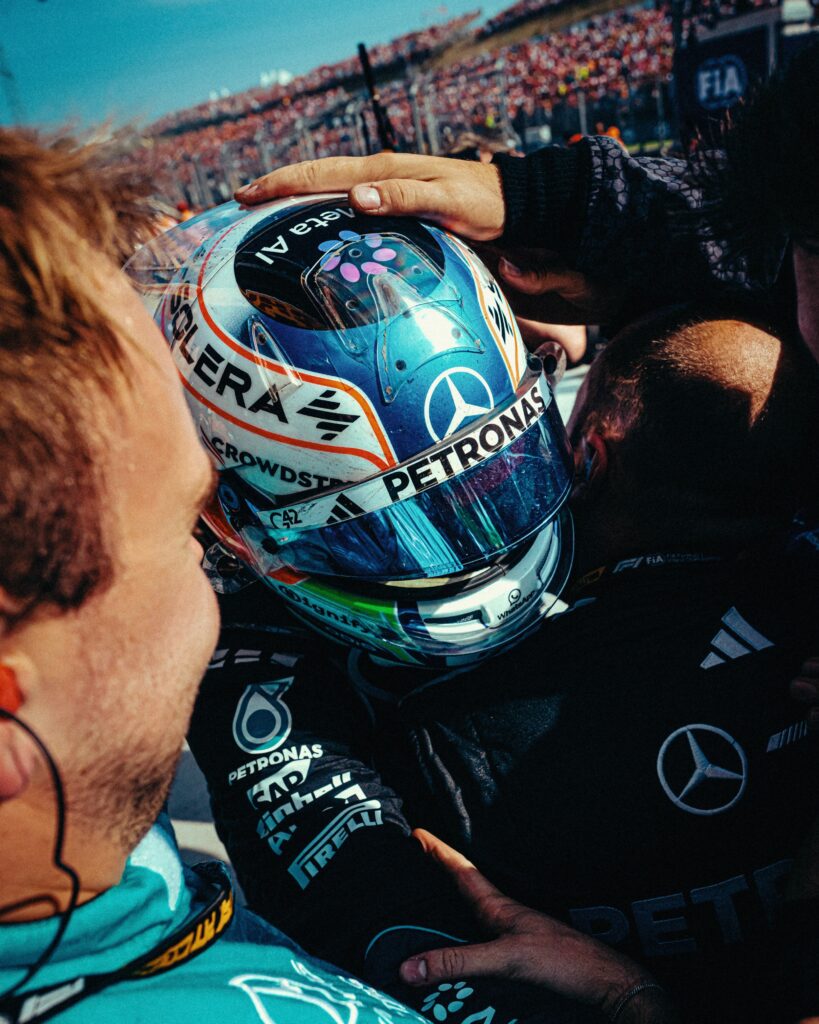
If you strip Formula 1 down to its most iconic frames, the podium ceremony stands at the very top. Three drivers, three helmets resting on the step or held aloft, three liveries reflected in the champagne. For the collector of full-size 1:1 replica helmets, this is the moment that justifies the shelf, the cabinet, the dedicated room.
The crest in close-up
Television directors have become increasingly sophisticated in their podium framing. The slow pan across helmets lined up on the front row of the rostrum has become a recurring visual signature. Verstappen’s lion, Hamilton’s union flag motifs, Norris’s papaya geometry, Leclerc’s Monégasque red — each one a self-contained piece of design history. Exhibition-quality replicas allow that same visual language to live in your home, on your office credenza, or behind glass in a curated collection.
Champagne, confetti, and the lasting frame
The wide shot of the podium — flags rippling, trophy raised, helmet placed deliberately to one side — is what fuels print sales, magazine covers, and the reference photography collectors use to choose their next 1:1 display piece. A race with fewer overtakes but a dramatic podium hierarchy (a polesitter holding on, an underdog third-placed driver, a rivalry settled by tenths) often produces stronger imagery than a chaotic race ending behind the safety car.
Liveries on the Grid: A Display Collector’s Race Recap
Before lights out, before the first overtake attempt, the grid itself is a curated gallery. Twenty cars, twenty helmet designs, ten liveries. For anyone who builds a display around the visual culture of the sport, the formation lap is arguably more important than the chequered flag.
Contrast and harmony on the starting grid
This season’s grid has offered some of the strongest visual contrast in years. The deep papaya of McLaren against the matte black detailing of Mercedes. The traditional Ferrari red set against Williams’s revived blue. Aston Martin’s British racing green next to Alpine’s electric variations. Each Grand Prix produces a slightly different palette depending on special-edition liveries — Las Vegas, Miami, Monza — and these are precisely the weekends that drive demand for full-size 1:1 replica helmets in matching colourways.
Helmets as personal signatures within a team identity
While liveries belong to the team, the helmet belongs to the driver. That distinction is what makes helmet collecting so personal. Two team-mates in identical cars wear two completely different lids — different colours, different graphic languages, different homages. A race recap viewed through helmets reveals subplots invisible in the standings: a one-off tribute design, a national flag for a home Grand Prix, a special motif for a milestone race.
The Races That Made History Without Constant Overtaking
To answer the headline question honestly, we need to look back. Monaco 1992 — Senna holding off Mansell with a damaged car for the final laps — featured almost no overtaking at the front and remains one of the most replayed finishes in F1 history. Suzuka 2005 had overtaking aplenty, but it is Räikkönen’s helmet on the podium, the ICE BLOC graphic catching the late-afternoon light, that endures as the defining image.
Tension as a visual currency
A race with three overtakes but two of them for the lead, on the final lap, with the championship on the line, is infinitely more valuable to the visual archive than a race with forty-seven passes for fifteenth place. Collectors understand this intuitively. The display-worthy moment is not the moment of greatest action — it is the moment of greatest meaning.
The helmet as memory anchor
This is why full-size 1:1 replica helmets function so powerfully as collector items. They are not merely objects; they are anchors to specific races, specific finishes, specific seasons. A Hamilton 2008 design recalls Interlagos in the rain. A Vettel 2010 lid pulls you back to Abu Dhabi and a first championship. A Verstappen 2021 design needs no explanation. Overtaking matters in these races, but the helmet is what survives in the room, on the shelf, in the photograph.
Building a Display Around the 2025 Season Narrative
If you are curating a collection inspired by the current era, the question of overtaking becomes a curatorial one. Do you build around the high-action weekends, with helmets representing the most photogenic battles? Or do you build around the championship-defining moments, regardless of how many passes occurred?
The case for a balanced shelf
A thoughtful display blends both philosophies. A full-size 1:1 replica from a chaotic Brazilian GP sits alongside a refined Monaco design. A special-edition Las Vegas lid contrasts with a heritage-styled Monza homage. The collection tells the story of a season the way a great race recap should — with crescendos and quiet passages, with action and atmosphere.
Lighting, plinths, and the exhibition mindset
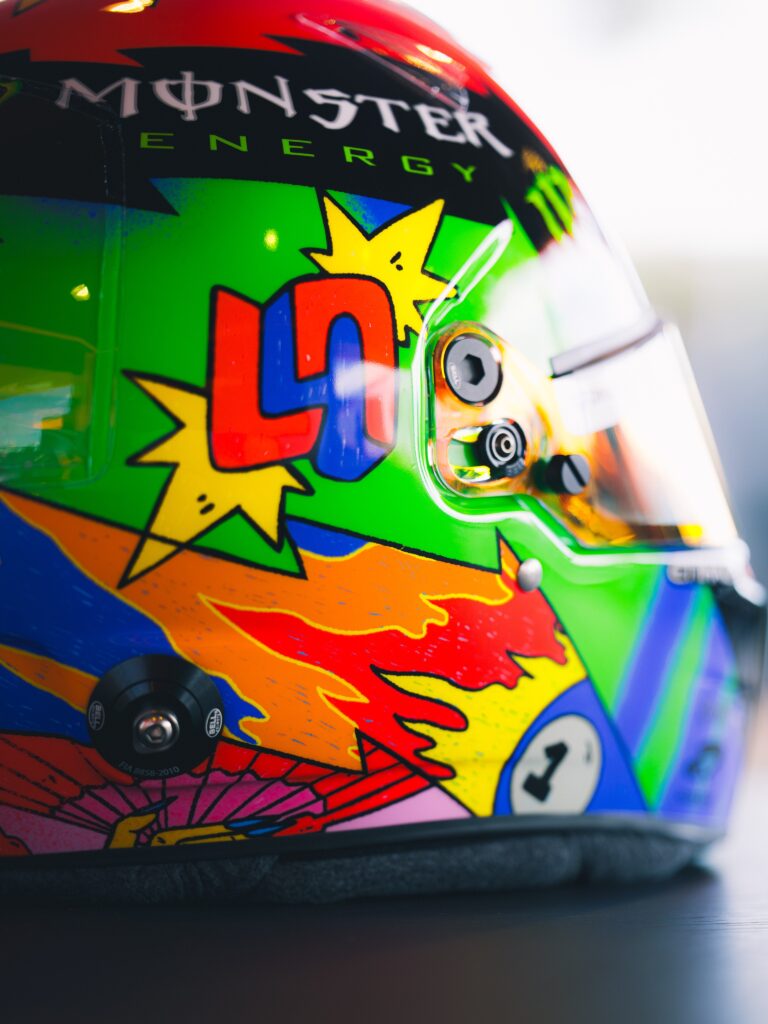
Treating helmets as exhibition pieces — not merely memorabilia — transforms the room. Direct lighting reveals the lacquer depth. Rotating display plinths show the rear graphic, often the most overlooked face of a modern F1 helmet. A neutral backdrop allows the livery-matched colourway to dominate. This is where collector display crosses into something closer to gallery curation.
So, Is More Overtaking Always Better?
The honest answer, after weighing the visual evidence and the collector’s perspective: no, not always. More overtaking is better when it serves a story — when it produces a fight for the win, a moment of redemption, a rivalry crystallised in a single corner. It is not better when it dilutes the meaning of position, when it reduces the race to a sequence of DRS-assisted slipstream passes that no one will replay in a decade.
The collector’s verdict
For those of us who build rooms around full-size 1:1 replica helmets, the best races are the ones that produce indelible images. Sometimes those images come from twenty overtakes; sometimes they come from one perfectly executed defensive lap. The helmet on the top step of the podium does not record how many passes happened on lap thirty-two. It records who won, what they wore, and how they looked in the moment of victory.
Looking ahead
As 2026 regulations approach and the sport prepares for another visual evolution, the debate will continue. New cars, new liveries, new helmet designs — and inevitably, new arguments about whether the racing is exciting enough. The collector’s task remains constant: identify the moments that matter, source the exhibition-quality replicas that capture them, and build a display that tells the story honestly.
“The greatest races in F1 history are not measured by overtakes — they are measured by the photographs they leave behind.”
— 123Helmets editorial perspective
FAQ
Q: Does a race with more overtaking produce better helmet display references?
Not necessarily. High-action races create dynamic onboard footage, but it is often the calmer, more dramatic finishes that produce the iconic podium imagery collectors use as reference for selecting full-size 1:1 replica helmets.
Q: What podium moments are most valued by display collectors?
Wide-angle podium frames, helmet close-ups during the national anthems, and the celebratory shots where a driver holds the lid aloft. These moments inform colourway choices and curatorial decisions for exhibition-quality replicas.
Q: Are special-edition helmets worth collecting compared to season-standard designs?
Both have merit. Standard season helmets anchor a collection chronologically, while special-edition lids — Monaco, Las Vegas, Monza homages — provide visual variety and often the strongest individual display pieces.
Q: How should I arrange a helmet collection inspired by a single F1 season?
Consider a balance of championship-defining moments and visually striking liveries. Group helmets by team for colour harmony, or by race for narrative chronology. Exhibition lighting and rotating plinths elevate the display significantly.
Q: Do 123Helmets replicas serve any protective function?
No. All pieces are display and collector replicas only. They are full-size 1:1 scale exhibition items intended for shelves, cabinets and curated rooms — never for any protective or wearable use.
Explore the full range of full-size 1:1 replica helmets and bring the most iconic podium moments of the season into your collection. Browse F1 Helmet Collection at /shop/.
Display and collector replicas only. Not certified for protective use. Full-size 1:1 scale.